
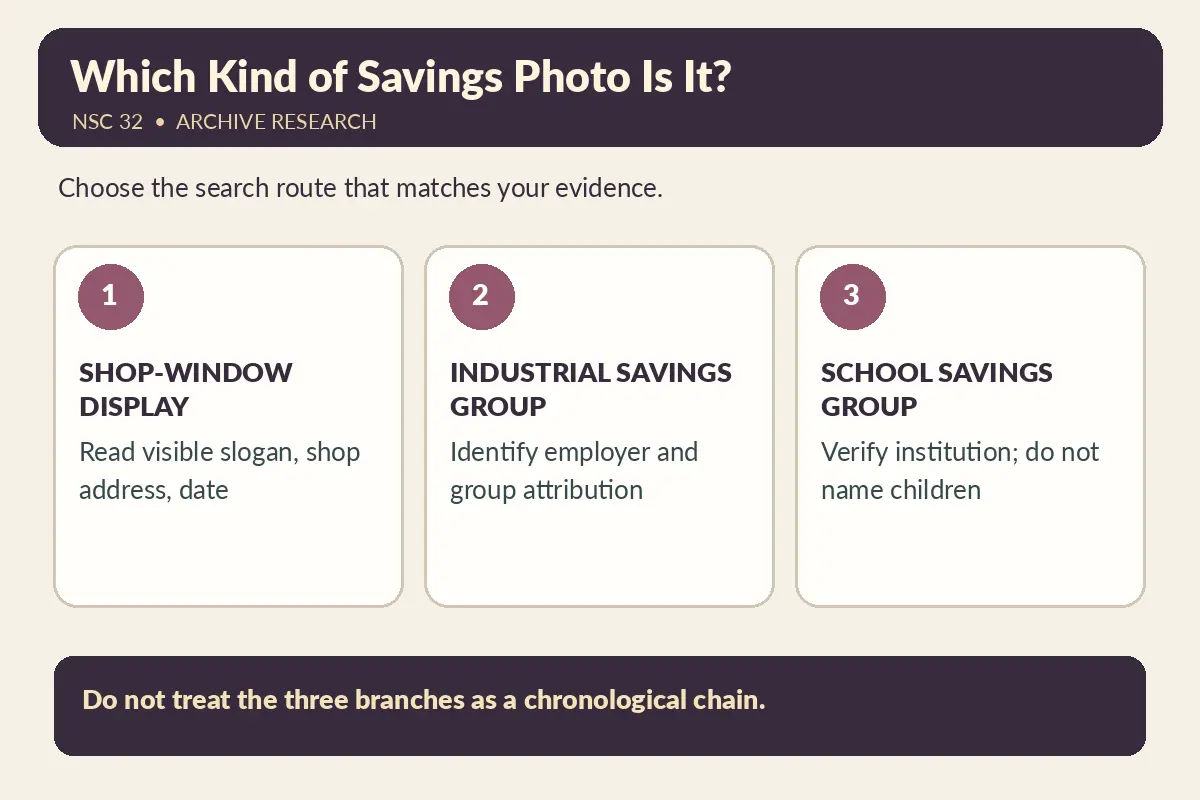
NSC 32 offers evidence about how the National Savings Committee presented savings campaigns to the public, but it is not a list of depositors. The National Archives photographic guide says that many images were made in connection with the wartime campaign, chiefly in 1940 and 1943, often for window displays; a few later pictures depict industrial and school savings groups. An appendix to that guide lists a different broad range for the series, so researchers must check the original piece-level dates instead of silently forcing both summaries into one timeline. The photograph documents visual publicity; actual savings behavior must be sought elsewhere.
Distinguish an Advertising Window from a Savings Transaction
Start with the object in the frame. Is it a printed window display, an organized group in front of a poster, a factory presentation or a school photograph? Record the slogan exactly where legible and describe only what can be seen. An image prepared for public use may be carefully staged; the presence of a prominent patriotic message establishes the message, not the financial response to it. Shopkeepers sometimes lent their windows to a campaign without keeping or making the savings deposits suggested by the poster.
The National Archives identifies NSC 32 as a discrete photographic collection, so begin with its series description and proceed to the relevant item. A general keyword such as “savings” may miss a picture described only by locality or display title. Try window, shop, factory, committee and school together with a district or campaign phrase. Keep the original item reference before trying to compare dates or images borrowed from another publication.
Handle the Conflicting Years as a Research Question
A subtle problem is visible in the official guide itself. Its account of the pictures emphasizes wartime photographs from 1940 and 1943, plus a small number from after the war. The appendix presents NSC 32 with a different nominal year range. Do not conceal this difference or treat a single series date span as the exposure date of every image. A printed guide can summarize different aspects of collection history, and it may also contain an editorial inconsistency that needs piece-level checking.
Make a date ledger with fields for original photograph caption, negative or print date, album or file date, catalogue covering dates, and later publication date. If two are inconsistent, retain both with their source labels. A wartime campaign year may date the event pictured, while the print itself may have been assembled into a later exhibit. Mark what is certain and what remains uncertain; do not resolve ambiguity by inventing an intermediate year.
Identify the Local Shop Without Assuming a Family Connection
A shopfront may show a trading name, street number, or neighboring businesses that can be matched to a period directory and map. If only the poster is visible, the location may be unknown. Even a clear storefront caption may be a national publicity caption rather than a local commercial inventory. Compare typefaces, windows and neighboring signs cautiously; multiple shops could use the same mass-produced display. Keep a distinction between the shop depicted, the proprietor named elsewhere and people merely passing in front of it.
A hypothetical family story says that an ancestor “organized the war savings drive” because a shop carrying their surname appears in an image. The sound next step is to establish who owned or operated that shop at the photographed date, then search local committee minutes or notices for a named organizer. The surname alone does not prove the organizer, and a directory may document a shopkeeper but not a campaign role.

Read Factory and School Groups with Privacy and Context
The guide notes that some later photographs concern industrial and school savings groups. A photograph of a group is not an attendance roll and does not establish that every person contributed money. A named industrial group might be a publicity team rather than the whole workforce. With schools, avoid inferring a child’s identity or contribution from a uniform, classroom location or position in a group. Seek caption names if actually given and a separate institutional record for claims about membership.
When compiling family history, distinguish a photograph’s intended audience from the people who genuinely participated. Publicity imagery may depict models, staff, guests or representatives. If local newspapers reproduce the same photograph, compare captions and publication dates for stronger attribution, but acknowledge that newspapers could repeat a central publicity description without independent verification. Never present modern face recognition or uncertain resemblance as a historical record match.
Trace an Advertised Campaign to an Independent Local Event
A sound sequence begins with the photographic motif, continues to a dated committee campaign notice or press advertisement, and moves to a local administrative record only if the place and event match. Posters could be reused across districts and years. An advertisement proves that an event was publicized; it does not show that the event took place as promised. A notice of a savings target is also different from the amount actually collected, which may exist only in aggregated returns.
Use a three-way comparison: visual claim, organizer’s administrative statement and independent local report. Check whether they refer to the same shop, organization and campaign period. If they do not, keep the images as background about public messaging and do not connect them to a particular resident. For a named person’s deposits, seek lawful person-level financial evidence when it survives; broad totals never identify an individual saver.

Cite the Image and Preserve What You Cannot Know
The official citation guide recommends a full archival reference and an internal page or image identifier. Record the NSC 32 piece, caption text, whether the original was inspected, any contemporary publication and the separate sources used to identify a place. Do not cite only a cropped image redistributed without provenance. If an archive search produces no matching photo, note the precise keywords and browse the series rather than concluding that the local campaign never existed.
Conclude at the right level. You might establish that a photograph illustrated a particular savings poster campaign or depicted a named shop window during a certain period. Without a named contemporary financial or committee record, neither its customers nor its depositors are known. Recording this limit protects both the historical evidence and the reputations of people who did not choose to appear in a public campaign.
More Records and Archives Guides
How We Research This Archive Collection
The description of NSC 32 in The National Archives photographic research guide is our starting point for collection scope, dates and photographic subjects; it does not imply that we have examined every original print. The method in the article uses the official Discovery search guidance, which explains that catalogue descriptions may be sparse and searchable names are not necessarily present in the descriptions. Search or browse the precise series, identify a complete piece reference and assess image-level annotations before stating what a particular picture depicts. Do not confuse an archival series summary with a transcript, caption or negative print that has not yet been viewed.
We distinguish first-hand observations from interpretation. A photograph may support a claim about visible structures, objects, people or terrain, depending on image quality and authentication; a date printed in an album might relate to assembly rather than exposure. The official citation guidance recommends full reference and internal page, folio or other identifier wherever available. For each candidate, retain the picture reference, verbatim caption, the field that supplies the date, how the image was accessed and one alternate interpretation to test. An example described as hypothetical here is not an original archival discovery.
This guidance intentionally avoids claims about named individuals, private employment, specific military actions, completed construction or legal ownership unless independently supported by a fitting record. Where access is limited or an original is undigitized, state that limit instead of inventing image contents. Respect privacy and cultural or historical sensitivities. Our affiliate disclosure describes site transparency; no commercial archive relationship is asserted by these citations.
No. Its value is primarily photographic evidence of campaigns and displays, not person-by-person deposits.
The official guide text and appendix present different ranges; check individual piece descriptions and photograph annotations before dating a specific image.
The official photographic guide specifically highlights pictures made in those wartime years for window displays.
Only with reliable attribution and appropriate care for privacy; a photograph is not a school register.
No. It shows publicity. Actual participation or totals require separate records.