
Start With the Archival Series and a Specific Question
Lake Denmark photographs in RG 71 LD record damage at a naval ammunition storage site in New Jersey in 1926. They are a valuable visual source for locating damaged buildings and studying the aftermath, but the archive does not describe them as a casualty roll. NARA lists 162 images in the LD group of the Bureau of Yards and Docks. An accurate research question begins with a photograph, a structure and a site identifier, not the assumption that every person present at the depot was photographed.
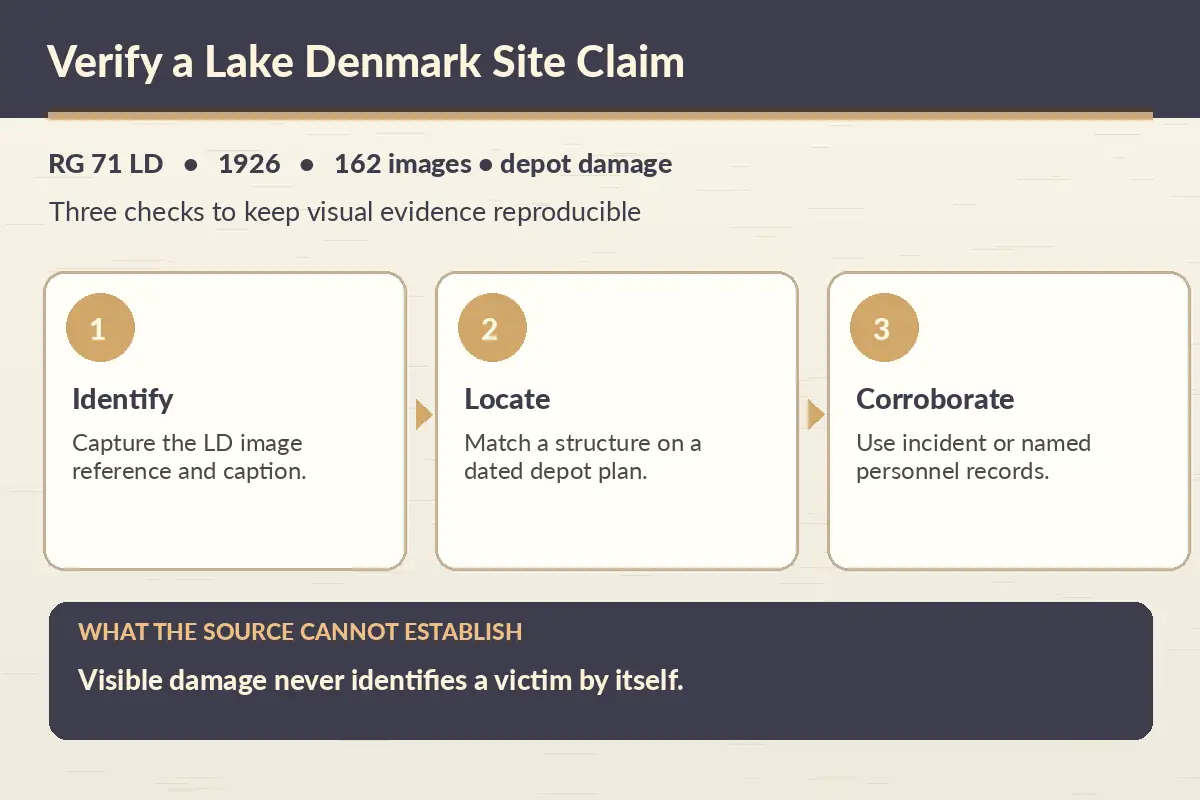
Treat the images as an administrative damage record. A collapsed wall, interrupted track or altered roofline can support observations about physical consequences; it does not establish who was working at that location, how every loss occurred or whether a particular individual was injured. The practical method is to identify the depicted structure, date the image through independent records and then consult separately documented personnel or incident evidence if a family story involves someone at the site.
Identify the LD Series Before Reviewing the Scene
The NARA RG 71 still-picture description places Lake Denmark damage images under LD and gives the year 1926 and a total of 162 photographs. Its brief entry calls the location NY, while the Navy’s official history identifies the depot near Dover in New Jersey. Retain that discrepancy in the research notes rather than inventing two separate Lake Denmark incidents. That matters because RG 71 also contains a vast range of naval construction photographs, naval station views, cranes, drydocks, wartime bases and Seabee training. A search result that mentions RG 71 is not necessarily one of the Lake Denmark views. Copy the full archival reference, local image number and original caption wherever available.
Do not mistake the agency record group for the photographer’s signature. The Bureau of Yards and Docks kept records about naval shore facilities, and the precise creator of a particular negative may require inspection of the original print or supporting file. Record whether the view is an exterior, interior, damaged installation, equipment detail or broader site panorama. Also keep an empty field for an unknown exposure date; the year range in a collection description cannot place every image on the same day.

Locate the Structure Without Inventing a Site Plan
Look for surviving wall alignments, loading doors, access roads, railroad spurs, roof types and identifiers that might distinguish one building from another. A photographer’s vantage may compress distance between structures, making two sheds look adjacent when a track or yard separated them. Use a dated depot plan or naval engineering drawing to test the proposed location. Never derive a precise parcel number from a generic warehouse facade without corroborating annotation.
A map prepared after damage may depict planned reconstruction rather than the immediate condition. In a research ledger, therefore, label the plan as pre-incident, post-incident survey or later proposal. When a building number is legible in a caption, check it against another record before treating it as stable across revisions. A photograph taken from the opposite side of the depot may reveal the same roofline; look for distinctive structural relationships rather than assuming every similar broken wall marks a new site.
Read Physical Damage Without Reconstructing the Cause
The imagery may document collapsed masonry, disturbed ground, damaged rail connections or partially intact buildings, depending on the particular frame. Describe those elements as observable features. Do not extrapolate from a photograph to a chemical mechanism, a sequence of detonations or the specific cause of damage. Such questions belong to reliable contemporary inquiry files and expert historical studies, not an interpretation of scorch patterns by a genealogy researcher.
Condition and chronology are equally important. A view of debris could show immediate aftermath, a subsequent inspection or cleanup activity. Without a dated caption, the same location may have been photographed on several days. A numbered engineering survey might provide ordering, but photo number need not equal the order in which the events occurred. Keep the assertion narrow: the photograph depicts a specified feature at an attributed site, whereas the exact moment and causal history remain to be independently established.
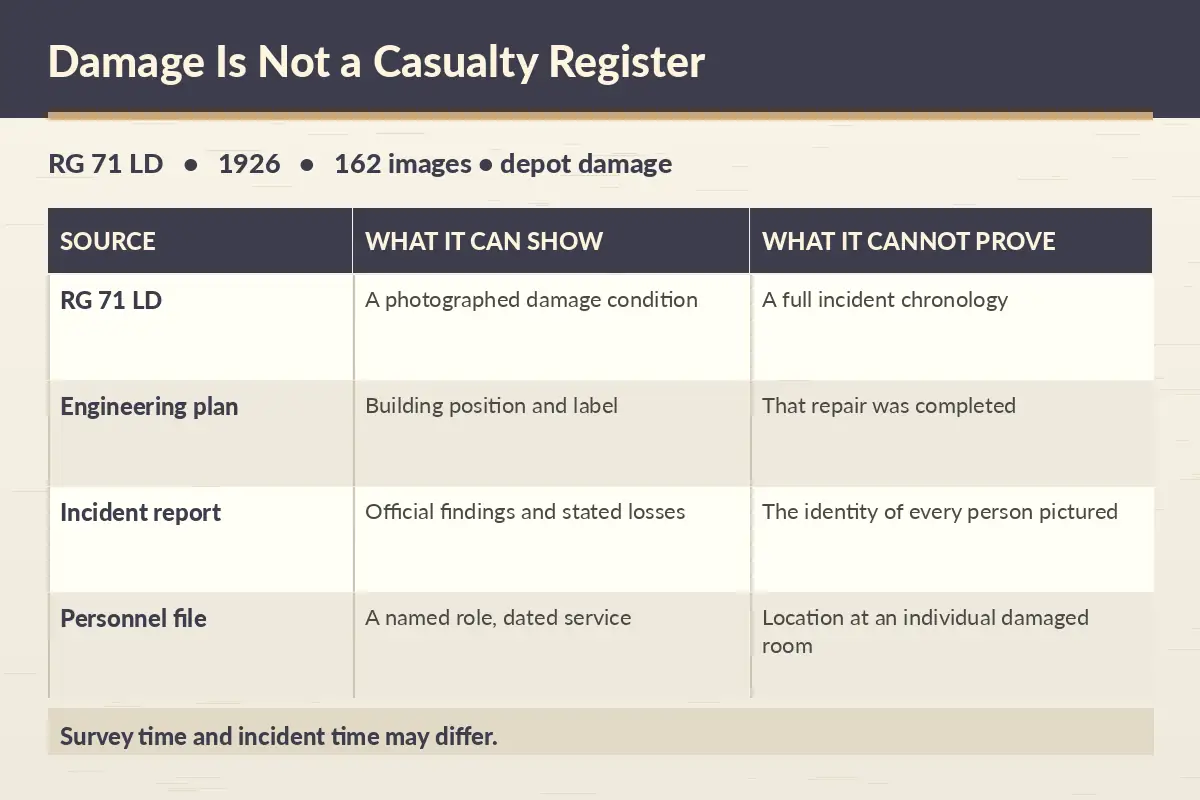
Separate a Depot Employee From a Pictured Building
A person’s employment at a naval depot must be investigated through named employment, service, contractor or payroll sources appropriate to their role. A uniformed figure, a group of visitors or a worker beside wreckage is not an identifying roster. Ask whether the research subject was a civilian employee, enlisted service member, officer, contractor or nearby resident. These categories can lead to different record custodians and different access restrictions.
Even a named roster may prove assignment rather than presence at a particular building when damage occurred. Cross-check dated duty or attendance records, correspondence and contemporary official notices before describing a person’s movements. Avoid inferring a death or injury from the location of a worksite, or the lack of an image showing the person. Where names are sensitive or uncertain, preserve spelling variants, distinguish similarly named individuals and mark every inferred link as unverified until a dated original identifies the same person.
Compare Damage Reports With Construction Records
A building seen damaged in LD might also appear in an earlier navy-yard engineering drawing, or in a later repair record. These document types form a comparison, not an automatic sequence proving a completed rebuild. For any proposed before-and-after pairing, verify the building identifier, angle, footprint and dates. A contract or appropriation may establish that repair was authorized without demonstrating its final form, while a later photograph might show a different installation built nearby.
RG 71 contains other images and textual material concerning naval shore construction. Use the original archival description to find the correct related series rather than assuming that construction photographs are appended to LD. Maintain distinct citations for the damage image, engineering plan and personnel source. If the damaged site was regraded, present-day aerial imagery may no longer align with the 1926 layout. A cautious comparison can show changes in the built environment without inventing continuous photographic coverage.
Write a Source-Based Incident Narrative
For each selected image, store the item number, catalog wording, material type, photographer if known, site identification, attributed date and independent map or report reference. Retain the distinction between the time the photograph was exposed and the date an archivist or official later created a description. When asking NARA for a reproduction, provide RG 71, LD, the local identifier and the location question. Do not state that every one of the 162 items is digitized or currently online.
A defensible narrative might say that a documented RG 71 LD image shows damage to a particular depot structure, that a named engineering record locates the structure and that an independent incident file documents a separate human consequence. If those elements cannot be linked, keep them as related but unjoined evidence. This approach makes an archival image informative for local history while avoiding invented employment, casualty details or an unsupported explanation of the incident itself.
More Records and Archives Guides
How We Research This Collection and Its Limits
The series description, dates, and record designation were checked against the official National Archives research guide on November 16, 2026. Independent context was compared with a second official research source, while NARA still-picture citation guidance establishes the information needed to locate an exact image. The site topic list and earlier production titles were compared for duplication. A series description does not identify every subject, date, or object in every frame, and access to a fully digitized item cannot be assumed. The figures in this guide are newly drawn explanatory editorial illustrations, not historical negatives or genuine reproductions. We make no unverified claims of commercial endorsements. See the affiliate disclosure for site policy.
The RG 71 listing describes 162 images under LD; it does not promise every frame is online.
No. Images show physical evidence. Consult reliable inquiry or official reports for causal findings.
No. Assignment and presence require dated personal or administrative records.
No. LD is one small series among many distinct RG 71 photographic groups.
Provide RG 71, LD, the image or frame identifier, the desired structure and any known original caption.