
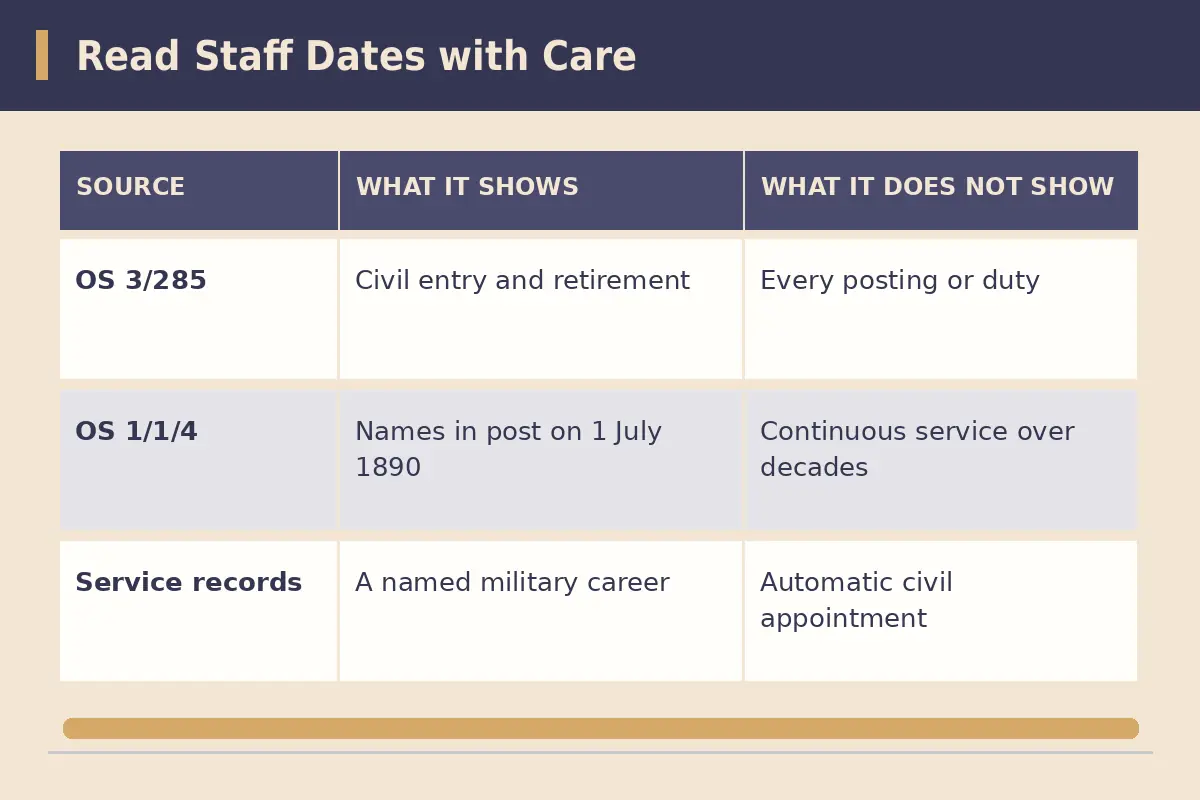
The National Archives identifies OS 3/285 as a register of Ordnance Survey civil assistants, including many former Royal Engineers, and says it records dates of entry into the Survey and retirement. This makes it a precise employment lead. It is not a full service dossier and cannot by itself establish every promotion, mapping assignment or place where an assistant lived. This guide gives a precise source route, identifies what the archive can and cannot show, and names the independent documents needed before a personal or geographic conclusion becomes defensible.
Establish Whether the Research Target Was a Civil Assistant
Start with a dated family source rather than with the assumption that everyone employed by the Ordnance Survey was a civilian. The institution employed both Royal Engineers personnel and civilians, especially before 1946. A census occupation such as “surveyor” may describe a private land surveyor, a railway survey employee or an Ordnance Survey assistant. Copy the exact description, the address and the household’s age information. Use the source’s date to decide whether OS 3/285 could plausibly help, rather than treating an occupational resemblance as an identity match.
The National Archives notes that many civil assistants in OS 3/285 had previously served with military survey companies. That means civil appointment and earlier military service may both appear in a single life, but they are not interchangeable. Search an individual’s full name, variants and likely time window in Discovery, and distinguish a catalogue reference to the register from an actual line read in the volume. If the name is common, reserve identification until you can compare another dated record such as a pension, army service document, directory or household return.

Record the Entry and Retirement Dates Literally
The two date types highlighted by the official guide are entry into the Survey and retirement. Build a timeline with the wording of each date, the documentary source and the action to which it refers. A date of entry does not tell you that the person began work in a particular county, or that they held the same position from the first day. A retirement date is not necessarily a date of death, and an employee may have had earlier work outside the Survey or later occupations after leaving.
A careful transcription separates exact dates from approximate dates, corrections and ambiguous handwriting. Write down the piece and folio or page when visible. If a surname is repeated, do not merge two entries based on age or initials alone. Track all plausible candidates, noting missing middle names and conflicting date ranges. Where one person appears to have entered during a known period of military service, investigate whether the record implies a civilian transition, a copied administrative date or merely that you have matched the wrong individual.
Hypothetical example: an 1881 household lists a “civil surveyor,” while an OS 3/285 entry for a similarly named man gives a later entry date. This could represent an earlier private job, a military-to-civilian change, an imprecise census occupation or two namesakes. Keep those alternatives separate until age, address and independent records make the identity stronger.
Use the 1890 Staff List as a Snapshot, Not a Ladder
The official Ordnance Survey guide points to OS 1/1/4 for a list of Royal Engineers officers and civil assistants in post on 1 July 1890. That is a valuable independent timestamp for a candidate who might have been employed that year. A presence on the list cannot establish service during the years before or after the snapshot. Equally, the absence of a person whose dates fall outside that single day is not a contradiction. Capture the specific list date in any diagram or written conclusion.
If the candidate belongs to the military side, the guide also describes other staff references, including OS 1/1/1 and selected military survey records. These serve a different role from OS 3/285. The civil register cannot supply an officer’s full regiment history, and a military seniority list cannot be used to fill civil retirement dates. Consider OS 10 only when there is a plausible senior-staff file; the guide explicitly calls the holdings selected, not a complete collection of all staff files.
Separate Service from Maps and Family Identity
A mapping sheet produced during a man’s lifetime does not prove he surveyed that particular district. Cartographic series organize work by geographical and technical purpose; several staff members and later editors could contribute to a map. If your family story says an assistant mapped a named place, seek a contemporary signature, assignment order, correspondence or similar direct source. A Survey-wide personnel entry alone supports service in the organization, not the attribution of a published map to that individual.
Personal identity still requires independent corroboration. Compare date of birth estimates, spouse names or addresses where available in civil registration, census or military records. A former Royal Engineers surveyor may have changed occupation wording between records. Record those changes without smoothing away inconsistencies. A payroll or directory entry at the right date can be more useful for confirming a workplace than an undated family anecdote. No piece should be expected to contain fields that the official description does not promise.
Evaluate Missing Names and Build a Reproducible Citation
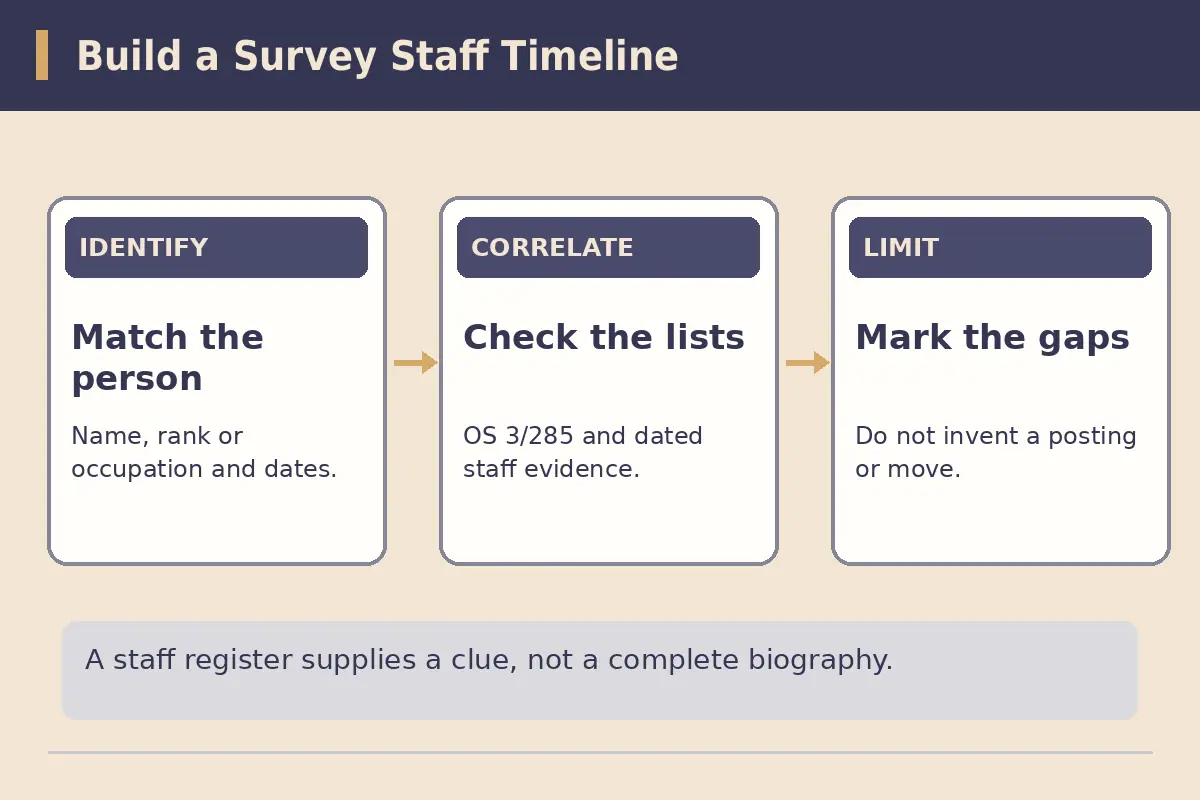
The National Archives explicitly says that comparatively few records survive for Ordnance Survey civilian staff. Therefore a missing OS 3/285 hit does not demonstrate that a person never worked for the Survey. The name may be recorded differently, the relevant status may have been military, or only selected files may survive. Log the name variants and which specific piece or index was checked; avoid translating a catalogue failure into a negative employment claim without assessing the collection’s arrangement and scope.
When you obtain the original entry, cite The National Archives, OS 3/285, page or folio and the wording used for the person. Add separate citations for OS 1/1/4 or any independently located household record. Distinguish a transcription, an official catalogue statement and a researcher inference in the final profile. The strongest useful outcome is often a narrow pair of employment boundary dates and a clearly identified next source, not a speculative paragraph covering every unrecorded decade of a life.
If your target was a Royal Engineers officer in 1890, do not force him into OS 3/285 simply because the reference is easy to name. Start with the military route and the actual 1 July 1890 snapshot. A civil assistant’s retirement date belongs in an employment timeline; any claim about marriage, migration, a particular survey map or death must rest on appropriate additional documentation.
More Records and Archives Guides
How We Research This Archive Series
This guide starts with the documented evidence in an authoritative source, not a claim that we have inspected a particular person’s private file or a specific original piece. The archival statements here concern the series or research method. A hypothetical example is labelled as such; it is not a newly discovered historical event. We use the Discovery search guidance to distinguish keyword matches from archive holdings and document contents, because catalogue descriptions do not transcribe every word of an original.
For every real candidate, record its historical place or person’s name, the creator, document type, date, full OS 3/285 piece or item reference, access restrictions, and the exact claim being tested. The official citation guide explains how to document those references so another researcher can retrace them. An unread document remains a catalogue lead, never proof of imagined details. If a record is missing, preserve the searched terms and dates and examine survival and alternate custodians before interpreting the gap.
Before sharing a conclusion, audit the difference between original source wording and your interpretation. Require independent evidence for any further claim about an individual, property owner, legal effect, or completed action. Respect archival access limits and living people’s privacy. This website also provides an affiliate disclosure; no paid partnership or commercial access is implied by these archival references.
The official Ordnance Survey guide identifies it as a register of civil assistants containing dates of entry into the Survey and retirement.
No. It is a particular register of civil assistants, while other military staff and selected personal papers have separate archival routes.
No. It is identified as a list of officers and assistants in post on 1 July 1890, a single date.
Not by itself. A specific assignment, signature or other supporting record would be needed to establish that individual contribution.
Check military versus civilian status, spelling variants, dates and survival limits before treating the missing entry as evidence against employment.