
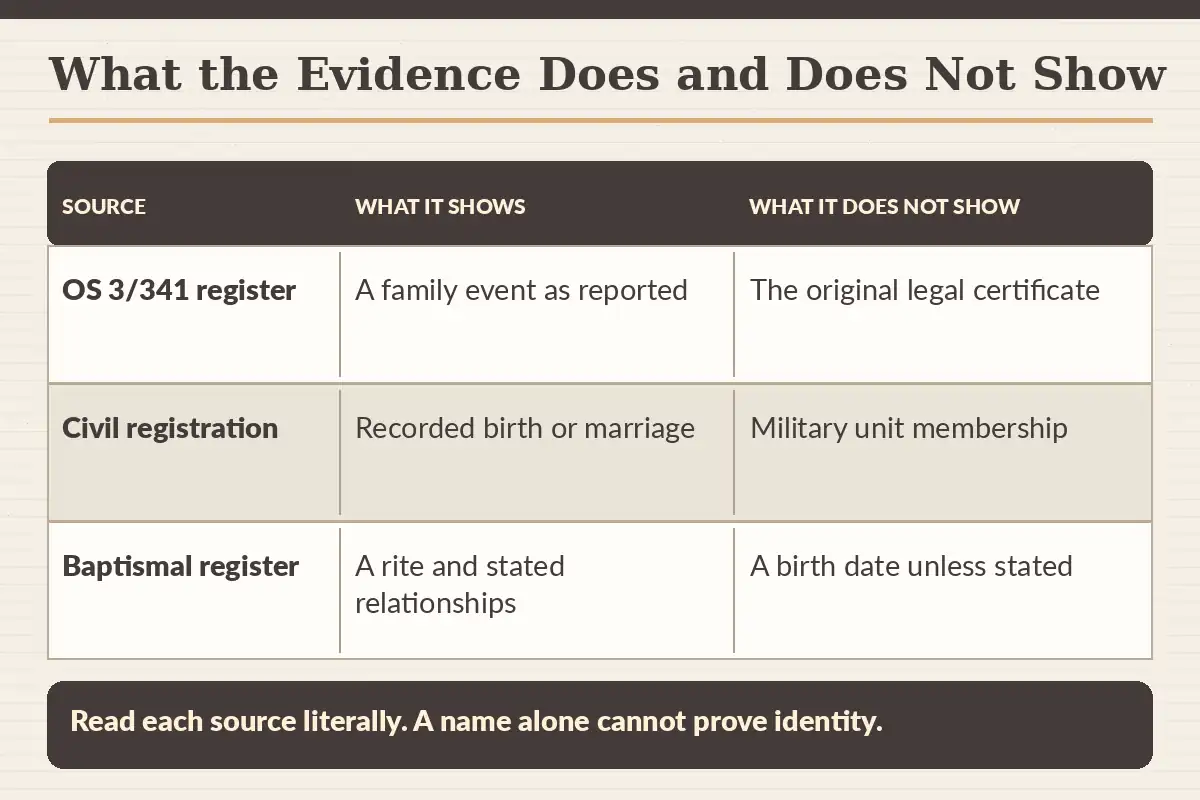
OS 3/341 is an unusually specific family-history source: The National Archives identifies it as a register of marriages, births and baptisms for men associated with 16 Survey Company, Royal Engineers, with dates spanning 1885–1939. Search it by name where possible, but keep the recorded event type intact. A birth report is not a baptism, and a marriage mentioned in a military register should be checked against its civil or religious original.
The National Archives stresses that Ordnance Survey staff records are limited and that the Survey employed both military and civilian people. OS 3/341 serves one identifiable military survey company, not everyone who ever drew a map or worked for the Survey. A correctly named soldier, partner or child may still require an independent identity match and chronological check.
Confirm the link to 16 Survey Company
Start with a unit clue, not simply an Ordnance Survey map from the family’s locality. The archive guide identifies OS 3/341 for the family events of men in 16 Survey Company, Royal Engineers. It is not a complete national list of engineers’ spouses or children. Record the unit as written, the soldier’s name and any known service number before using an entry for family reconstruction.
If a candidate worked in a civilian department, it may be wrong to search this military register first. The same archive guide points to OS 3/285 for certain civil assistants and OS 1/1/1 for Royal Engineer officers. These are role-driven alternatives, not evidence that every individual passed through all three. Build a dated service timeline first.

Distinguish a birth from a baptism or marriage
Create separate columns for date of birth, registration, baptism, wedding and the date the military entry was created. Not every entry supplies every field. A baptism may take place weeks or years after a birth, while a marriage entry might be recorded retrospectively. Copy the field label as it appears instead of moving a date into the column you wanted to fill.
If a family story states that a child was born while the father served with the Survey, OS 3/341 may help locate a report. It does not automatically establish the child’s civil registration district or where the family lived throughout the pregnancy. Confirm the locality and family names using an appropriately dated civil or church record.
Read the surname and relationship evidence literally
Compare the soldier’s forenames, rank or initials with related service evidence and the family’s civil records. Married surnames, repeated given names and later alterations can create false matches. A spouse named in a register may be recorded under a surname or abbreviation that differs from a modern family tree. Preserve the original spelling in the transcription.
Check the exact relationship wording. A record that notes “son” or “daughter” can be valuable, but it is not a license to invent a spouse’s maiden name or a full set of siblings. If the register records an event for a soldier’s child, link that child to one household only after date, parents and locality agree with another independently created source.
Use civil and parish records as a second test
For an English or Welsh civil birth or marriage, use the appropriate statutory index and original certificate where obtainable. For a baptism, identify the specific church, denomination and register. Do not promise that every event in a mobile military family occurred in England: movements and station locations may affect where a certificate can be found.
Keep source dependencies visible. A modern index derived from the same military register is not independent corroboration, even if hosted on another website. A civil certificate or a contemporary chapel entry usually answers a different question because it was created for another administrative purpose. Compare the event, participants and date explicitly rather than simply counting two search hits.
Handle different periods and later annotations
The National Archives describes OS 3/341 across 1885–1939. This is a collection scope, not proof that every entry spans that whole interval. An event can be entered after it occurred, and later annotations may report subsequent family changes. Separate these layers when interpreting a soldier’s postings or identifying a child in later censuses.
For earlier or later family events, search appropriate local or service records rather than stretching OS 3/341 beyond its documented range. A record of a father in a military unit at one date does not prove his children were born at that duty station. Address history, actual birth location and service chronology need individual documentation.

Cite and preserve unresolved identity questions
Record the OS 3/341 page or entry, exact family names, field labels, event dates and repository. If using a Discovery description rather than viewing the register, say so. Add the independent certificate or register reference beside the specific claim it supports. A family group sheet should make it possible for another researcher to retrace every asserted parent-child connection.
A useful conclusion might read: “OS 3/341 reports a baptism for a child named Mary associated with a named 16 Survey Company soldier; a civil birth record with the same parents has not yet been located.” This expresses what the register supplies without assigning an invented birth date, birthplace or maiden surname. Save negative searches and alternate candidate households for future testing.
Create a source-linked research ledger
Set up columns for full archive reference, historical creator, actual date of the item, date of the event it discusses, original wording, evidence category, named people and roles, independent comparison source, access limitations and unresolved questions. OS 3/341 concerns family events linked to 16 Survey Company; it is not a comprehensive registry for all Royal Engineers. Start each new research session by rereading the previous entry rather than depending on memory; this protects subtle differences between an original, a printed summary and a database index. A failed surname search is useful only when the search range and the underlying record coverage are recorded.
Make the narrowest claim supported by your strongest source: A family event as reported. Never quietly convert that into the original legal certificate. Before adding a relative to a tree, compare identifying details, not just a surname and date range. If your documents disagree, preserve the conflict and specify which additional original could settle it. Equally important, describe whether you saw the original image or only an archive guide, catalogue summary or third-party index. This method creates a conclusion that another reader can independently test.
More Records and Archives Guides
How We Research and Verify the Sources
We checked the archive’s published research description on 2026-11-03. The National Archives identifies OS 3/341 for marriages, births and baptisms connected with 16 Survey Company over 1885–1939 and explains staff source limits. The cited description establishes the collection and its limits, not the existence of any particular ancestor in it.
We checked the archive’s published research description on 2026-11-03. The British Army muster and pay guide demonstrates that wife and child data can appear in military material but must be distinguished from original family certificates. The cited description establishes the collection and its limits, not the existence of any particular ancestor in it.
We distinguish the record route from the family claim and do not represent stylized cover art as an original manuscript. No paid record vendor or partnership is presumed. See our affiliate disclosure.
The National Archives describes the register as connected with 16 Survey Company, Royal Engineers.
The TNA guide gives an overall range of 1885–1939; confirm dates for the actual entry.
No. Check the appropriate civil registration or other original for the family event.
No. They are distinct events and may have different dates and places.
No. It records a family event; find separate evidence of field posting or map production.