
Questionnaires about grain elevators in the 1930s can reveal what federal transportation researchers studied about an industry, but the archival description does not make them employee rolls, shipment ledgers or proof that a particular farmer delivered grain. The National Archives identifies completed questionnaires, correspondence and related survey records for grain elevators, 1933–1935, in Record Group 133, section 133.3.1, the Research Section of the Federal Coordinator of Transportation.
This is a different starting point from a railroad employee search. The RG 133 guide says the Federal Coordinator was established in 1933 to investigate transportation conditions and reduce duplicate services, among other tasks. A completed industry questionnaire is an administrative source, not a comprehensive company history. Keep the form, correspondent, place and date visible when assessing what it says about an elevator operation.
Enter Through the Research Section, Not a Payroll Index
Use RG 133.3.1 in the guide as the first archival locator. The Research Section records include surveys of water freight transportation, 1933, inter-road accounts, 1934, and grain elevators, 1933–1935. These are neighboring subjects within a larger research function, not three parts of a single required record for every elevator. If your question concerns a grain facility, ask specifically for the completed grain-elevator questionnaires and any related correspondence.

Record the facility name as given on a document; avoid silently modernizing corporate suffixes or assuming that a similarly named elevator in the same county was the same company. Searching by town can produce multiple facilities, operators or owners over time. If only a summary description is available, note that you have identified a series, not inspected a completed form. Ask the repository for box, folder or questionnaire-level finding aids before extracting specific values.
Read Survey Purpose Before Trusting a Number
A questionnaire may represent answers supplied by a respondent, a clerk’s compilation or a later agency calculation. Until an original form is examined, the guide does not establish which numerical fields were recorded or how they were defined. A reported capacity could be nominal rather than observed throughput; a statement of ownership could be an assertion rather than a deed. Read instructions and column headings on the actual page before making comparisons.
Copy each figure with the original unit and reference date if known. An elevator, rail siding and grain warehouse can be related facilities but are not interchangeable. When a questionnaire asks about transportation, it may concern the services or practices under review, not a complete accounting of every shipment. A blank line might mean “not applicable,” “unknown,” “not supplied,” or simply an incomplete form; do not translate every blank into zero.
Match the Elevator to a Real Community
Compare the questionnaire’s firm name, address and operating location, if supplied, with local directories, business filings and contemporary maps. An elevator may serve a rural hinterland without standing at the postal address of the managing office. Keep railway junction, town, county and state in separate fields. Cross-check a dated plat or town map before pinning a business to a modern street corner, especially after track relocation or demolition.

For house and family history, the valuable question may be whether a named business existed near an ancestor’s farm during 1933–1935. The federal survey can offer a lead if the particular file supports it. It does not establish that the ancestor sold crops there. To connect a farmer with the elevator, locate receipts, account books, agricultural correspondence or a reliable local business record that names both parties and gives a date.
Separate Federal Study From Business Action
Federal Coordinator reports, questionnaires and internal correspondence can contain diagnoses or proposals, but neither a recommendation nor a survey response proves that an elevator later changed ownership, closed, expanded or consolidated. Search the chronology of the particular concern. Company minutes, court files, property conveyances and local reporting may document the outcome; an administrative survey describes conditions or claims at the time of study.
The agency existed for a limited New Deal period, with the NARA guide dating its abolition to 1936. Do not attach the survey automatically to a later transportation authority. If a document cites a subsequent study, identify that new creator and record group rather than placing everything under the same federal heading. Retain the distinction between the respondent’s assertions, the Research Section’s interpretations and independently verified events.
Reconstruct Work and Family Links Only With Named Evidence
A surname associated with the elevator in a family story is a useful search clue, not evidence that the person worked there. For employment, search dated payrolls, tax files, directories, labor contracts, union records or a signed business document. For ownership, seek corporate records or county deeds. For individual grain transactions, look for a receipt or account entry. Each tells a different kind of story and may name different people.
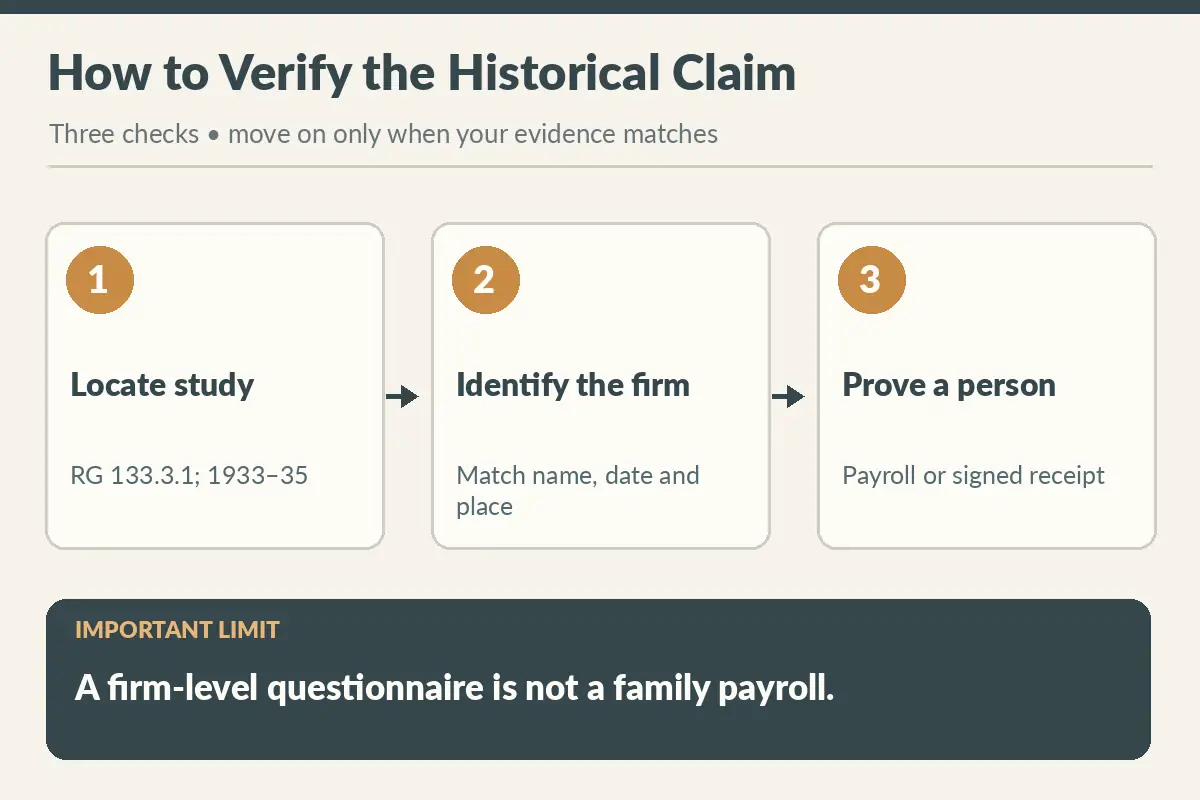
A safe hypothetical conclusion is: “A 1934 federal survey identified the facility named in a contemporaneous directory.” A stronger claim that a specific ancestor was its manager needs a named original source. To avoid wrong-person matches, compare occupation, full name, address, age and neighboring records. A business with changing legal names may retain the same structure, while a similarly named operator could occupy another site entirely.
How We Research Grain Elevator Questionnaires
We follow a document-first route: locate RG 133.3.1, request the correct grain-elevator survey records, identify the respondent and compare the dated information with independent local evidence. We label each entry as an original form, a correspondence statement, an agency synthesis or a later interpretation. We do not assume a questionnaire contains a worker’s name, precise storage capacity or shipping totals merely because those details would be useful to a modern researcher.
For current holdings, reconcile the historical RG 133 guide with the National Archives Catalog. The NARA reproduction guidance advises providing an exact document citation for copies. Include box, folder, date and any form number obtained from the actual record, and keep the accompanying correspondence if it clarifies terminology. Diagrams here are modern teaching aids, not reproductions of a 1930s questionnaire. See our affiliate disclosure.
More Records and Archives Guides
Questions Researchers Ask About These Records
RG 133.3.1, the Research Section records of the Federal Coordinator of Transportation.
The NARA guide gives 1933–1935 for the grain elevator survey materials.
No. It identifies questionnaires and correspondence, not a payroll series.
No. Check corporate or legal records for a completed change.
Ask for the specific grain elevator series and seek its box, folder or item locator before requesting copies.