
Understand the Unusual 1935 Collection Before Searching Names
National Archives Record Group 83 covers the Bureau of Agricultural Economics and predecessor offices. Within section 83.4.3, NARA explicitly identifies questionnaires and summary sheets on farm practices for Sherman County, Oregon, kept as a sample from a general rehabilitation survey in 1935. The description does not call this a complete named enumeration of every county household. That qualification is the central research fact: a preserved sample can illuminate practices or survey methods without establishing universal participation or coverage.
Start with a farm-history question rather than the assumption that the archive holds a ready-made ancestor roster. Are you investigating cultivation methods, farm tenancy, an economic rehabilitation policy, or a possible named operator? These require different evidence. An individual questionnaire might contain useful details once examined, but the publicly described collection does not guarantee what personal fields, if any, were captured on every form. Until an actual item is consulted, describe possible leads as possibilities, not transcribed biographical facts.
Place the survey in its documented setting. NARA groups the Sherman County material with the Division of Farm Management and Costs and predecessor records, alongside other farm business surveys, production-cost studies and regional planning reports with their own spans. The existence of these neighboring series does not mean they share the same individuals or questions. Preserve the specific 1935 sample description and do not merge it with unrelated national surveys simply because the subject matter is farming.

Distinguish Questionnaires, Summary Sheets and Published Statistics
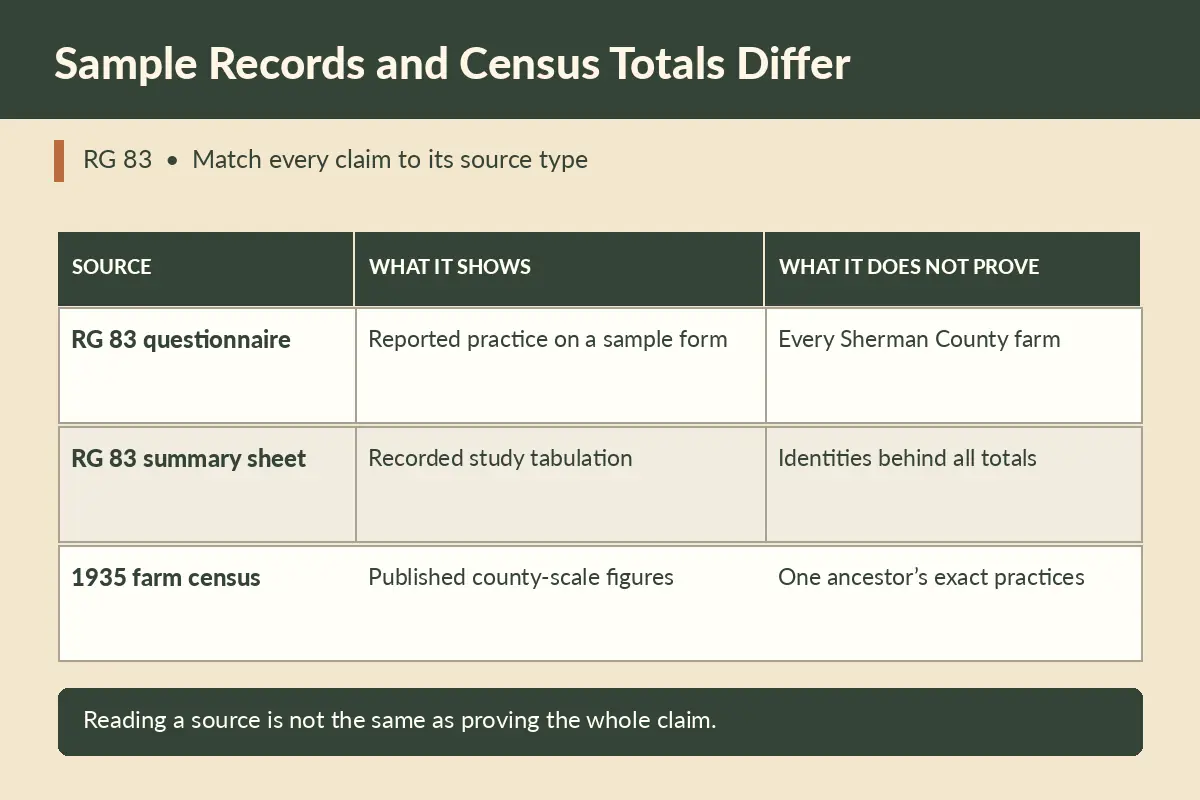
The source type should appear at the top of a researcher’s notes. A questionnaire may preserve a survey response, a summary sheet may aggregate or classify responses, and a published agricultural census may report totals for an entire locality. These are not interchangeable. Check the printed form title, creator, dates, record identifiers and any instructions before determining the level of observation. If a sheet uses a code rather than a name, do not guess which farmer it describes.
USDA’s National Agricultural Statistics Service provides a separate historical archive of Census of Agriculture publications, including 1935. Those published volumes supply important context about farm numbers, acreage, tenure or production, depending on the table. They are not the same physical collection as the Bureau of Agricultural Economics’ retained rehabilitation-study sample. A census aggregate can establish a county statistic as published; it cannot identify the individual respondents in the RG 83 sample or authenticate a particular farm practice.
Avoid a misleading comparison in which a number reported on a sampled questionnaire is multiplied to reconstruct countywide totals without knowing the sampling design. Ask whether selection rules, geographic scope, definitions or missing forms are documented. Differences between the survey sample and published county totals may reflect distinct programs, periods, definitions or coverage. If the archival file is only partly preserved, note that limit rather than using absence from the sample as evidence that a particular farm did not exist.
Create a Farm-Level Ledger Without Assuming Personal Identity
For every actual item inspected, copy the recorded county or locality, date, any farm or respondent identifier, the stated activity and the source’s own terminology. Record whether a number describes a field, one farm, a group of farms or a derived summary. A label such as owner, tenant or operator may describe different legal relationships in different datasets; do not silently substitute one for another. The original questionnaire instructions, if they survive, are part of the evidence and should be cited alongside the completed form.
When a recognizable name appears, test it against independent records for Sherman County in 1935 and surrounding years. Useful sources may include land assessments, contemporaneous county tax rolls, deeds, directories, farm organization lists and the 1930 or 1940 federal population census, subject to their own limitations. A matching surname and county are insufficient in an agricultural community with repeated family names. Look for consistent township, property description, spouse or household detail when the sources actually contain such information.
A county farm could be owned by someone who did not operate it, worked by a tenant, or divided across parcels. Keep land title, farming activity and household residence in separate columns. A published county census table describes the agricultural population in aggregate, not ownership of a particular field. An archival response might describe work on an operation at one date while saying nothing about whether the respondent retained the farm the next year. Date each claim instead of turning one observation into a lifetime history.
Reconstruct What the Rehabilitation Study Actually Asked
Do not invent a questionnaire’s exact questions from a generic description of federal agriculture surveys. First inspect a blank form if present, then transcribe the filled item. Identify the unit of measurement, reference period and official terminology. A question concerning acreage planted, for example, would not automatically establish harvest, income or crop failure. For financial entries, determine whether the value is a reported amount, an estimate, a cost category or a later calculated statistic before using it in a family narrative.
If the study summary uses categories absent from the published 1935 agricultural census, document the mismatch. Two reports may both discuss “farms” yet define the operator, tenancy or observation period differently. Include any sampling or coding instructions, and preserve blanks and illegible text. A blank answer may reflect a question not asked of that respondent, a missing page, a nonapplicable category or an unrecorded response. It cannot be read automatically as a zero or as proof of nonparticipation.
A meaningful finding may be methodological. The sample can show how agricultural officials investigated certain practices in Sherman County; related program reports can help establish the policy question; and published tables can frame the county context. Each level has value if its evidentiary status is named. For a family historian, the most responsible use may be to understand the local farming conditions while continuing to seek person-specific evidence elsewhere.
Cite the Sample and Explain the Search Boundary
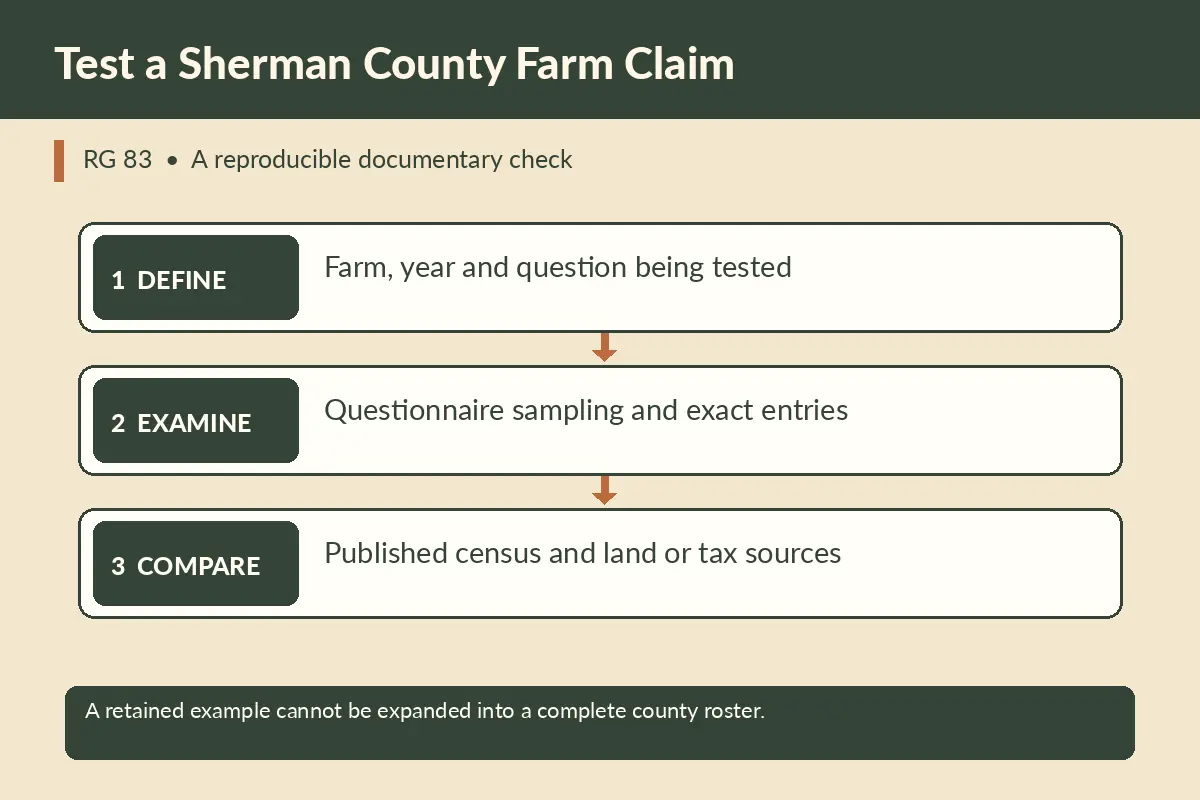
Write the citation with RG 83, the Division of Farm Management and Costs, the Sherman County 1935 questionnaire or summary-sheet series, and any folder, item or image label actually seen. Include the National Archives location and access method. A citation to the NARA guide proves that the described sample exists within the record group; it does not prove an individual resident completed a form. Cite USDA’s historical Census of Agriculture archive separately when presenting published county statistics.
A reproducible negative search reports which forms or files were available, what name or farm identifiers were checked, the date span and whether an index exists. Since the inventory explicitly calls the retained questionnaires a sample, failure to find a person does not carry the weight of absence from a complete register. Do not describe an unreviewed box as fully searched. Where digitization is uncertain, ask the archival custodian about actual holdings and whether additional instructions or survey design documentation survives.
The strongest narrative may state that the federal study retained a sample of Sherman County farm-practice evidence in 1935, that the relevant sample item reports a particular observation, and that independently published census tables describe the wider agricultural setting. Only a corroborated named source can connect that observation to a specific ancestor. Such restraint helps keep local economic history useful without manufacturing a complete genealogy from a partial survey.
More Records and Archives Guides
How We Research and Verify the Original Records
We reviewed the official National Archives RG 83 guide and checked section 83.4.3 for specific record classes, dates and custody. We compared the evidence limit with a second institutional source about the relevant historical context or research method. A published archival inventory supports the existence and stated scope of a class of records; it does not authenticate details of an individual item that we have not inspected.
Our recommended method separates three levels: the archive catalog or institutional guidance, the exact original document and an independent dated confirmation. Search failures are recorded with terms, jurisdiction, years and access method rather than represented as proof that an event did not happen. The site’s affiliate disclosure describes relationships; the official record links here are informational research sources, not statements of sponsorship.
No. The NARA inventory specifically says the retained questionnaires and summaries were a sample.
No. The NARA study sample and the USDA archive of published agricultural census data are distinct sources.
Possibly, but inspect the individual form before claiming a name or specific fields are present.
Only that no item was located in the scope searched; it does not show that the farm or farmer was absent.
Use independently dated property, tax, census or other records to establish the person and farm identity.