
For an early Travis County, Texas marriage, use the county’s direct and reverse name indexes to locate the recorded license book, then read the ceremony return. The Travis County Archives documents marriage records beginning in 1840, and the University of North Texas has digitized early county clerk index and marriage volumes. An index supplies a locator; a license may document permission; a completed ceremony return supplies additional event evidence. Dates can differ, so record them separately rather than creating one guessed ‘wedding date.’
Start in the Direct and Reverse Name Indexes
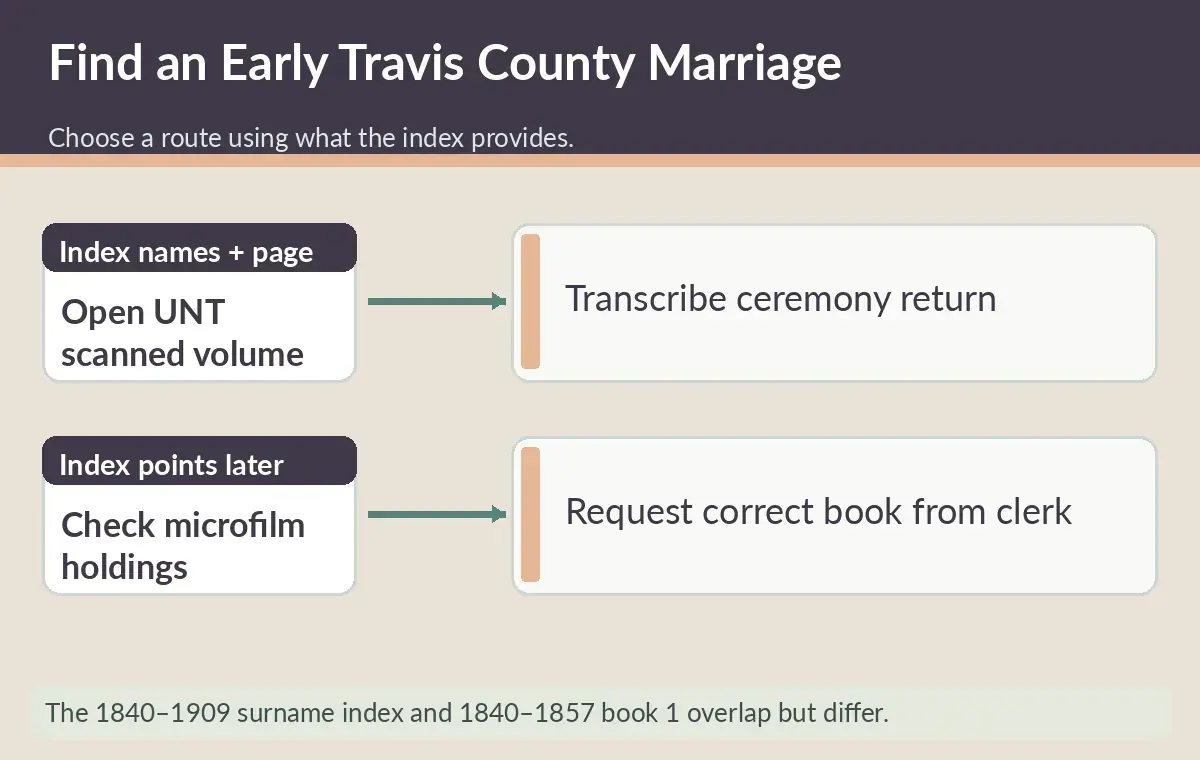
Historic marriage indexes for Travis County are organized under both parties’ names. The UNT digitized Marriage Record Index 1 covers entries dated 1840–1909 and identifies license number, the two parties, marriage date, volume and page. Search both the bride’s and groom’s known surnames, retaining maiden-name variants and abbreviations. A handwritten index may contain spelling errors or references copied from the wrong volume, so preserve the locator exactly before interpreting it.
Separate an index book’s broad date span from an individual marriage’s actual dates. Later and overlapping index volumes exist. The Texas State Library reel list describes overlapping index microfilms, which can rescue an entry absent from one transcription. Make a candidate record for each index hit, including the index title, image or page, partner names, volume/page pointer and what remains unverified.

Open the Recorded License Book, Not Just the Search Hit
The Travis County Marriage Record 1 digitized by UNT covers May 1840 through January 1857. Its descriptive catalog identifies county of issue, license number, the named parties, issue date, official signature, ceremony date, officiant, return and the recording certificate. These are multiple actions in one recorded document. A later clerk’s copy also has its own recording date, which is not necessarily the date the marriage occurred.
After finding a volume and page, move to the original scanned page and check the heading and neighboring entries. Do not assume a page number written in a surname index is a modern scan number; handwritten folios and image sequence counters can diverge. Note whether you viewed a bound county copy, an original loose license or a later database transcription. An index hit alone does not let you verify whether a ceremony return was completed.
Distinguish Permission, Ceremony, Return, and Recording
A license grants permission to marry under the law applicable at the time. A returned certificate or officiant’s endorsement may document that a ceremony was performed. A return-to-clerk date reflects administration of the form; the recording date reflects entry into an official book. Four dates therefore can legitimately appear. Write each literal date in an event table and identify the field that supplies it instead of silently selecting the earliest or latest as ‘the marriage date.’
Where a return is blank, do not automatically state that a wedding occurred. A missing completion may reflect an unreturned form, a damaged leaf or different record-keeping practice. Follow the documented parties to church registers, newspaper notices or other contemporary sources if needed. The names on a marriage record support the recorded couple, but they do not by themselves prove the parents, children or later residence of either person.

Choose the Correct Access Path for an Early or Later Year
Travis County Archives explains that marriage records predating 1999 were microfilmed and that some earliest clerk volumes have been digitized through UNT. Access may differ by book and year. For an early historical marriage, first try the digitized index and volume; if the locator points beyond what is scanned, consult the Texas State Library microfilm list or the county clerk. A record’s existence in a dated series does not guarantee every page is online.
The county also holds some loose paper licenses, and those may provide additional evidence beyond a recorded copy. Ask the custodian which form survives for the specific license number before paying for a reproduction. Modern marriage-application fields and access rules should not be projected back onto nineteenth-century books. Limit your public examples to historical persons and do not reproduce identifiers or private information from more recent applications.
Resolve Namesakes and Cross-County Confusion
A couple may be identified by a short forename, a surname variant or handwriting that is hard to distinguish. For a fictional ‘M. Smith’ marrying ‘J. Lee,’ compare the exact full names on the license, likely ages, residence and a later census rather than joining two familiar names to a family tree. Where one name is ambiguous, compare both indexed surname positions and the actual license number before deciding the two index references point to one event.
County geography matters. A marriage license recorded in Travis County does not automatically prove a residence, birth or death in Austin, and a ceremony could be reported with different county terminology in family narratives. Confirm the jurisdiction on the original instrument. Keep competing candidate marriages in separate rows until an independent dated record connects the people. Silence in one alphabetic index is not evidence that no marriage happened.
Record a Citation and a Narrow, Defensible Conclusion
Cite the creator as Travis County Clerk, the exact index or marriage-record book title, volume, manuscript page or entry, parties, relevant dates and UNT stable archival link or microfilm reel. If the original loose license was inspected, cite that separately. Include a brief transcription of the officiant’s wording where legible, distinguishing printed boilerplate from completed personal information. This gives another researcher an exact path to the same image without relying on a search result’s unstable rank.
An evidence-based statement might read: ‘The county’s recorded return names these two individuals and gives the ceremony date shown.’ It should not extend to parents, birthplace, future children or lifelong marital status without separate sources. Log failed searches and whether you consulted both surname orientations. For site transparency, see our affiliate disclosure; archival links do not create a partnership with UNT or Travis County.
More Records and Archives Guides
How We Research This Collection
We compared Travis County Archives custody guidance with UNT descriptions of the 1840–1909 name index and 1840–1857 recorded book, then used the state library microfilm list for later-volume gaps. The example couple is fictional and no actual marriage identity is asserted.
The Travis County Archives lists marriage licenses and indexes beginning in 1840.
The county index can be consulted through both parties’ names; use its book/page locator to find the recorded form.
No. Read the officiant’s ceremony and return information rather than equating permission with performance.
Selected digitized Travis County Clerk volumes are hosted by UNT’s Portal to Texas History.
Identify county clerk, specific book/volume, page, license number if present, and the image or microfilm reference.