
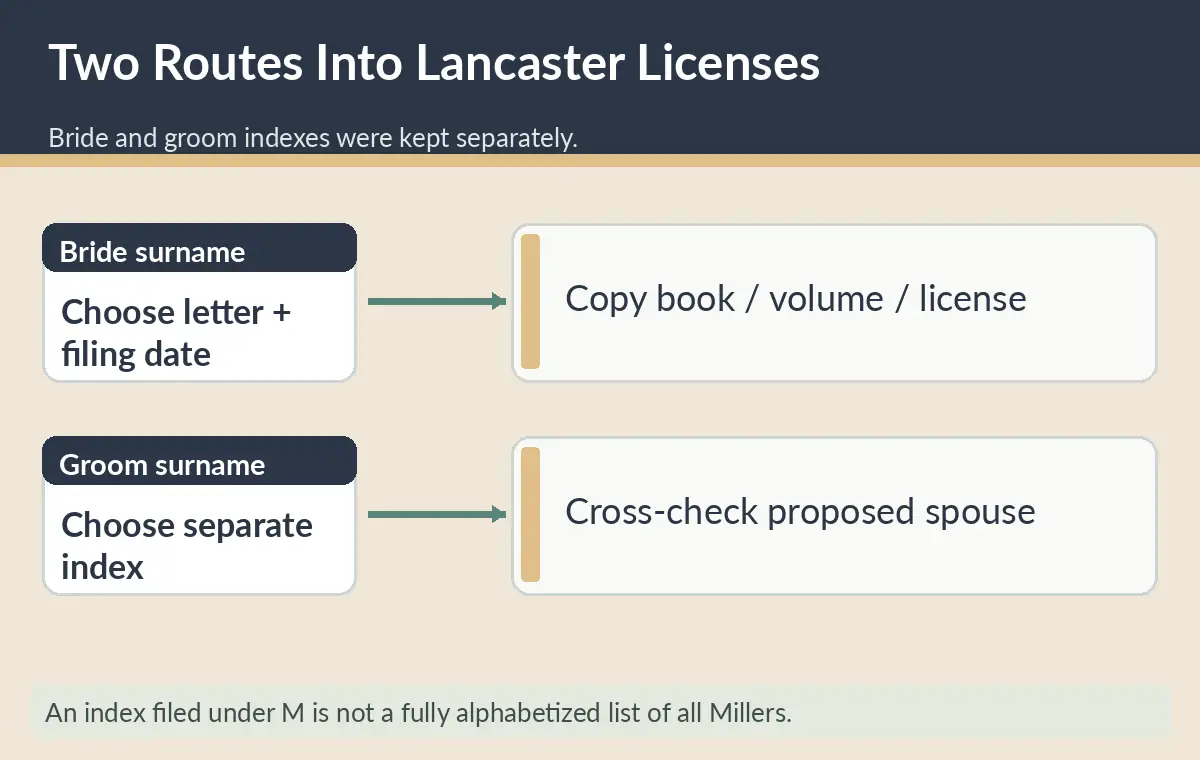
Lancaster County, Pennsylvania, provides historical bride and groom Marriage License Index books for 1885–1936. The indexes are arranged by the first letter of a person’s surname and chronologically by the date filed, not as one alphabetically sorted list of all couples. Search each spouse separately, capture the book, volume and license number, then request the underlying license application or marriage record. An indexed application does not, by itself, prove that the wedding ceremony took place.
Open the Bride and Groom Index Books Separately
Pennsylvania’s county marriage recordkeeping requirement began in 1885; the state archive specifies 30 September 1885 for the county-issued license system. Lancaster’s archive publishes separate historic index paths for brides and grooms. Use the first letter of each surname to select the right book and browse by filing date. A surname may appear in multiple nearby entries, so record the opposing spouse and the reference as displayed rather than assuming that the first matching name is the intended person.
If you know only one spouse, start with that person’s index and note all plausible candidate entries before jumping to a conclusion. For a woman with an uncertain surname, an independently documented later marriage or birth record may help identify a prior name variant; do not invent a maiden name to force a result. These volumes are contemporary or later courthouse indexing aids. Their arrangement is a practical way into an original application, not a replacement for it.
Use Filing Date as a Search Key, Not the Wedding Date
The county describes the historical indexes as sorted chronologically within surname-initial groups by the date filed. A file date can precede a marriage ceremony or refer to a license that was never used. When a family memory states a marriage in November, inspect records filed in nearby months rather than assuming the filing and ceremony share a date. This distinction is especially important where certificates, returns and later judicial records were separately kept.
Write down three dates when each is supported: application or filing, actual ceremony, and any later recording or certification. If the index supplies only one date, label it as the index’s own date field. Do not let a genealogy application’s generic ‘marriage date’ label silently change the meaning of the source. A subsequent newspaper announcement or parish register can provide independent evidence of the event, but it must be cited in its own right.
Preserve the Book, Volume and License Reference Exactly
Lancaster County asks researchers to provide the book, volume and license number when requesting references. These particulars are more reliable locators than a common name alone. Copy the symbols as printed and note whether the result came from the bride or groom volume, the letter group and any date. If you need to request a page scan, include both sides of the proposed couple, because the second index may expose a spelling error or point to a different license.
A book or license reference is a retrieval key, not evidence that the parties are parents of later children. Once the application or return arrives, transcribe residence, age, reported parents or officiant only to the extent that they are actually recorded. Do not populate blank fields using a marriage announcement or family tree. If two documents contradict, preserve exact text and explain whether one comes from an applicant or a later clerk.

Move From 1885–1936 to the Correct Later County Series
Lancaster also provides a separate historic index series for 1937–1972. Those later volumes are divided into filing periods and letter groups. A license thought to date from the 1940s should not be treated as an omission in an 1885–1936 book. Route it to the later series and record which year’s volume was searched. This is an archive-selection problem, not a family mystery. Earlier or later marriage-related sources may have different archival custody or legal basis.
The Pennsylvania State Archives explains that county Clerks of the Orphans’ Court or Registers of Wills maintain post-1885 county marriage licenses, while state microfilm holdings cover only some county collections. Do not assume a statewide name index contains every Lancaster application. Where a researcher needs an original copy, follow the county custodian’s request process and verify current access rules rather than relying on a static price or an unrelated state’s online portal.
Resolve Two Couples With Similar Names Using Document Roles
Suppose two Mary Millers appear in the same decade. Make a paired candidate worksheet for each entry: index side, filing date, proposed partner, book and license number, reported residence from the retrieved document, and an independent source. One couple may share a denomination, occupation or neighborhood with the ancestor, but those background similarities are corroborating context, not proof by themselves. Refuse to collapse two records simply because a website transcribed one spouse’s name the way you expected.
A clerk’s application, a certificate of performed marriage and a notice in the local press may all refer to the same event but make different claims. Rank them by relevance to your specific question and what the informant could know. If the original application lacks a return or is incomplete, explain that limit rather than assigning a ceremony date from the file number. The research record should reflect both what the county index finds and what remains unverified.

Cite the Two Index Layers and the Requested Marriage Record
For the name search, cite Lancaster County Archives, historical marriage license index, bride or groom volume, letter group, filing date and the listed book, volume or license number. Add the official URL and access date. Then create a separate citation for any actual application, marriage return or certificate obtained. If a third site republishes the index, explain whether you saw the county page or only the intermediary transcription; the latter does not become the original by being searchable.
The affiliate disclosure describes GenHis transparency; this guide is not sponsored by a record vendor. At the end, classify your evidence as an index lead, a retrieved license/application, or a documented ceremony supported by a relevant return. A targeted county request and a citation trail are more useful than a family-tree link that never reveals its source.
More Records and Archives Guides
How We Research This Collection
We compared Lancaster County’s official 1885–1936 indexing instructions with the Pennsylvania State Archives account of county custody and the separate Lancaster 1937–1972 series. We did not treat the date filed as a ceremony date or fill absent application fields by assumption. All same-name examples are hypothetical demonstrations of why both spouse indexes matter.
The official historic indexes are organized by surname initial and then by filing date.
Each spouse has a separate index route, and the second can help verify spelling and a proposed pairing.
Copy the book, volume and license number shown in the index, with the filing date and index side.
No. The license application is not necessarily evidence the marriage was solemnized; seek the return or an independent ceremony record.
Use the county’s separate 1937–1972 index series rather than the 1885–1936 books.