
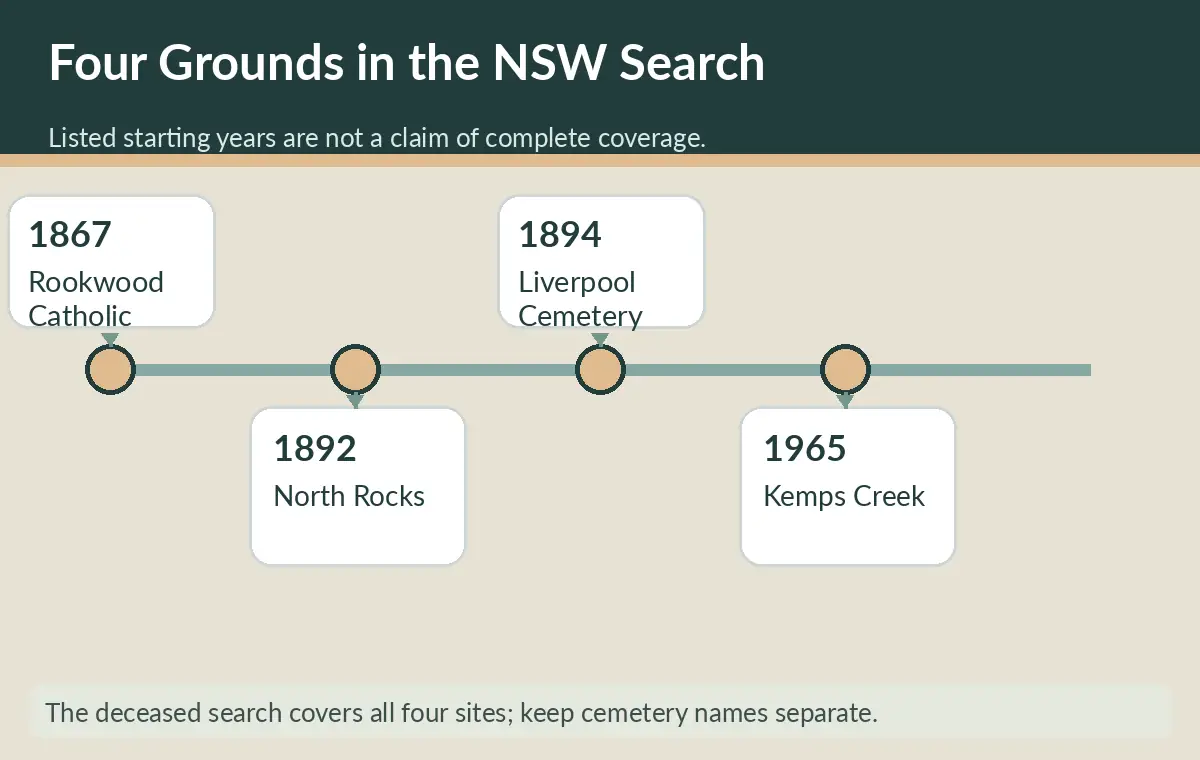
Liverpool Cemetery and Crematorium’s official Deceased Search is not restricted to a single location. The operator lists Catholic Cemetery Necropolis Rookwood, Catholic Cemetery North Rocks, Liverpool Cemetery and Crematorium, and Catholic Cemetery Kemps Creek. Each listed ground has a different historical starting point. Search by the known person’s name, save the actual cemetery shown, and independently verify the death and family relationship. A search hit is an interment clue, not a family-tree record.
Separate the Four Cemeteries Before Selecting a Person
The search page lists Catholic Cemetery Necropolis Rookwood from 1867, Catholic Cemetery North Rocks from 1892, Liverpool Cemetery and Crematorium from 1894, and Catholic Cemetery Kemps Creek from 1965. These are operator descriptions of their collections, not proof that every individual year has a fully indexed original volume. The oldest plausible date for a result and the ground shown should be transcribed as two separate data fields. A Liverpool surname match returned for Rookwood is not evidence of a burial at Liverpool itself.
A place name may change in family memory as suburbs or administrative boundaries change. If a family says an ancestor was buried ‘at Liverpool,’ distinguish the town or district from the cemetery’s actual administrative name. Confirm the result with a contemporary funeral notice, death registration or cemetery receipt. Never substitute a modern geographic label for the original event’s place or automatically assume a funeral in Liverpool meant interment at Liverpool Cemetery.
Treat the Deceased Search as a Narrow Administrative Index
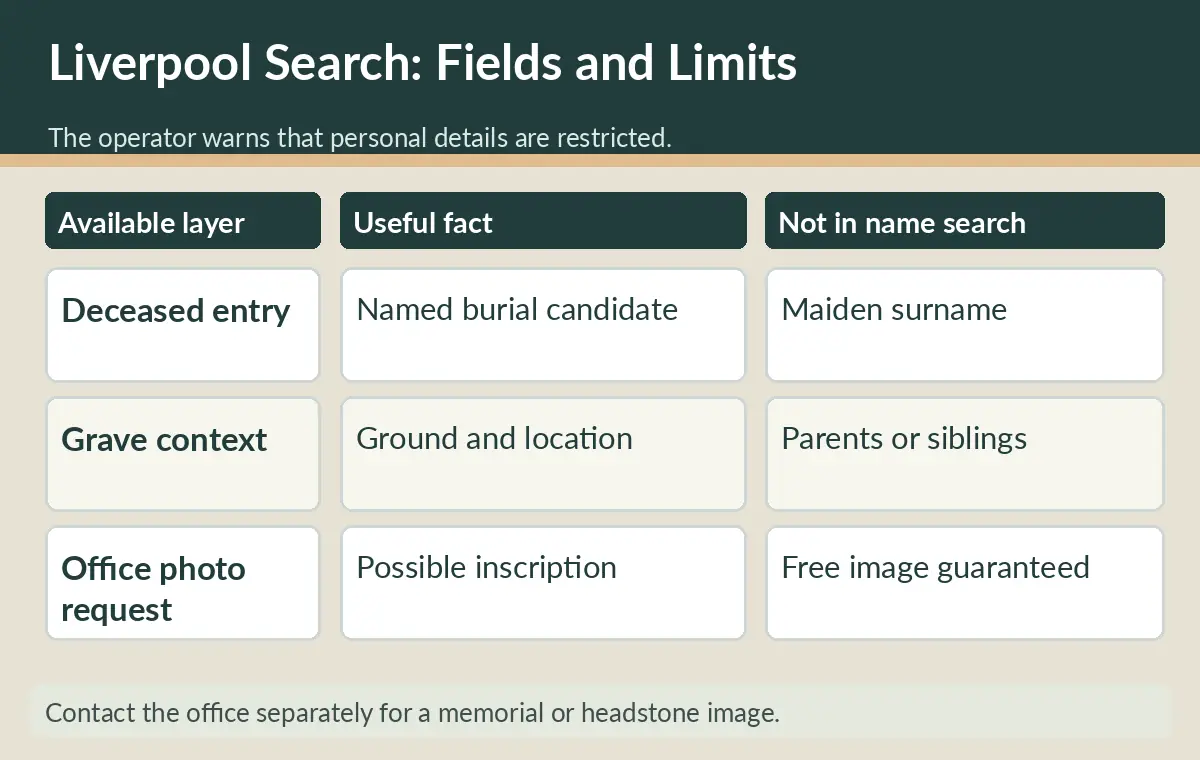
The operator warns that its displayed records reflect the information recorded at the time of death and that early entries are less detailed. Specifically, its search does not furnish maiden names, parents, siblings, immigration facts or newspaper announcements. Do not build a family connection from a displayed given name and cemetery alone. Extract only stated details, and keep a second field for those biographical claims that will require an independent record.
For a woman who may have used a married name, search both historically documented surname forms and identify why each form is plausible. For two people of the same name, compare event chronology, age if displayed, burial ground and civil record rather than relying on a nickname supplied decades later. If a search yields no result, note possible transcription omission, alternate cemetery administration and incomplete early records before concluding the burial is not among the operator’s holdings.
Request Inscriptions and Headstone Photographs Separately
Liverpool Cemetery says headstone and plaque inscriptions are not held in its ordinary name-search database. A researcher who needs the physical inscription, its lettering or a photograph must contact the office about a separate manual request. Fees may apply; the service advises allowing working time for a response. Do not promise that a photograph exists or will be free. A plaque may commemorate a person, whereas a burial record concerns an actual interment or disposition.
When writing to the cemetery, supply the name exactly as returned, the cemetery name, any section or grave reference, date range and what you require: inscription transcription, location confirmation, or a view of the register. The same inquiry should not demand protected details about living family members or present-day plot-right holders. The operator states it does not disclose owners or next of kin through these records. Do not work around that boundary using speculation.
Cross-Check the Deceased With NSW Historical BDM
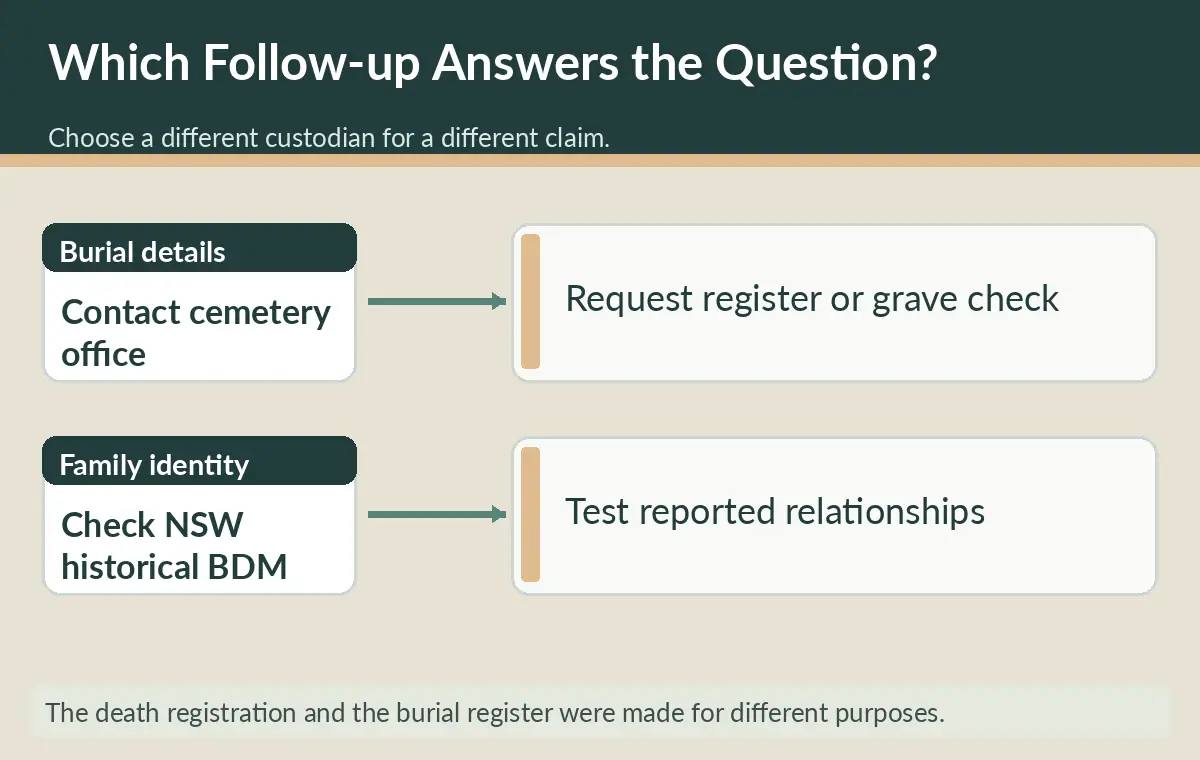
The NSW family-history search is a separate path to registrations of historical births, deaths and marriages. It may support a death date or parental claim, but its indexes and ordering conditions differ from cemetery operations. Use the death certificate or another record that contains a relevant reported relationship when identity matters. The place of death and the place of burial can differ; cite both instead of silently treating one as the other.
If an indexed cemetery entry and a death registration disagree by one day, examine whether the two sources refer to death and burial respectively. If the given name differs, look for a documented nickname, full legal name or informant variation. Do not assume a certificate would prove every relationship correctly: informants can make mistakes, and a relationship may not be directly stated in every historical record. A source supports the exact claim its wording and informant can sustain.
Handle Multiple Shared-Grave Occupants Without a False Family Tree
For a shared grave or memorial, create one row per named person: exact inscription, cemetery register link or reference, burial or commemoration date, and whether the individual’s physical interment is confirmed. Adjacent plots and a common surname do not prove a household. Someone may have arranged a burial for a friend, and a memorial may name relatives interred at other sites. These are examples of why a location needs independent personal records before constructing kinship.
When your candidate shares a common name with several local people, an exact grave number can be more discriminating than a rough age. Pair that locator with a dated independent source such as an obituary that specifically identifies a spouse or address. Document any mismatches in a comparison table rather than dropping an inconvenient candidate. The goal is an identity decision that another researcher can reproduce, not an expanded tree at any cost.
Record a Citation That Names the Cemetery and Search Layer
Cite the Liverpool Cemetery official deceased-search service, the exact deceased name, the specific cemetery, any date or plot identifier and the access date. Keep a separate citation for office correspondence or a photographed inscription. For a death registration, use its state issuing office, index or registration reference, and image or copy actually inspected. A screenshot of a search result cannot be presented as a scan of the original interment register.
Use the GenHis affiliate disclosure when evaluating recommendations; no commercial relationship with the cemetery is claimed here. Finish by labeling your conclusion as ‘indexed possible burial,’ ‘interment independently verified,’ or ‘identity unresolved.’ Recording the unsuccessful variants and time span protects against repeating the same work and keeps the meaning of a search failure appropriately narrow.
More Records and Archives Guides
How We Research This Collection
We read the cemetery operator’s own explanation of its four-grounds search, earliest listed years and missing data fields, then compared those with the separate NSW historical BDM route. We treated fees, data access and privacy statements as operator-specific, not transferable to another cemetery. The claim-check scenarios are illustrative, not named family case studies.
No. Its official search includes Rookwood, North Rocks, Liverpool and Kemps Creek Catholic burial grounds.
The operator states that maiden names and family information are not part of its deceased-search data.
No. The operator offers separate, potentially fee-based requests for inscriptions or photographs.
No. Shared interment or a shared marker alone does not establish a biological or legal relationship.
Compare an independent NSW death registration or a documented funeral notice with the exact cemetery and interment details.