
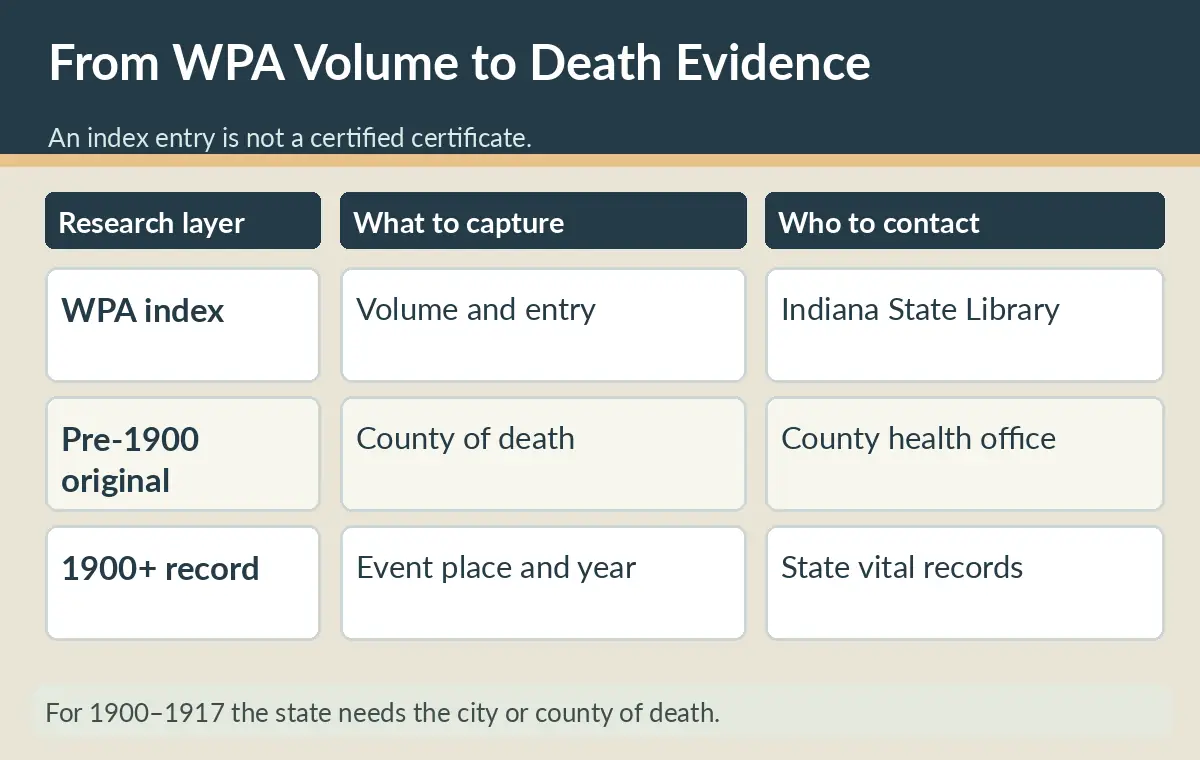
The Indiana State Library identifies a Marion County WPA index to death records from 1882–1920 under reference call number ISLG 977.201 M341un, volumes 5–8. This is a finding aid, not a complete statewide certificate image collection. Begin with the library’s Marion County guide, copy any volume or page reference, and determine whether the original was retained by a county health department or recorded in the state system. Marion County includes Indianapolis; it is not the same place as the city of Marion in Grant County.
Distinguish Marion County From the City of Marion
A database snippet labeled ‘Marion Indiana death records’ is easy to misroute: Marion County is the county containing Indianapolis, while Marion is also the name of a city in Grant County. Establish the geographic jurisdiction from a dated death certificate, newspaper, home address or contemporary map. If the known death occurred in the city of Marion, a Marion County WPA volume is not the correct starting archive just because the names match. The place of residence and the place of death may also be different.
Write the intended jurisdiction in the research log before searching: county, town or city, and state. Compare the original date with changes in municipal boundaries if the address is old. A family member who lived in Indianapolis could die in another county’s hospital or institution. That event may be registered where death occurred, while a funeral or obituary may appear where the family lived. Name alone cannot select the correct custodian.

Find WPA Death Index Volumes 5–8 for 1882–1920
The Indiana State Library’s county guide lists the WPA index to Marion County death records for 1882–1920 as volumes 5–8 under ISLG 977.201 M341un. Note both the call number and volume span when consulting the library; it is not safe to guess which volume covers a surname without seeing the physical arrangement. Record the exact spelling, date, location or source reference actually printed. WPA indexes summarize records created through an earlier administrative system and may contain transcription or categorization errors.
If a name is missing, try historically documented alternate surnames and consider whether the death date falls at the edge of an index’s range. A book published later than the event is a derivative source, not an eye-witness registration. An index title gives collection coverage at a high level, not proof that every death was registered or every original was indexed. Save what you checked and contact the library about the source and original before treating a no-hit as negative evidence.
Route Deaths Before and After State Recording Began
Indiana’s health department explains that its state office began recording deaths in 1900. For deaths before 1900, historical original records were kept at the local county level when they were recorded. A Marion County death indexed in the 1880s therefore does not imply that a modern statewide certificate is waiting with the same format. For 1900–1917 searches, the department says the city or county where the death occurred is necessary to locate the correct record.
Do not simplify the date rule to ‘Indiana vital records start in 1882’ without identifying county versus state custody. The statewide record system and the WPA index do not share one identical start or completeness. Ask the current Marion County health office which historical records it holds or who has archival custody, and follow state certificate rules for later years. Avoid promising instant online viewing or a certified copy from the public library; a finding aid and an official vital-record issuance process serve different tasks.
Correlate the Death Index With a Local Newspaper Issue
The Indianapolis Public Library holds local newspaper microfilms and explains how researchers can request a focused obituary search when they have a precise date. A WPA index date can guide that issue search, but a reported obituary may use different spelling, a publication day after the death, or a funeral place outside Marion County. Keep death, publication and burial in three separate fields. A notice is testimony published by a newspaper, not a substitute for the original registration.
For two individuals named George Johnson in Indianapolis, compare an indexed date with an independently documented address, reported spouse, church affiliation or funeral director if sources provide those fields. If the newspaper supplies a family relationship, identify the person reporting it and whether another record supports it. An obituary’s survivor list is a useful clue but not automatic proof of parentage. Do not borrow a person from a household simply because both records contain one common name.
Identify What the Index and Original Can Actually Establish
Create an evidence grid with columns for the WPA transcription, any underlying death registration and a third independent source. The index may point to an event; an original record may report a death date and other facts supplied to the recorder; a later obituary may connect the deceased to a community. Do not assume that a particular book contains a cause of death, exact birth date or parent names until you inspect it. Different periods and jurisdictions recorded different fields.
When the date conflicts, record which is actually the event date and which might be registration or publication. The person who registered a death may not have known childhood facts accurately. Citation quality requires preserving the wording of fields instead of converting a reported birthplace into a verified migration narrative. If the index describes an individual who might be your ancestor, test the proposed relationship using civil, church or household documents generated independently of that index.

Cite a Marion County Item Without Claiming a Certificate You Did Not See
For an index finding, cite Indiana State Library, Marion County WPA Index to Death Records 1882–1920, ISLG 977.201 M341un, the relevant volume and printed page or entry if available, together with the date and method accessed. For a copy of a death registration, identify the custodian, register or certificate number, copy type and pertinent reported fields. For a newspaper notice, cite the specific issue and page. A library holding description alone is not a person-level citation.
See the GenHis affiliate disclosure for site transparency; this article makes no commercial endorsement. Finish by identifying whether you have a catalog description, an actual WPA index entry, an image of an original registration or a candidate supported by multiple sources. Note the exact next record needed and the competing identity, if any. Clear source boundaries keep a sparse old index useful without exaggerating what it proves.
More Records and Archives Guides
How We Research This Collection
We checked the Indiana State Library’s county call-number listing against the state health department’s record-start rules and the Indianapolis library’s microfilm search guidance. We kept Marion County and the city of Marion in Grant County distinct, and did not assert that a WPA entry is an original certificate. All example identities are invented only to demonstrate a careful two-candidate comparison.
No. Marion County includes Indianapolis; the city of Marion is in Grant County.
The Indiana State Library lists ISLG 977.201 M341un, volumes 5–8, for death indexes dated 1882–1920.
The state health department reports state death recording began in 1900; earlier recorded deaths were held locally.
Indiana’s health department states the county or city where death occurred is necessary for death searches from 1900–1917.
Not by itself. Read the underlying death record and independent evidence for each proposed relationship and location.