
Choose Baltimore City Rather Than the County Record Path
For a Baltimore City death between 1875 and 1972, start with the year and the Maryland State Archives’ city-specific index, then request or view the separately held death record. The official death-record guide distinguishes Baltimore City from the rest of Maryland and divides records into different access ranges. An online index entry is not the certificate itself, and a similar surname found in a county index may describe a different person or place.
Before choosing a series, ask where the death reportedly occurred. Burial in a Baltimore-area cemetery, a county residence, or an obituary printed in the city does not necessarily fix the jurisdiction of death. Use the contemporary locality in the original evidence. Record the event date rather than the funeral date, since this selects the index period and the certificate range. Keep the city–county distinction even if present-day addresses blur that boundary.
Understand the Vowel Index and Soundex Change
The Archives describes a city index arranged by the first letter of a surname and its first vowel for the earlier period. For a surname such as Martin, the illustrative filing cue would be initial M with first vowel A. This is a way of reaching the right index section, not a personal identification code and not an actual discovered Martin certificate. Find the complete entry and copy its name, death date and certificate number.
Beginning with the 1950 index, the archive directs users to the phonetic Soundex system. Standard Soundex uses an initial letter followed by three digits representing consonant sounds; Martin is M635 as an illustrative encoding. It does not mean records from 1875 should be searched with M635. A failed modern surname query may be a filing-method failure, not a missing death. Study the archive’s converter and the year label before deciding which index section was examined.

Link CE42 or S1483 to the Certificate
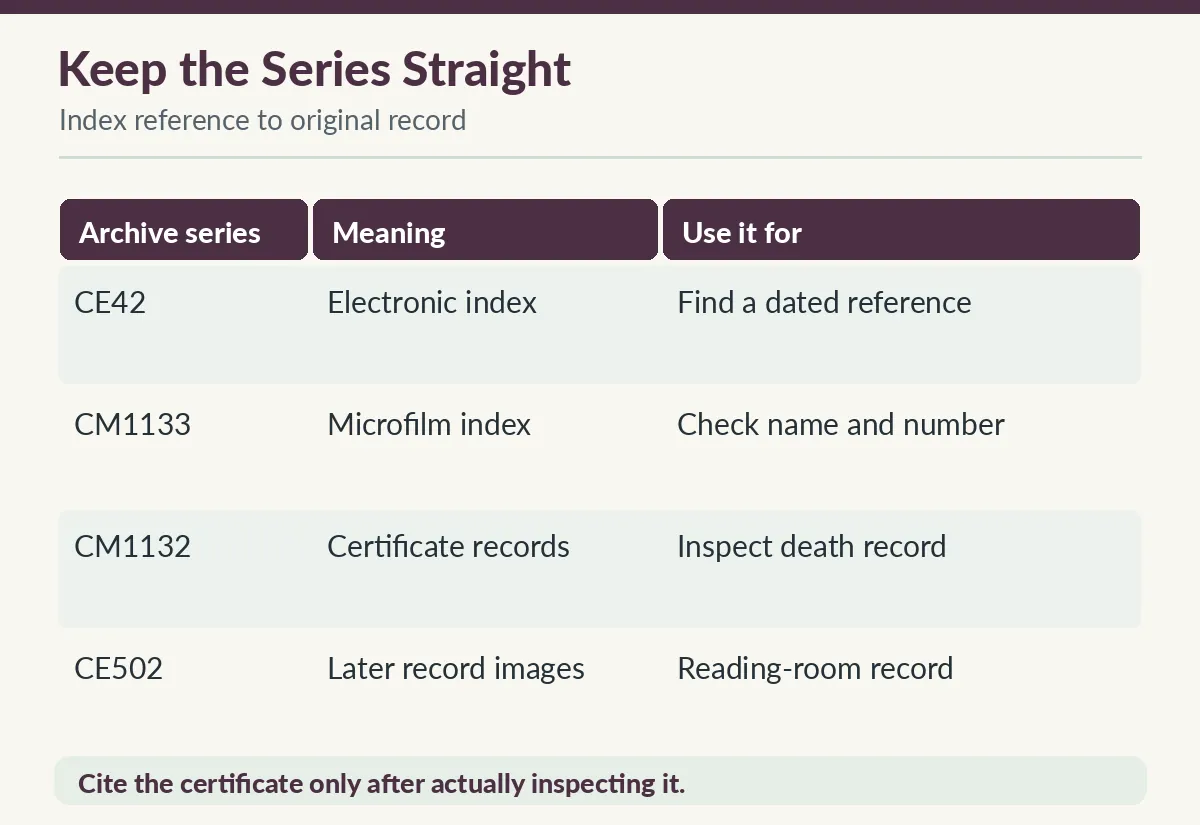
The Archive’s series crosswalk describes CE42 as an electronic index, CM1133 as a microfilm index, and S1483 as an access path relevant to 1943–1949. Indices give a route to the death date and certificate number. The certificate itself is represented by different series, principally CM1132 and later CE502. Write these identifiers in different spreadsheet columns so you do not accidentally cite an index as a personally inspected death certificate.
For 1875–1925, the current state guide lists CM1132 certificates online. For 1926–1949 it lists CM1132 certificates on the Archives’ searchroom computers, and for 1950–1972 CE502 on those computers. Access descriptions can be updated, so confirm the guide again before travel. The index may be web-accessible even when the certificate image is not. That split is often the difference between a useful home lookup and a research-room task.

Handle Gaps and Conflicting Finding Aids
A detailed CM1133 series description lists narrower survival and arrangement notes for its microfilm material, including some intervals lacking indexes within that specific series. The newer general guide points to other electronic paths. These descriptions are not automatically contradictory: a gap in one cataloged microfilm index is not proof that the city has no certificate, while an electronic index listing does not automatically fill every original-record gap.
Keep the access path with the result. If CE42 yields a reference but a CM1133 volume appears absent, capture the electronic reference and ask the Archives where that certificate is held. If an index has no hit, test alternate surname spellings, approximate dates and the city-versus-county jurisdiction first. Record exactly which index years and filing systems you searched. Never report that a named individual died elsewhere solely because one vowel grouping was empty.
The general death guide offers distinct 1875–1925 and later viewing routes even though the archival series descriptions span somewhat different beginning years. In a research log, keep three independent statuses for each target: an appropriate index located, a certificate reference obtained, and an image actually inspected. A certificate reference with no accessible image can still direct a legitimate request, but it cannot support additional claims about medical cause, informant, parentage or exact residence. Such facts should remain blank until the primary record can be read.
Evaluate the Death Certificate Carefully
When a certificate is obtained, separately extract the event date, place, deceased name, age or birth data, address, informant and burial disposition if those items appear. Do not infer that every historical certificate contains the same fields. Compare names and locations with census, marriage or cemetery records. The person who supplied parent names may not have firsthand knowledge; death records often combine direct observation of the death event with reported biographical claims.
Suppose an index names Mary Brown with the right approximate date, but a certificate describes a different street and a different spouse than your relative. Keep the candidate on hold, search a neighboring date and inspect the competing certificate numbers. The fictional exercise demonstrates why the index alone cannot settle kinship. Conversely, a matching address, occupation and independent burial note can make a stronger identity argument than an exact spelling alone.
More Records and Archives Guides
How We Research Maryland Archive Series
We cross-check the State Archives’ current year-and-access guide, its series explanation, and microfilm catalog details. We distinguish what an index says from what a later certificate image confirms, and we label source-specific catalog gaps instead of treating all missing hits alike. The key fields are year, filing method, index series, certificate number and retrieval route.
We cite the viewed source, not merely the name of the collection we intended to consult. Dates, relationships and death location are subjected to an independent evidence test; the spelling and number in an index remain transcription-level clues. Our affiliate disclosure describes site policies and does not imply financial ties to Maryland’s public archive.
An alphabetical finding system grouping surnames by the first letter and first vowel. The cited index normally supplies the death date and a certificate number.
The Maryland State Archives directs researchers to Soundex ordering from 1950 for Baltimore City death indexes.
No. The Archives lists 1875–1925 CM1132 images online, 1926–1949 CM1132 on reading-room computers, and 1950–1972 CE502 on reading-room computers.
No. A number leads to the certificate. Record the separately viewed certificate series and details when you obtain it.
Not automatically. The Maryland State Archives distinguishes Baltimore City record paths from the state’s other counties and later periods.