
The New South Wales historical BDM index mixes two important eras: church baptisms, marriages and burials beginning in 1787, and statutory birth, death and marriage registration that began on March 1, 1856. A successful name search may locate an entry in either era, but the original documents can answer different questions. Search the free official index, preserve each registration reference, and identify the type of record before ordering a certificate. This guide includes a second safeguard: older indexes can contain late or repeated registrations, so two similar hits do not necessarily represent two separate events.
Put the event on the correct side of March 1856
The NSW Registry says it holds church records of baptisms, marriages and burials dating from 1787, with some later church entries, and that compulsory civil registration began on March 1, 1856. For an 1840 baptism, do not assume a civil birth certificate exists. For an 1862 birth, start with the civil index but still test what the registrar actually recorded. A pre-1856 marriage or burial entry may contain much less genealogical information than later certificates. In your log, name the record type explicitly instead of labeling every hit ‘birth,’ ‘marriage,’ or ‘death’ without qualification.
Use the official open-access windows
The public historical index covers births more than 100 years ago, marriages more than 50 years ago, and deaths more than 30 years ago, subject to legal exceptions. The index opens new records as they become eligible, so a fixed end year in an old genealogy book can become outdated. Some records, including certain pre-adoption material, remain subject to restrictions even within a general age band. When a newer event does not appear, respect the registry’s lawful certificate request process and avoid interpreting nonappearance as proof the event was unregistered.

Build a small NSW search before broadening it
The Registry recommends searching by a person’s name or, when already known, a certificate number. For a birth search, surname, given name and a short date range are a sound beginning; parent given names may help, but are not required in every query. The NSW guide cautions that a place of registration need not match the known place of birth, so forcing that field too early can hide a relevant candidate. Widen one parameter at a time and log exactly which years or spellings you tested. Capture the search date, event category and reference from each promising result.
Look for index duplication and late registrations
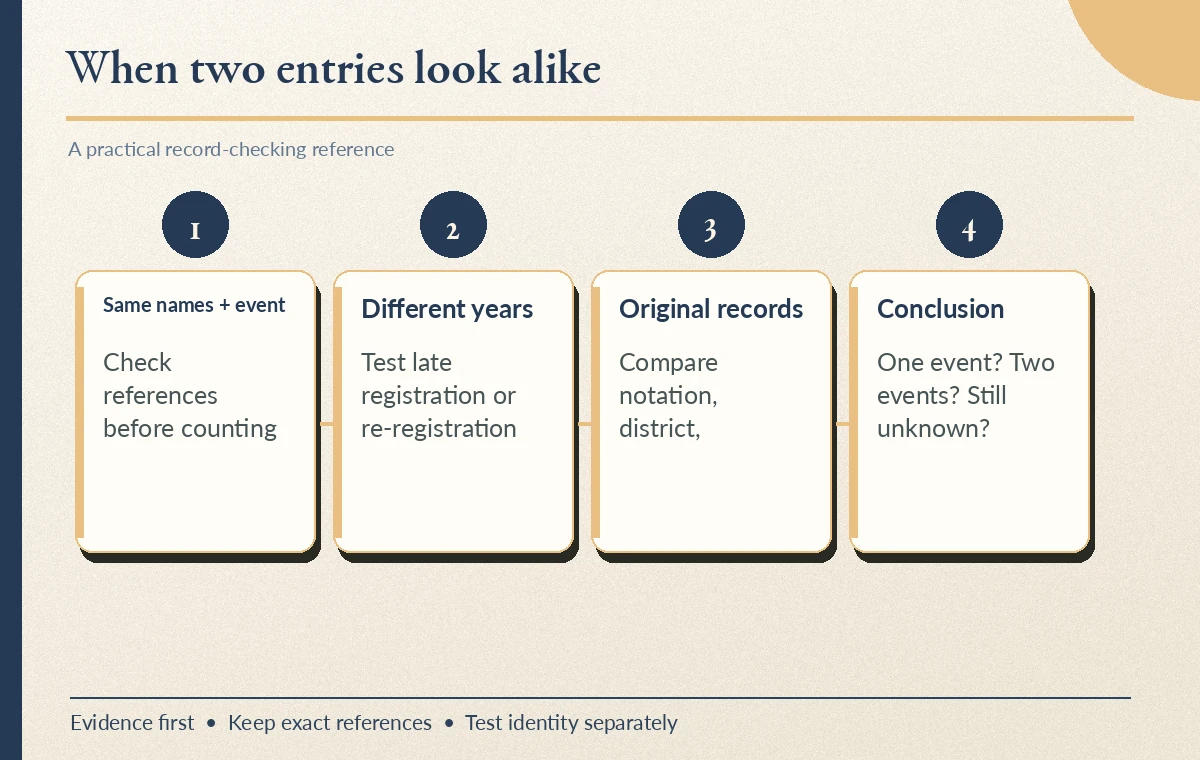
The NSW Registry’s own history explains that re-registrations, legitimations, adoptions and late registrations were often indexed both under an event year and the year of registration. Two similar references may therefore be two index paths to related paperwork, not evidence of two births or marriages. Do not merge them automatically either: compare the exact reference, year, names, district and available notation. If you encounter a potentially sensitive registration, follow the registry’s access rules rather than speculating about a living family member’s circumstances. Mark the duplicates as a testable hypothesis until the underlying material clarifies them. To go further, our guide “Victoria Historical BDM Index” shows how to find registrations and check the images.
Read old church volumes on their own terms
A colonial church entry records a religious event, and the amount of detail depends on the register and era. A baptism may have occurred weeks or months after birth; a burial may not state a precise death date. A church wedding is an event in its own right, not automatically a civil certificate with later reporting standards. Transcribe the exact event label and any source volume reference. Then compare the place, officiant, witnesses and family relationships if these are present. Avoid inventing missing parents simply because a modern index interface groups the entries under the familiar BDM heading.
What later NSW certificates can—and cannot—tell you
The registry’s official record guide gives examples of family details that later certificates may contain: parent names, occupations, birthplaces and informant information for births, or witnesses and party details for marriages. What is actually present varies by event, period and entry. Death certificates may contain recollections passed to the informant; their value for parentage is different from their value for a reported death. Copy literal wording, mark blank fields as blank, and attribute each statement to its information source when possible. Neither an official form nor a precise-looking age automatically proves a biological connection.
Worked example: one person, two NSW index results
Suppose a fictional researcher sees an 1854 marriage entry in a church volume and an apparently identical couple’s reference under a later year. The correct response is not to count two weddings without investigation. The researcher first copies the exact volume and registration references, checks the NSW registry’s indexing history, and orders or locates the primary entries permitted by access rules. An unrelated address or witness might distinguish two couples; an annotation may indicate a later registration. Until the documents are compared, label both entries ‘possible match’ and keep the supposed spouse link provisional.

Route missing evidence to the right custodian
If a named baptism is missing, ask which denomination and parish served the family and whether the local register survives outside the Registry’s holdings. If a later NSW certificate does not appear, review spelling, year, district and a possible registration delay. Families also traveled: an event described in a family narrative as ‘Sydney’ might have been registered elsewhere, particularly for people arriving or departing by sea. Newspaper notices, passenger records, land records and cemetery registers can supply independent clues without being substituted for the civil event. Treat each failed search as evidence only about the repository, period and search terms actually tested.
| Era or issue | Best starting point | Interpretive caution |
|---|---|---|
| 1787–1856 church entries | Baptism, marriage or burial volumes | Not necessarily a civil vital event |
| After 1 March 1856 | Civil registration index | Fields differ by form and date |
| Repeated-looking entry | Exact references and annotations | May reflect a late or changed registration |
Prove the family link, not the index interface
Create a three-column worksheet: exact source claim; information source or limitation; independent test. A marriage index may reliably direct you to a record involving two named parties, while parentage might not be part of that entry. A death certificate might state a reported marriage or birthplace that must be checked against earlier evidence. Prioritize independently created records near the event rather than repeatedly copying online trees. Write the conclusion with its limits—for example, ‘likely the same household, pending confirmation of the district’—and retain all rejected candidates so another researcher can reconstruct your decision. Our guide “Western Australia Historical BDM” goes into more detail.
How We Research
This guide was developed by comparing official registry or archival descriptions with the public search process and testing each recommended inference against its stated record type. Dates, jurisdiction boundaries and access restrictions are attributed to the relevant custodian; examples are expressly fictional. We distinguish a source’s literal statement from an interpretation and a question needing corroboration. Online coverage, fee rules, and search interfaces can change, so recheck the authority’s current guidance before paying or concluding that a record is absent.
More Records and Archives Guides
Primary sources and archive guides
NSW church-era boundary, civil registration start and available event types (www.nsw.gov.au).
Government name and certificate-number search instructions and open access thresholds (www.nsw.gov.au).
Index construction, duplicate-looking re-registrations and lack of automatic family linking (www.nsw.gov.au).
Disclosure and research limits: This is independent educational genealogy writing, not legal advice or an archive endorsement. This guide contains no affiliate links. Historical records may contain harmful colonial terminology, erroneous claims, and information that should not be exposed about living people. Respect current archival restrictions; see GenHis affiliate disclosure.
Compulsory civil birth, death and marriage registration began on March 1, 1856.
No. The registration district may differ from the event location, and older church records have different fields.
The government describes free historical index searching; certificates are a separate purchase.
Late registrations and some re-registrations can create entries in an event year and another registration year.
Not by itself. It proves the baptism recorded; compare any stated birth date with independent evidence.