
For New Zealand genealogy, begin with a confirmed event and use the right custodian for its kind of record. The Department of Internal Affairs provides a historical births, deaths and marriages search with privacy-based cutoffs; Archives New Zealand holds passenger lists and other government records; and the National Library makes historical newspapers available through Papers Past. Their indexes answer different questions and are not interchangeable. This guide provides a short, reproducible workflow for locating an original entry, connecting it to an arrival or local notice, and leaving unsupported family relationships unclaimed.
Begin from one known life event and a New Zealand place
Write a research question that contains an identifiable person, event and date range, such as a marriage recorded near a particular town before a verified child’s birth. Retain the Māori and English forms of historical place names where relevant and quote the contemporary locality as written. A family story about arriving in Auckland may be a clue, but not an established port or ship. Use letters, a home-held certificate or an independently sourced notice to fix the earliest reliable point before opening broad nationwide indexes.
Make separate columns for identity, residence, family relationship and unverified tradition. A marriage certificate might support an event in one place, while a newspaper notice gives additional reported detail. These are different evidence types, and the informants may not be independent. A recent family tree repeating an earlier online tree is not a second original source. When multiple people share the same surname, compare locations, dates and witnesses instead of selecting the first indexed hit.
Use the official historical BDM search correctly
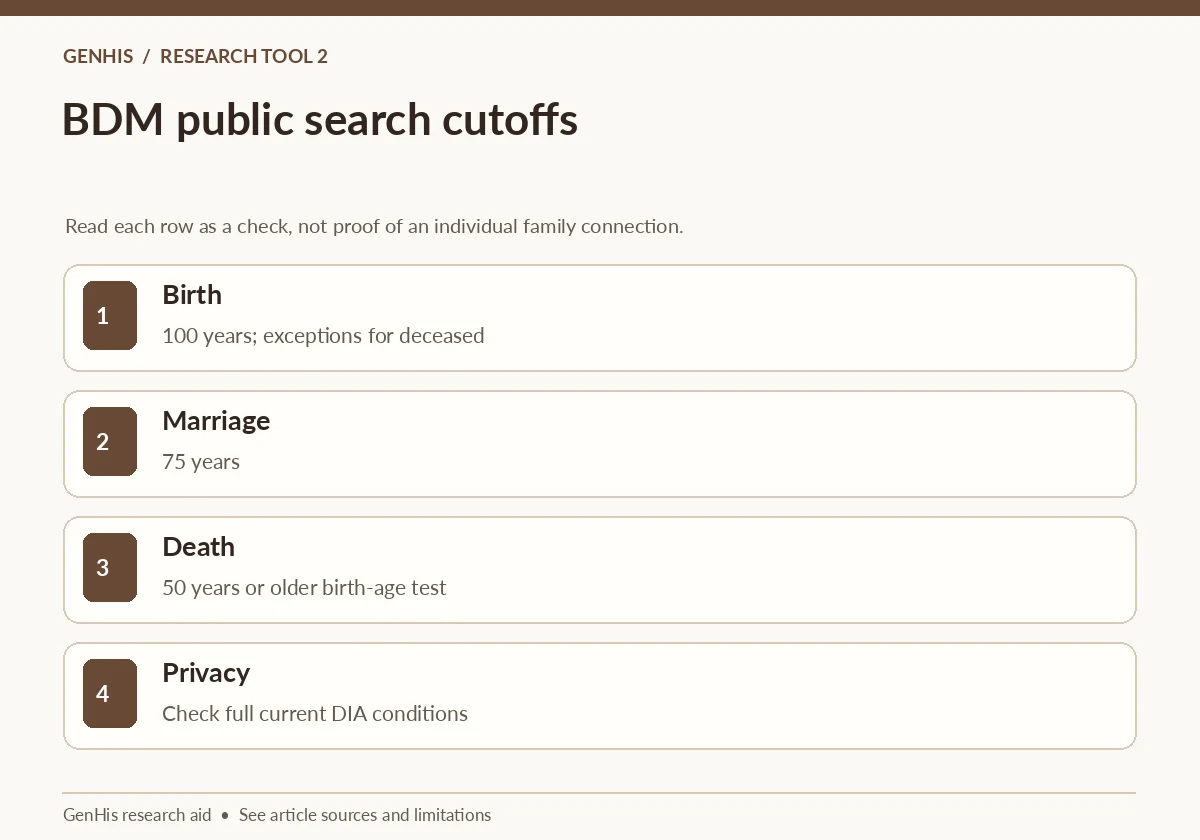
New Zealand’s Birth, Death and Marriage Historical Records site publishes eligibility rules designed to protect people who may still be living. In general, the historical search includes births at least 100 years old; births of people who died at least 50 years ago or were born at least 80 years ago; marriages at least 75 years old; and deaths at least 50 years old or where the deceased would be at least 80. Check the official wording before each search because access rules and application requirements are specific. For the fuller picture, see our guide “New Zealand Historical Death Records”.
The official search help advises supplying a family name with a date window or a registration number, and it cautions that scanning introduced transcription errors. Start broad enough to account for inaccurate ages and name forms, then narrow by year rather than expecting an exact spelling. An index gives a path to an official registration, not always all the details of the event. Note the registration number and what it explicitly shows; order a printout or certificate through the authorized service when needed, checking current options and fees.

Trace arrivals without mistaking voyage for settlement
Archives New Zealand explains that its passenger lists span roughly 1838–1973, but early collections are inconsistent and not every voyage or traveler was recorded. It describes online access to digitized passenger lists, with older material available through FamilySearch and physical or catalog options for other records. Start from a likely port and date, then search a name, vessel or ship’s list rather than treating an absent index hit as evidence a person did not immigrate. Some passengers are recorded only by initials or with unexpected spelling. Our guide “New Zealand Historical Birth Index” goes into more detail.
Read the ship’s actual page to establish which names traveled and what was stated about ages or occupations. A passenger beside another person might be a friend, servant or fellow migrant, not necessarily a relative. Arrival at a port is different from permanent residence there. If a relative later lived inland, use newspapers, electoral rolls, land records and marriage notices to bridge the time between the two events. Cite the archive’s series or item reference alongside the arrival date and vessel.
Find context in Papers Past newspapers
The National Library’s Papers Past provides digitized newspapers and other historical publications. Search the surname with a place, vessel or occupation rather than using only a common full name. Old newspapers can reveal engagements, marriages, deaths, probate hearings, shipping and employment events. Optical character recognition may split a surname across lines or misread letters; when a likely result appears, view the original page and the surrounding column instead of relying on a search snippet.
Papers Past cautions that its newspaper holdings cover only part of all papers published in New Zealand. A failed search therefore cannot establish that no notice existed. Browse an issue around an independently known event date, try initials, and inspect a regional newspaper whose digitized dates include the locality. Some publications and notices use historical language now considered harmful; describe it as source wording and do not casually repeat it in present-day family narratives. Cite paper title, date, page and article location. To go further, our guide “Auckland Libraries Family History” shows how to use Kura, local newspapers, and Archives.
Expand from BDM to probates and intentions to marry
Archives New Zealand’s life-events guidance directs researchers to Births, Deaths and Marriages for certificates and explains that some probate, marriage and coroner files may exist in government collections. It also warns that access to some records is restricted. When a marriage lacks a known locality or a person’s move is uncertain, a notice of intention to marry may provide a lead, where surviving and open. A probate can name beneficiaries, property or executors, but it does not automatically prove biological relationships. To go further, our guide “New Zealand Intentions to Marry, 1856–1956” shows how to find notices and proof.
Search the relevant archives catalog by surname, event date and district; record the exact series and item number. Do not invent a probate file merely because a person died with property. The title of a record may reflect a historical administrative purpose rather than a modern life-event category. If access is restricted, contact the custodian and follow the applicable process; a genealogical interest alone does not override privacy rules. Keep a note of material that remains unconsulted so it is not mistaken for evidence.
Research whakapapa with cultural and privacy care
Whakapapa is more than a set of Western-style civil documents and cannot be reduced to an online surname chain. Archives New Zealand includes guidance on researching whakapapa; the appropriate sources and permissions can depend on whānau, hapū and iwi context. State-created records may omit relationships, apply inappropriate historical categories or present colonial viewpoints. Respect the authority of relevant communities and living people in deciding what information can be shared or interpreted publicly. Our walkthrough on how to Start Australian genealogy research across state Archives sets out each step.
Do not use an ethnicity estimate or an ambiguous name to claim a specific iwi or hapū affiliation. A connection asserted in an old administrative document needs the same careful source evaluation as any other claim, and may need culturally informed context that the document alone lacks. If an archive warns that an item includes sensitive content, preserve an accurate reference without spreading restricted or distressing material unnecessarily. Keep modern relatives’ identities and contact details out of public drafts.
Finish with a four-source evidence trail
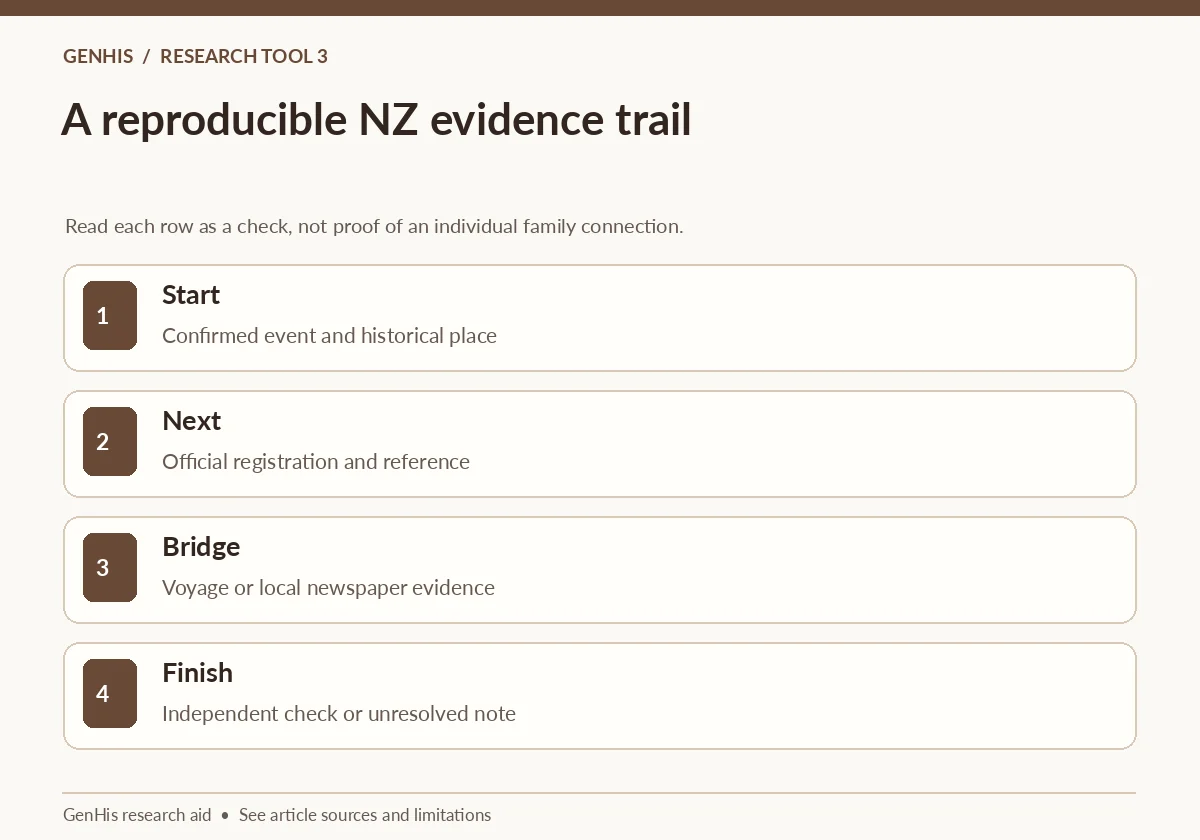
A strong first investigation can use one official registration, one passenger or place record, a newspaper notice and a second independent document. They need not all be available, and one should never be fabricated to fill a checklist. Create a table listing which event each source recorded, how it identifies the subject, its custodian and remaining contradictions. Mark inferred relationships separately from direct observations. If a notice conflicts with a registration, compare the writer’s likely access to information before choosing a conclusion.
For an illustrative workflow, begin with a verified marriage registration and search its district in a period newspaper. Use the resulting occupation or place to narrow a passenger list, but only link that voyage if independent dates or other details connect the person. Then look for a later probate or death record. This is a process example, not a claim about a real named ancestor. Save enough archival detail that a second researcher could repeat every step, and identify which link still needs evidence.
How We Research and Verify the Source Claims
For New Zealand we read the Department of Internal Affairs historical BDM search conditions, including the deceased-person exceptions that a short cutoff chart cannot completely represent. We checked Archives New Zealand’s passenger-list survival and research instructions and the National Library’s description of the Papers Past newspaper collection. The resulting workflow distinguishes a public index, a register copy, a ship list and an editorial notice instead of treating them as equivalent evidence of family connection.
We also reviewed Archives New Zealand’s guides for life events and whakapapa, then limited the article to publicly documented procedures and respectful privacy safeguards. No living person’s identity, iwi or hapū affiliation was inferred or presented as confirmed. Every example is a research method rather than a claimed discovery. Researchers should confirm the current DIA eligibility rules and any archive access or cultural permissions before ordering, reproducing or sharing an item.
Authoritative Sources and Archive Access Notes
bdmhistoricalrecords.dia.govt.nz — official collection guidance. Official historic New Zealand BDM eligibility and privacy thresholds.
bdmhistoricalrecords.dia.govt.nz — official collection guidance. Official BDM search inputs, transcription and search-range advice.
www.archives.govt.nz — official collection guidance. Passenger list dates, gaps, digitization and search routes.
www.archives.govt.nz — official collection guidance. Custodianship for life-event and other government documents.
paperspast.natlib.govt.nz — official collection guidance. National Library newspaper source coverage and limitations.
www.archives.govt.nz — official collection guidance. Archives New Zealand genealogical and whakapapa research guidance.
More Records and Archives Guides
Disclosure, Privacy and Limits of the Evidence
Whakapapa, historical identity and relationships require care beyond matching surnames in colonial indexes. Respect whānau and community permissions, and do not reveal details of living people or restricted files. Searchable historical records may have fees or privacy conditions. GenHis is independent of the New Zealand government, National Library and Archives New Zealand. Consult our affiliate disclosure; no affiliate relationship is claimed in this guide.
Eligibility depends on privacy cutoffs. Common thresholds include births 100 years old, marriages 75 years old and deaths 50 years old, with additional deceased-person provisions.
No. Archives New Zealand notes that earlier collections can have gaps and inconsistent coverage.
Papers Past, operated by the National Library of New Zealand, offers searchable digitized publications with incomplete nationwide coverage.
No. It can document a voyage and reported fellow travelers, but kinship usually requires independent records.
No. Such estimates do not independently establish whakapapa or a specific community affiliation; research should respect whānau and community guidance.