
New Zealand’s official historical birth index is a starting point for confirming registrations, not a downloadable copy of every birth certificate. Search the government’s Birth, Death and Marriage Historical Records site by family name and date range or by registration number. The historical-access test differs for a person born at least 100 years ago and for a deceased person whose death or birth date qualifies under a separate rule. Record the registration number, distinguish registration from the actual birth event, and order a research printout when the index does not answer the family question.
Check the historical-birth eligibility before searching
The official BDM Online portal permits historical searching for a living person’s birth once it is at least 100 years old. It also includes births of deceased people when the person died at least 50 years ago or was born at least 80 years ago. These alternative routes do not mean every birth from eighty years ago is automatically exposed in a public name search. Establish the event year and any documented death circumstances before assuming the person’s record falls within the public historical index.
This is a privacy screen, not a way to derive an individual’s living status from a blank result. A failed index query may indicate restricted disclosure, incomplete data, alternate spelling, mistaken date or a registration outside the expected district. For newer events, use the government’s authorized nonhistorical service where appropriate, rather than looking for workarounds. Avoid publishing records about living relatives without consent or other proper authority. Eligibility and prices can change; rely on the currently displayed government conditions.

Search with surname and date, or a known registration number
The government search form requires either a family name and a Search From date or a registration number. Start with the most reliable historical surname and a generous range around the proposed birth year; avoid filling too many optional fields at once. The official instructions explicitly recommend a ‘less is best’ strategy because errors were introduced when registers were scanned. Narrow the date range only after checking plausible variants and spelling changes.
The government explains that the modern registration number is unique within an event type and is different from the older folio number found in microfiche indexes. Record the number exactly with the event class and year, not as a floating identifier. When two same-name children appear with nearby numbers, do not infer they are siblings simply because their entries were adjacent in an index book. Use parent’s given names where available and independent household evidence before deciding which index entry belongs to your target.
| Search input | When useful | Risk |
|---|---|---|
| Surname + From date | Start from a known family name | Transcription variants |
| Registration number | Revisit a known index entry | Not the old folio number |
| Narrow date range | Reduce many candidates | May exclude delayed entries |
Distinguish the event date, entry date and registration year
A birth occurred on a date, but its official registration might be made later. A result’s recorded registration year and number do not alone prove a precise birthday. The BDM historical search form warns that for pre-1875 records a date-specific query can expand to the entire year if a matching event date is not present in the database. Therefore, a hit after entering a calendar date does not guarantee the database confirmed that exact day. Read the field labels on the displayed result.
Maintain two columns for event and registration. If an index only provides a registration year, mark the exact birth day as unknown until a trustworthy printout or other independent source supplies it. A baptism, school record or newspaper notice may add a date but has its own informant and timing. When a child’s given name changed soon after birth, search the registration under likely earlier spellings. Never convert a year into a made-up first-of-January birth date just to satisfy genealogy software. For a related choice, see our guide “Alberta Historical Birth Records”.
Choose a research printout instead of assuming the certificate has every field
New Zealand government guidance distinguishes a printout, which is a copy of information from the register and generally offers more detail for family research, from an official certificate. Check current products, delivery rules and prices before ordering; an index entry is not either of those documents. If the genealogical task is to verify parents, exact event wording or informant detail, review the government’s stated information content for the registration era and decide whether the printout best serves the question.
Transcribe the resulting document in its own words. The name of an informant is not necessarily a firsthand witness to every detail; a parent field on a delayed entry can be supplied later. Compare names against a marriage, another birth in the family or a probate file. For an older certificate issued much later, record the date of the copy separately from the birth and registration. Ordering a document can answer a question, but payment is not proof of identity; that decision comes from correlation.

Use parental clues to separate children with the same name
The National Library of New Zealand notes that historical birth results can include parents’ first names as well as the year and registration reference for eligible records. That is useful when a surname appears repeatedly, but a parent given name alone is not unique. Set up candidates A and B, noting registration year, district if shown, both parent-name details, and any independent address. Only assign a candidate to a family when at least two or three distinctive features agree with independently located events. Our walkthrough on how to Start New Zealand genealogy with BDM and passenger records sets out each step.
If parents share names across cousins or successive generations, compare their marriage dates and known residence. A family narrative saying someone was born in Wellington is a hypothesis to check, not a substitute for the register’s recorded location. Record conflicts even when one candidate otherwise looks promising; a changed birth year may reveal a second child with the same name after an infant death. Never infer that such an event occurred without a separate birth or death record.
Record the search so another researcher can repeat it
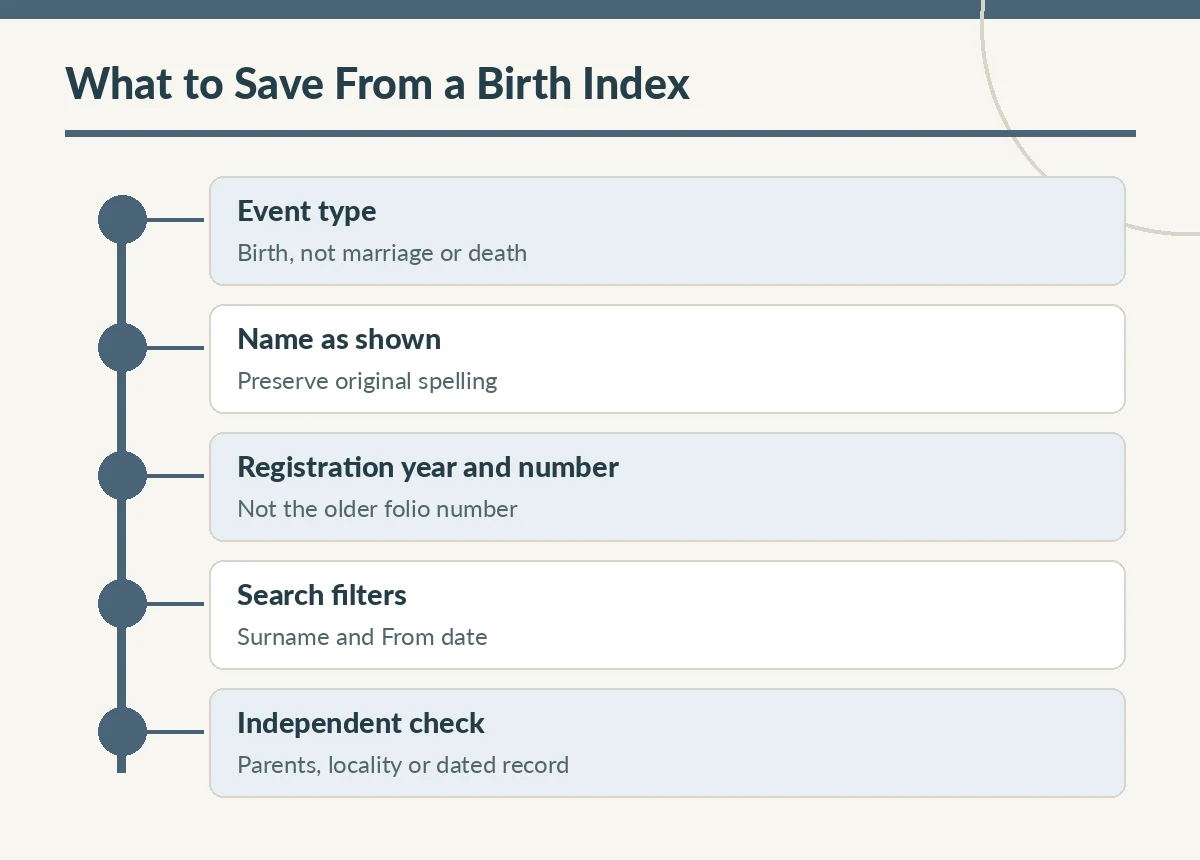
Save the index’s event category, exact displayed name, year, registration number, filters, site title and date accessed. If you obtain a printout, cite its content separately, including issue date where shown. Capture the source of any independent marriage or death comparison; a personal family tree is not a replacement for those records. The government’s own help pages describe the search input and warn about transcription issues, so include spelling alternatives in your log. Our guide “New Zealand Historical Death Records” adds more detail on this.
Treat ‘no results’ as a test of one query, not evidence that someone was never born in New Zealand. Repeat with a shorter surname, wider dates and known number if one exists. Verify that the event qualifies for historical access, then consult appropriate church, local or contemporary evidence if the registration remains unlocated. Do not use the public historical site as a pretext to find restricted personal details about living people.
More Records and Archives Guides
How We Research the New Zealand BDM Search
We checked New Zealand’s government BDM portals for the precise historical birth eligibility alternatives, mandatory search fields, pre-1875 date behavior and the difference between old folio and registration numbers. We cross-checked printout-versus-certificate advice with the New Zealand Government and the National Library’s historical family guide. The examples are hypothetical; no named private person’s record was searched or exposed.
This article describes record sources and legal limits, not a purchasing endorsement. The index is the starting clue and a printout is a separate source requiring appraisal. We do not assert a paid commission; see our affiliate disclosure. Always consult the live government portal for current ordering and historical-access rules.
No. The public historical birth rules distinguish a living person at least 100 years old from qualifying deceased-person cases.
The government requires a family name with a Search From date, or a known registration number.
No. The government explicitly distinguishes the modern event registration number from old folio references.
Not by itself. The government warns a precise-date search may expand to the whole year.
Government guidance says research printouts usually give more information than certificates; compare the available product with the question.