
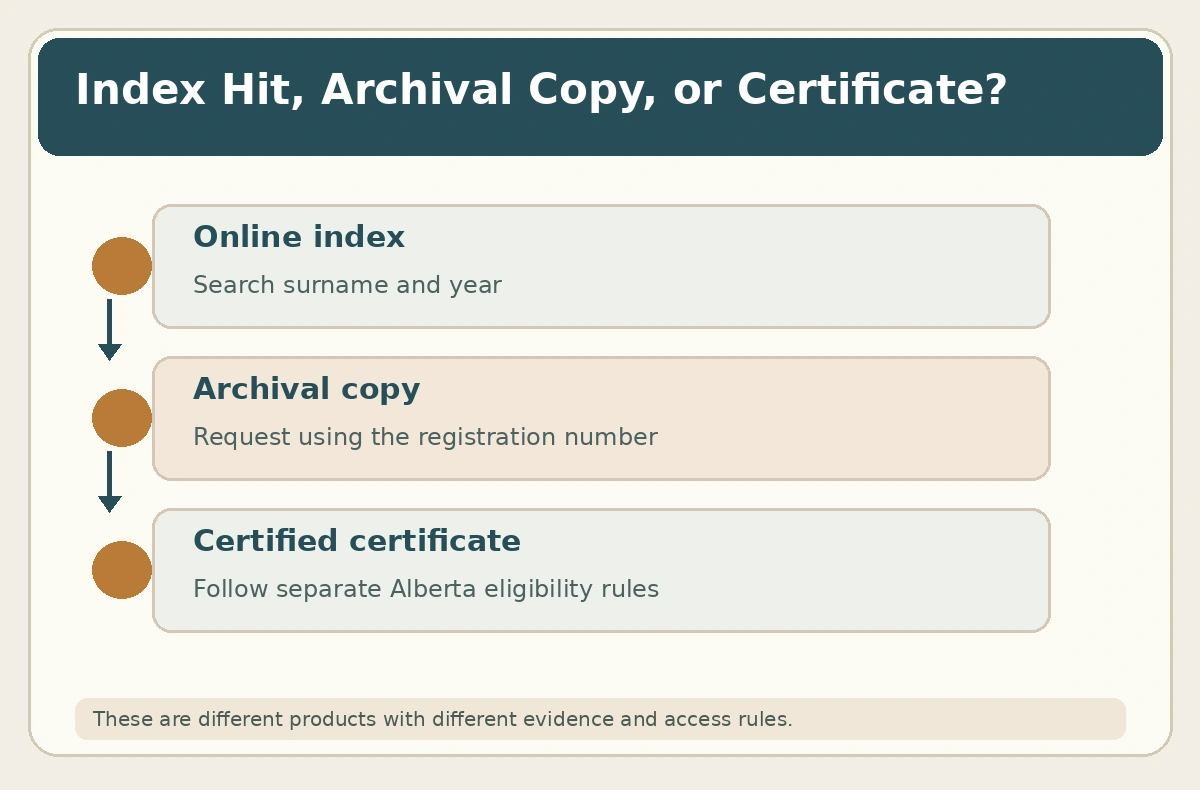
To research an Alberta birth, begin with the Provincial Archives of Alberta index, not a generic request for a birth certificate. A historical registration may be requested when the birth occurred at least 120 years ago, or when the individual has been deceased for at least 50 years and the required proof can be supplied. The surname index identifies a registration number; the archived registration is a separate record request. Neither an index hit nor a same-named birth establishes which child belonged to your family.
Decide Whether the Birth Qualifies as Historical
The Provincial Archives applies two distinct access routes: a registration 120 years old or older measured from the date of birth, and an earlier registration for someone deceased for at least 50 years with proof. Do not convert these into a simple calendar-year list without checking the exact birth date. A person born late in a boundary year may not qualify when a person born early that year already does. Recent registrations remain under the government’s regular eligibility system, not a loophole in the archival index.
Search the Alberta Birth Index by Surname and Year
The archive’s guide says to choose the first letter of the surname and locate the entry under its year. The index provides the name, place of birth, registration number and event year. A spelling variation, surname change or mistaken year can hide a plausible candidate. Record each competing entry rather than selecting the first matching given name. Note the exact heading under which the archive files the surname; a correctly copied registration number matters much more than an approximate family story.
Carry the Registration Number Into the Request
Once a candidate appears, transcribe the registration number and accompanying place and year exactly as displayed. Provincial Archives states that the original Vital Statistics registrations are not available for routine reading-room handling and are not simply viewable online; requests use its online payment system. Before ordering, verify the index fields against an independent census, school record, church baptism or household location. A surname-only order may retrieve the wrong record, and paying for a record does not make its recorded parentage independently proven.

Keep Archival Registrations Separate From Certificates
A photocopy of a historical registration from the Provincial Archives is not the same product as a certified government birth certificate. Alberta’s certificate service has its own eligibility categories, even when the event is old. Decide which document your research question needs: an archived entry for historical evidence, or a certified legal extract for an administrative purpose. If you need the latter, follow the provincial certificate route rather than assuming an archival scan will substitute for it. To go further, our guide “Alberta Historical Death Records” shows how to read the indexes and request the registration.
Check Registration Geography Before Declaring No Result
Ask first whether the birth actually occurred and was registered in Alberta. A later Alberta residence, marriage or death does not mean an earlier birth took place there. Family moves across the North-West Territories, Saskatchewan, British Columbia or international boundaries can send a search to another jurisdiction. Compare the earliest reported birthplace with contemporaneous material and list plausible alternatives. An unsuccessful index search proves only that your query did not retrieve a record in the searched index, not that the birth never happened. Our guide “Saskatchewan Historical Birth Records” adds more detail on this.
| Index field | Copy into your log | What it cannot prove |
|---|---|---|
| Name | Spelling as filed | Identity on its own |
| Place | Town or locality | Later residence |
| Event year | Indexed year | Precise birth date |
| Registration no. | Exact reference | Parent-child link |
Compare Index, Church Entry and Census Claims
A family register may report a baptism, a census may report an age or birthplace, and a vital registration may report a birth. These statements can disagree for understandable reasons, especially when years were calculated from ages. Make a three-column claim list: what each record actually says, who likely supplied the information, and what remains unverified. For example, a baptism recorded in January does not prove a January birth unless the entry gives both dates. Do not merge similar Alberta-born children before checking parents and place.

Choose the Next Search When the Name Is Missing
Try variants of both surnames and given names; revisit the likely decade rather than using only the estimated year. If no index entry fits, look for a local baptism or a newspaper announcement and establish whether the family lived in another province at the relevant time. Preserve your negative searches with index name, date range and spelling choices. Some missing results reflect the scope or indexing of the collection rather than missing persons. A reproducible failed search is useful, but not proof of absence.
Build an Evidence Worksheet Before Ordering
For each candidate keep a compact worksheet: name as indexed, event year, place, registration number, independent household clue, access rule applied, and uncertainty. Add the date you consulted the online guidance because eligibility, forms and fees may change. A second same-named birth can remain plausible even if the first record is a convincing match. Do not claim a maternal maiden name or exact parentage on the basis of an index that does not present those particulars.
Illustrative Alberta Candidate Comparison
Suppose the index lists two children with the same surname and first initial within three years. One place aligns with a later household in the province; the other belongs to a different district. Write both entries into the worksheet with their distinct registration numbers and note why the first is only a stronger candidate. Then seek the actual registration and cross-check the reported parents using an independently dated record. This example is conceptual and represents no identified historic family. It illustrates how to avoid letting a small numerical age difference or a matching surname stand in for a sourced parent-child link. State unresolved conflicts openly, including whether the birth was registered across a border. Our guide “New Zealand Historical Birth Index” covers a related question.
Cite the Record That You Actually Examined
For an online index, cite the Provincial Archives, the index title, the searched surname/year, the registration number and date of access. Once the archival copy is received, replace any vague index citation with a separate citation describing the exact registration, image or copy and custodian. Keep the original index citation as the path by which you found it. If you have not requested the registration, say that clearly in your research conclusion; a predicted content field is not an observed fact.
More Records and Archives Guides
How We Research Alberta Birth Registrations
We checked the current Provincial Archives research guide against Alberta’s historical-record access page and certificate guidance. The workflow deliberately separates age eligibility, index identification and the record actually supplied. Our illustrative comparisons contain no real family claims. Fees, access routes and indexing coverage should be rechecked at the source before a request.
Official custodial documentation reviewed: Provincial Archives of Alberta birth indexes, request process, and access thresholds. Government of Alberta age and deceased-person eligibility rules. Eligibility and distinctions for an Alberta birth certificate as opposed to an archival copy. The links are research sources, not paid endorsements. Our affiliate disclosure explains the site-wide policy.
The surname index is online, but the Provincial Archives says historical registrations themselves must be requested through its record-request system; do not confuse an index hit with an image.
The normal archival test is 120 years from the date of birth; another route can apply after the person has been deceased for at least 50 years with proof.
An archival copy and a legally certified birth certificate follow different provincial services and eligibility rules. Choose the document that fits your purpose.
Keep both registration numbers and compare birthplaces, years and independent family evidence before ordering or assigning either record to an ancestor.
No. Review spelling, event jurisdiction, date estimate and index scope before using a no-result search as evidence.