
An Ayrshire death recorded from 1 January 1855 belongs to Scotland’s statutory civil registration system and can provide names of parents, the spouse, informant and exact place of death. Search the official ScotlandsPeople death index by name, approximate year and registration district, then read the register image rather than stopping at a name hit. Earlier Ayrshire deaths need a different route through incomplete church burial records and other sources. Treat any Register of Corrected Entries reference as a separate follow-up, not as a detail to ignore.
Begin at the Scottish 1855 Registration Boundary
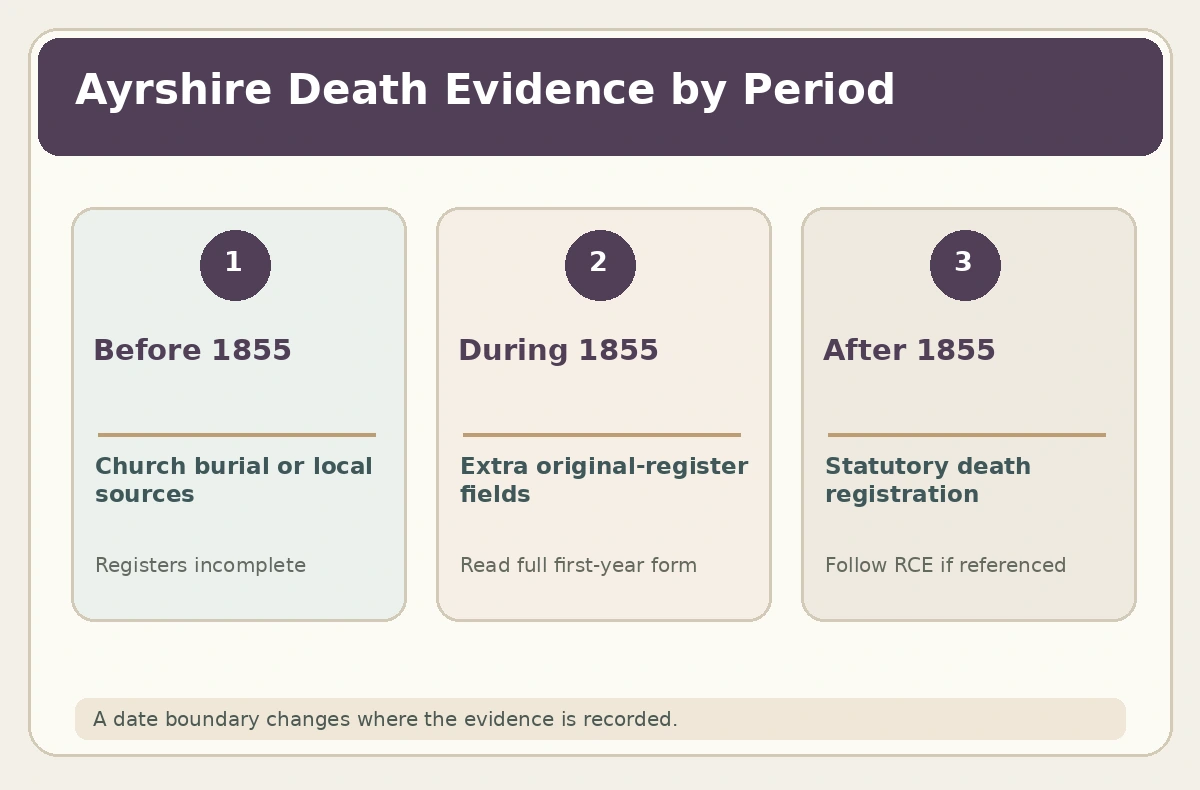
Scotland introduced compulsory civil registration of deaths on 1 January 1855. An event before that date cannot be found in a later statutory death register merely by expanding a date filter. First estimate whether the death was pre- or post-boundary from independent evidence such as a burial date, probate file or later census. If the family tradition says “about 1855,” search both sides in the appropriate classes rather than selecting a convenient match. The event date is different from the date a certificate is ordered or an index was created. For a related choice, see our guide “Irish Civil Death Records”.
Choose Ayrshire and the Relevant Registration District
ScotlandsPeople supports narrowing record searches by county and registration district, but a person described as “from Ayrshire” may have died while visiting or living elsewhere in Scotland. Use a known parish, town, spouse or address as a starting point. Record the locality appearing on the actual registration, because an administrative district label and a historic village name are not always identical. When a search fails, loosen the district constraint while retaining age and date, and check adjacent counties only when there is reason to expect a move.
Read the Full Original Death Registration
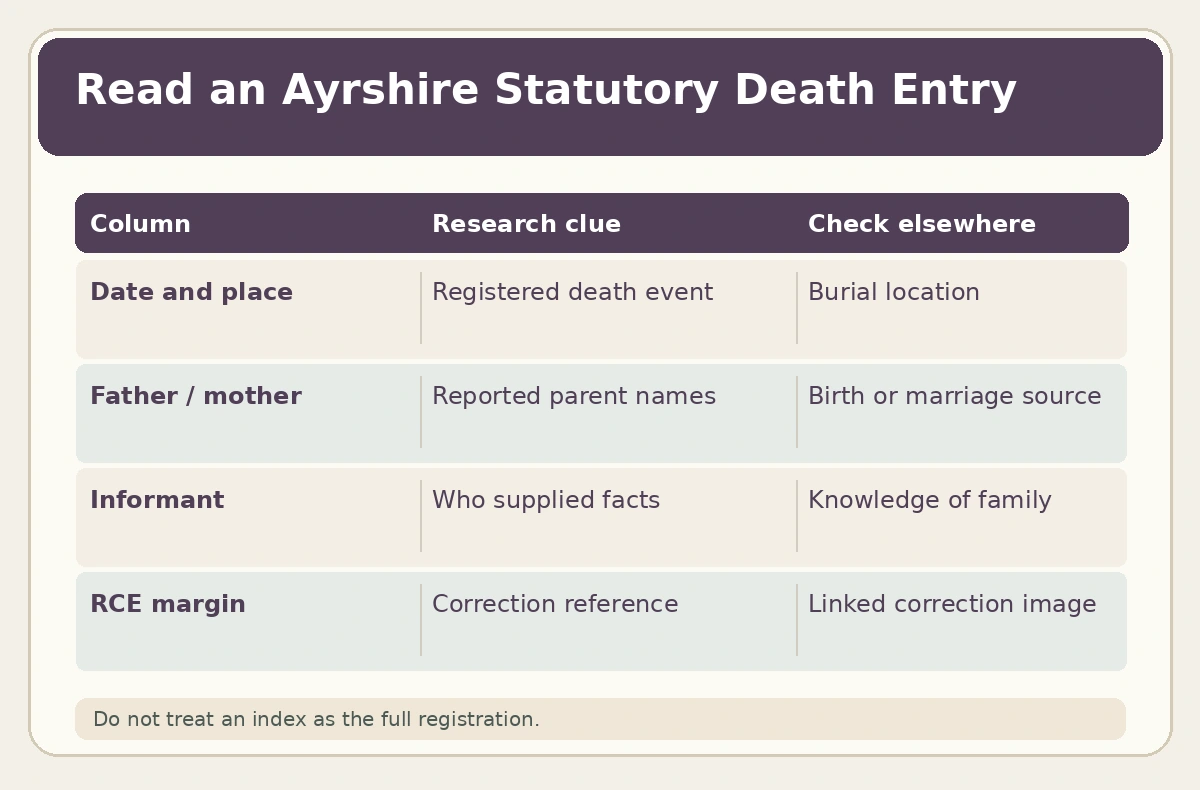
The National Records of Scotland describes routinely recorded fields including the deceased’s name, marital status, occupation, date and place of death, age, spouse where applicable, father’s name and occupation, mother’s maiden surname, cause of death, and the informant. Such details can be mistaken, particularly parental names given by someone who did not know the family well. Transcribe the handwriting and column headings before summarizing. Separate what the registrar recorded from what the informant apparently knew; an official format does not make every genealogical statement infallible.
Treat the Richer 1855 Entries as a Distinct Source
The 1855 register included additional information not consistently found in subsequent years, including a deceased person’s birthplace, time in the district and names and ages of children. This makes an 1855 record unusually useful for building leads, but never assume that an 1875 entry will display the same columns. Check the year-specific form on the original image and copy only what is actually present. A list of children is reported evidence to verify, not a final family tree derived from one informant.
Follow Register of Corrected Entries References
Sudden or unexplained deaths could lead to an official investigation, and a death entry may carry a marginal reference to the Register of Corrected Entries, now called the Register of Corrections Etc. ScotlandsPeople explains that a linked RCE image may be available below the statutory image. Open the correction when a reference appears; it may amend the certified cause or another detail. Cite the original entry and correction separately. A correction reference is an archival cross-link, not proof of criminal wrongdoing or an additional death.
| Column | Research clue | Check elsewhere |
|---|---|---|
| Date and place | Registered death event | Burial location |
| Father / mother | Reported parent names | Birth or marriage source |
| Informant | Who supplied facts | Knowledge of family |
| RCE margin | Correction reference | Linked correction image |
Understand the Historical Image Access Window
ScotlandsPeople states that digital images of Scottish death registers are accessible online after a 50-year privacy cut-off, with newer entries following official certificate procedures. The displayed eligible end year changes over time; use the current service rather than embedding a permanent endpoint into a family history citation. Index results for newer material may exist without the same immediate image access. Do not attempt to bypass lawful restrictions or infer sensitive facts about living relatives from modern register references. For the next step, our guide “Scottish Birth Registers from 1855” explains how to find parents and check original entries.
Separate a Burial Place From the Death Location
Ayrshire gravestones and parish burial registers can corroborate a death, but they may record different dates and places. A person might die in a hospital outside Ayrshire and be buried in the family parish. The death registration proves what was entered about the death event; the burial record reflects interment or commemoration. Compare dates, spouses, residences and informants before merging records with the same surname. A grave inscription may memorialize more than one person, and not everyone named on a stone was necessarily buried beside it.
Research Pre-1855 Ayrshire Burials Without Inventing Coverage
Before statutory registration, search relevant Church of Scotland Old Parish Registers and, when appropriate, Catholic or other church records through ScotlandsPeople. The official church guide warns that record-keeping varied greatly by parish and year; an empty burial search cannot establish that the person lived or died elsewhere. Identify the specific congregation, preserved volume and date range. Supplement a missing burial with cemetery inscriptions, estate or testamentary material and other contemporary evidence, acknowledging when neither death date nor parents can be proven. If you want the full process, read how to find Scottish ancestry records from civil registers to parish books.
Illustrative Ayrshire Register Conflict
Suppose a statutory death registration lists a married woman with parents whose surnames match a local parish baptism, but the estimated age differs by six years. The appropriate next search is not to change the age until it fits: transcribe both sources, verify the spouse, and compare addresses and informants with another dated document. An index result using the same name could concern a second person. Check whether the death entry has a marginal correction reference and whether that correction changes your interpretation. This example describes no real Ayrshire family. Its purpose is to demonstrate the difference between the evidence written into a registration, the knowledge of the reporter and a defensible conclusion about identity.
Compare Parent Names With Earlier Family Evidence
Parents named in a statutory death entry are often an excellent clue, especially a mother’s maiden surname. Yet the informant may be a neighbor, institution worker or adult relative who knew the deceased only in later life. Search a corroborating marriage or birth entry and examine whether the father’s occupation and family locality fit. For common Ayrshire names, keep the candidate list separate and document reasons for rejection. If a parent was unknown, record that uncertainty rather than treating a similarly named couple as necessarily the parents.

More Records and Archives Guides
How We Research Ayrshire Death Registers
We reviewed the ScotlandsPeople death-register guide alongside National Records of Scotland’s statutory-register and RCE explanations, then checked the official church-register caveats for the pre-1855 period. The page is designed for historical Ayrshire locality searches; no hypothetical register fields or parent-child ties are represented as observations from a named family.
Official custodial documentation reviewed: ScotlandsPeople guide to Scottish statutory death registers and special 1855 fields. National Records of Scotland explanation of death fields and Register of Corrected Entries. Pre-1855 church burial register limits and denominational differences. The links are research sources, not paid endorsements. Our affiliate disclosure explains the site-wide policy.
Ayrshire followed Scotland’s national start on 1 January 1855. Earlier deaths need parish, burial or other contemporary sources.
The statutory form includes parent fields, but entries can be incomplete or informants mistaken; verify names independently.
The first-year form carried extra information, potentially including birthplace, residence duration and children, which later forms did not routinely repeat.
It points to a Register of Corrected Entries record, often associated with an investigated or amended detail; read the linked correction.
No. Internet image access follows a 50-year privacy threshold; newer entries have different certificate access.