
A historical Brantford death notice is often found through the Brantford Expositor, but the library’s index must be treated as a finding aid, not a provincial death registration. Brantford Public Library currently reports that the online Expositor Birth, Marriage and Death Notice Index is temporarily unavailable during a website migration. Its local-history team can still assist with targeted requests. Identify the person and date, locate the original newspaper item and separately verify the event with civil records; an indexed obituary does not by itself establish every family link printed in it.
Account for the Temporarily Unavailable Library Index
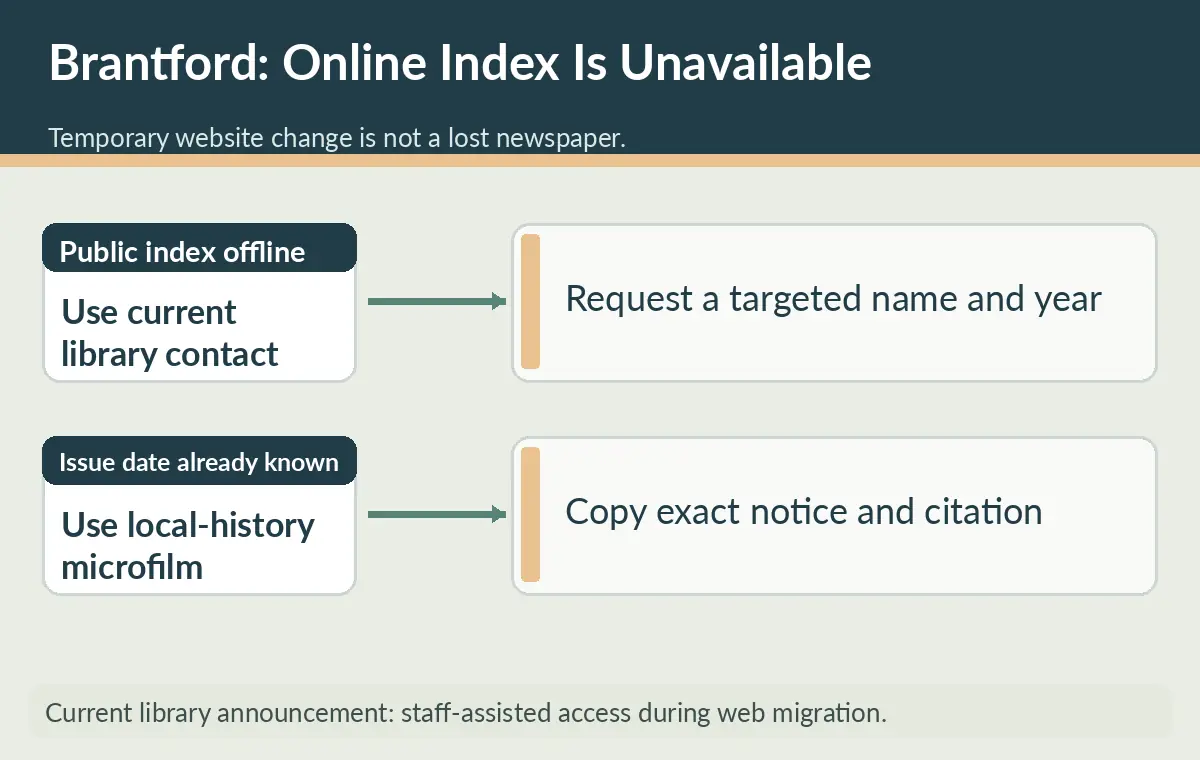
The library’s current local-history notice says the public online War Memorial Search and Brantford Expositor BMD Index are temporarily unavailable as its website changes. This does not mean the underlying newspaper collection or the index entries have been destroyed. The same notice offers staff assistance for requests associated with these normally online tools, and describes a limited number of items per inquiry. Check the live library page rather than relying on an outdated screenshot or a copied link to an inactive form.
For a research request, provide a full historical name, documented surname variants, an estimated year of death, and an address or spouse when known. Do not ask staff to reconstruct an entire family from a common surname without identifying dates. A targeted lookup should request the index citation and, when available, the actual issue or clipping. Record the date and wording of any reply, since the online service may be restored or its access conditions revised.
Distinguish a Newspaper Notice From a Vital Registration
The Expositor index identifies newspaper notices, which may include obituaries, funeral details and other public announcements. It is a pointer to what appeared in print, not a statement from Ontario’s Registrar General that a death was registered. A printed death date might differ from publication or funeral dates. Reproduce those three kinds of dates in separate columns, and cite the page of the actual issue when seen. A notice can be published days after death and can mention a person who died away from Brantford.
Brantford-area deaths can also appear in the newspaper when the deceased lived elsewhere or had local relatives. Someone described as formerly ‘of Brantford’ may not have died or been registered there. The city provides information about applying for historical death certificates through Ontario routes, but modern rules governing certified copies and detailed registrations differ from open historical indexes. Never report that the newspaper notice and official certificate are interchangeable documents.
Find the Dated Issue in the Local History Room
The Geoffrey Moyer Local History Room lists newspapers on microfilm dating back to the 1850s, along with census material, city directories, cemetery transcripts and Ontario Archives reference resources. If the index supplies a newspaper date, ask whether the relevant issue can be viewed or reproduced from this collection. When browsing, check the actual page heading, date and surrounding column: OCR transcriptions may omit a line, conflate adjacent notices or read a surname incorrectly.
An index hit may not show all reported survivors or the cemetery, while the full issue may have related funeral and memorial notices. Still, these details often came from relatives or an undertaker rather than a first-hand witness to every event. Note the newspaper name, publication day, page and article text; if you only obtained an index response, cite that as an index. Do not attribute a quote to a full newspaper issue you did not see.

Use Directories, Cemetery Entries, and Ontario Civil Records
To match an Expositor notice with an ancestor, compare the address, occupation, spouse and age with dated city directories or census returns. The local-history room describes directory and cemetery-transcript resources that can supply independent leads. A cemetery listing reports a burial or memorial, whereas the newspaper reports what was printed and the civil registration records the death. Each requires its own citation and may contain mistakes. A shared family name on a monument is not independent evidence that every named person was interred there.
The City of Brantford’s life-events guidance directs users to Ontario’s provincial records and explains that older death registrations may require archival searches. Ask for the right record type and event year instead of assuming a library photocopy is an official certificate. If the printed notice reports a relationship such as stepdaughter or nephew, look for a separate marriage or birth record before treating it as proven biological parentage. Distinguish the informant’s report from your own later inference.
Handle Name Variants, Dates, and False Matches
Consider two fictional people named George Wilson who appear in the region in neighboring decades. Compare dated addresses, spouse’s identity, occupation, approximate age and any documented middle initial. An Expositor article mentioning ‘George Wilson of Brant County’ may refer to another local person of that name. Search both a maiden surname and a married name if the evidence permits. Never insert a missing relative from assumptions about gender or household position; family notices can omit or simplify relationships for editorial reasons.
A no-hit in the temporarily unavailable public index is not a genuine completed index search. Record instead that the online interface was unavailable and whether library staff, microfilm or another newspaper was consulted. If an actual issued date and relevant years were browsed with no match, state the searched ranges and any gap or missing issues rather than declaring no obituary ever existed. Restrict claims to events supported by the documents you examined.

Preserve a Search Trail That Survives Website Changes
Keep a research log recording the date of the library request, search names, issue and page, whether an image was seen, exact names and dates printed, and independent verification attempted. The library may alter fees, delivery limits or systems during a migration. Use the present contact page rather than preserving a once-valid offer as a permanent entitlement. Cite an emailed staff answer by its actual date and archival reference; do not create a publication date or issue number if staff could not identify one.
Our explanatory visuals use a fictional newspaper page and demonstrate how to separate a temporary online access gap from a permanently missing document. They do not pretend to reproduce an authentic Brantford Expositor notice. An evidence-based conclusion can be modest: an issue was located, a reported death notice matches several independent details, or a candidate remains unresolved. GenHis’s affiliate disclosure explains commercial transparency; no vendor partnership is implied here.
More Records and Archives Guides
How We Research This Collection
We checked the current Brantford Public Library service announcement against its local-history room holdings and older genealogy instructions, and distinguished the temporary public-index outage from the existence of newspaper microfilm. We compared the city guidance on civil death records with newspaper notices and avoided assuming online availability, a fixed price, or a proven family relationship.
The library currently reports its public web index temporarily unavailable during a website migration; consult the current notice.
No such loss is indicated; library staff can assist, and historical newspapers remain in its local-history resources.
No. It is a published report; seek civil registration separately to test the event details.
Ask Brantford Public Library about the Geoffrey Moyer Local History Room and its newspaper microfilm.
No. A survivor list is a clue; verify each stated relationship with independent records.