
Finding a historical U.S. death record often requires more than looking up a name and year. A civil death certificate, a county death register, a cemetery interment log, an obituary and a Social Security index are different records with different creators and limitations. Their dates may refer to death, registration, burial or publication; those events should not be collapsed into one. This guide begins with the correct jurisdiction, then offers a source ladder and a practical way to separate reliable evidence of death from later family recollection. It focuses on deceased ancestors and does not invite disclosure of private information about living people.
Establish a death interval and the possible record office
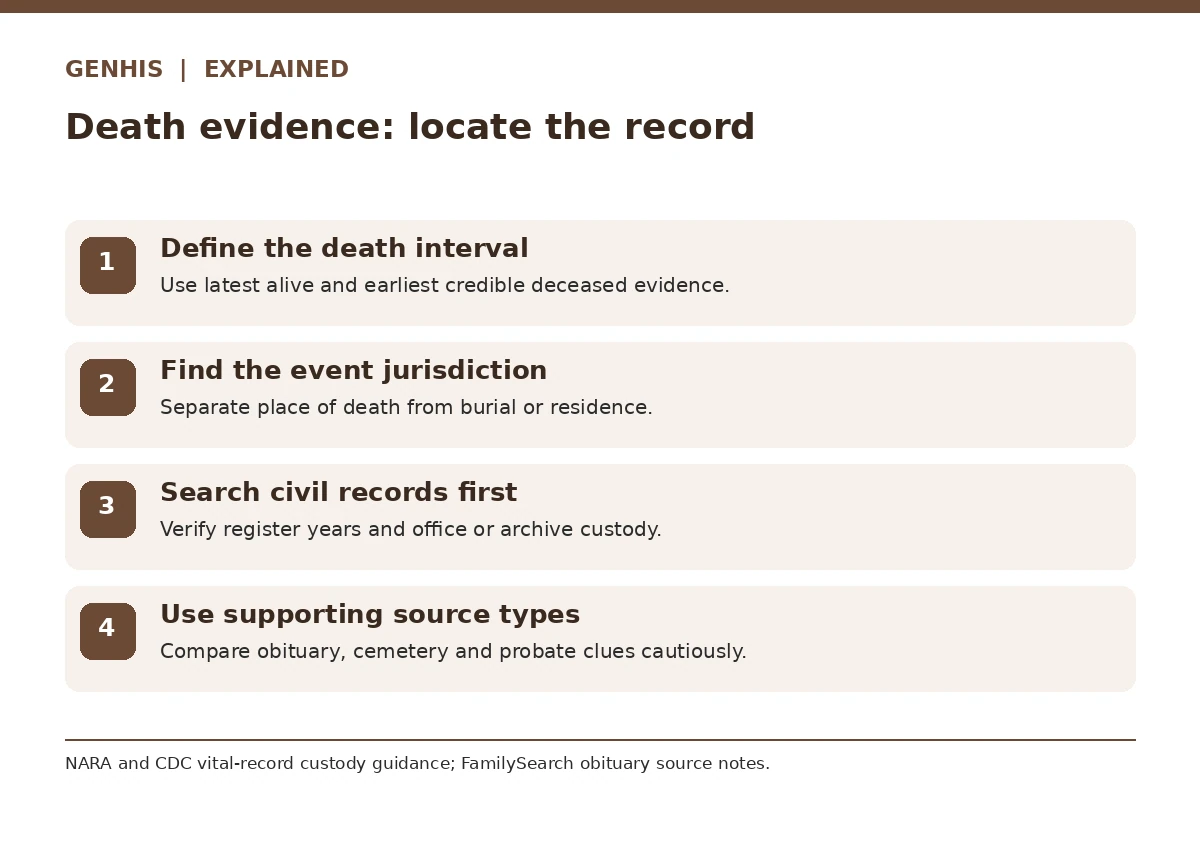
Start with the last source showing someone alive and the earliest credible evidence that the person had died. Those dates define a search interval even when an exact death date is unknown. Determine a possible locality from residence, probate, burial place or newspaper announcements; the place of death may differ from the place of burial or the family’s usual home. Be explicit about which place each source documents. A modern cemetery location alone does not establish the county that registered the death.
U.S. deaths were commonly registered through local and state systems, with start dates and custody varying widely. NARA explains that the ordinary certificates are not federal National Archives records. Use CDC’s current state/territorial contacts as one entry point, then check the relevant state archive, county clerk, health department or historical repository for older series. Never assume that because a statewide index exists for one interval, it covers an earlier county ledger. Record what collection was searched, the years it covers and the kinds of record it actually contains.
Classify death records before extracting facts
A death certificate typically documents an administrative death registration, although the exact fields vary. An obituary is a narrative produced by a newspaper or funeral home and may contain accounts supplied by relatives; it can be excellent for names and leads without being an official certificate. Cemetery and funeral records might document interment rather than the death itself. Probate documents can establish that someone had died by a particular legal action without specifying the day of death. Each source answers a different question and may need confirmation from another. Our walkthrough on how to find historical U.S. birth records and verify the source sets out each step.
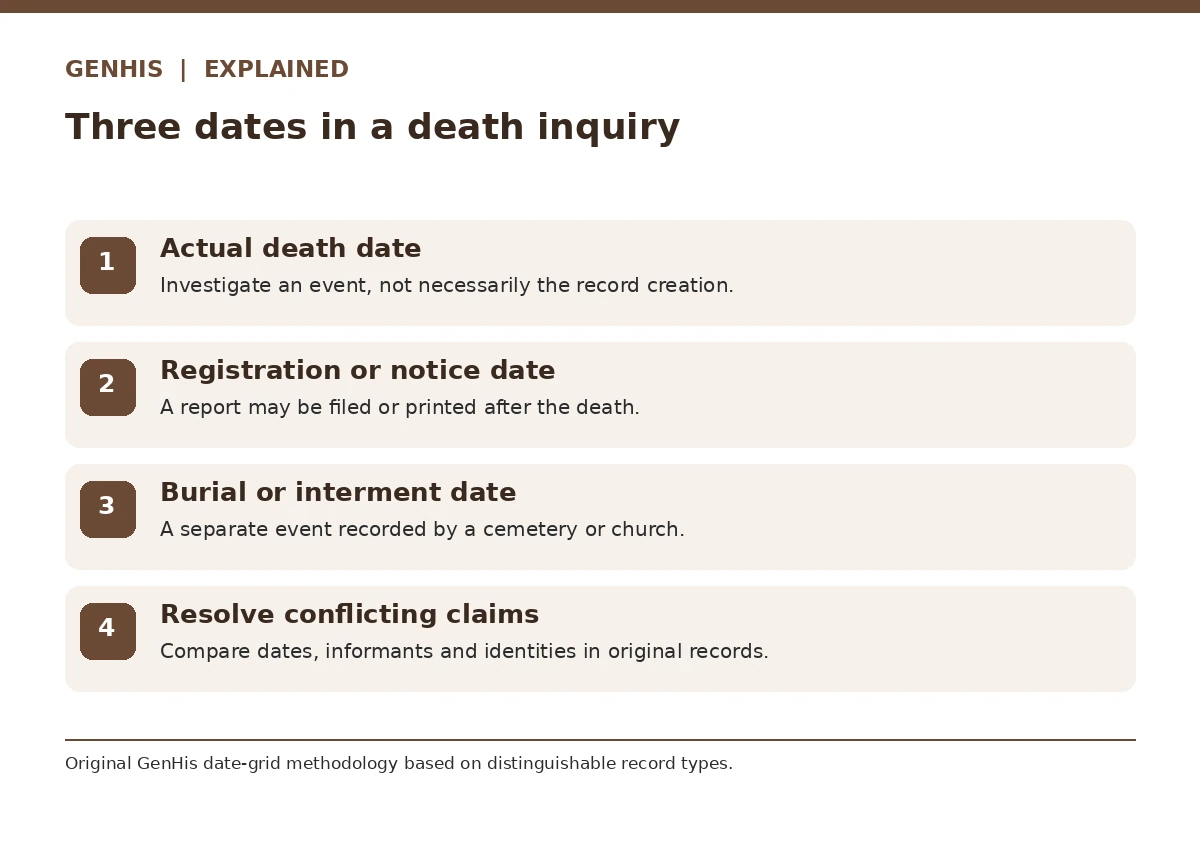
For an entirely fictitious individual, an obituary might say “died Monday” while a burial register is dated Friday. Those are not automatically conflicting death dates because the register may record an interment several days afterward. Copy column labels, document creation dates and event dates separately. If an index provides an age at death, that yields an estimated birth period, not a verified birth date. Parents, spouse or birthplace on a later death record may reflect an informant’s secondhand knowledge. Keep the informant and the event report distinct in the evidence table.
Search death indexes without treating them as complete
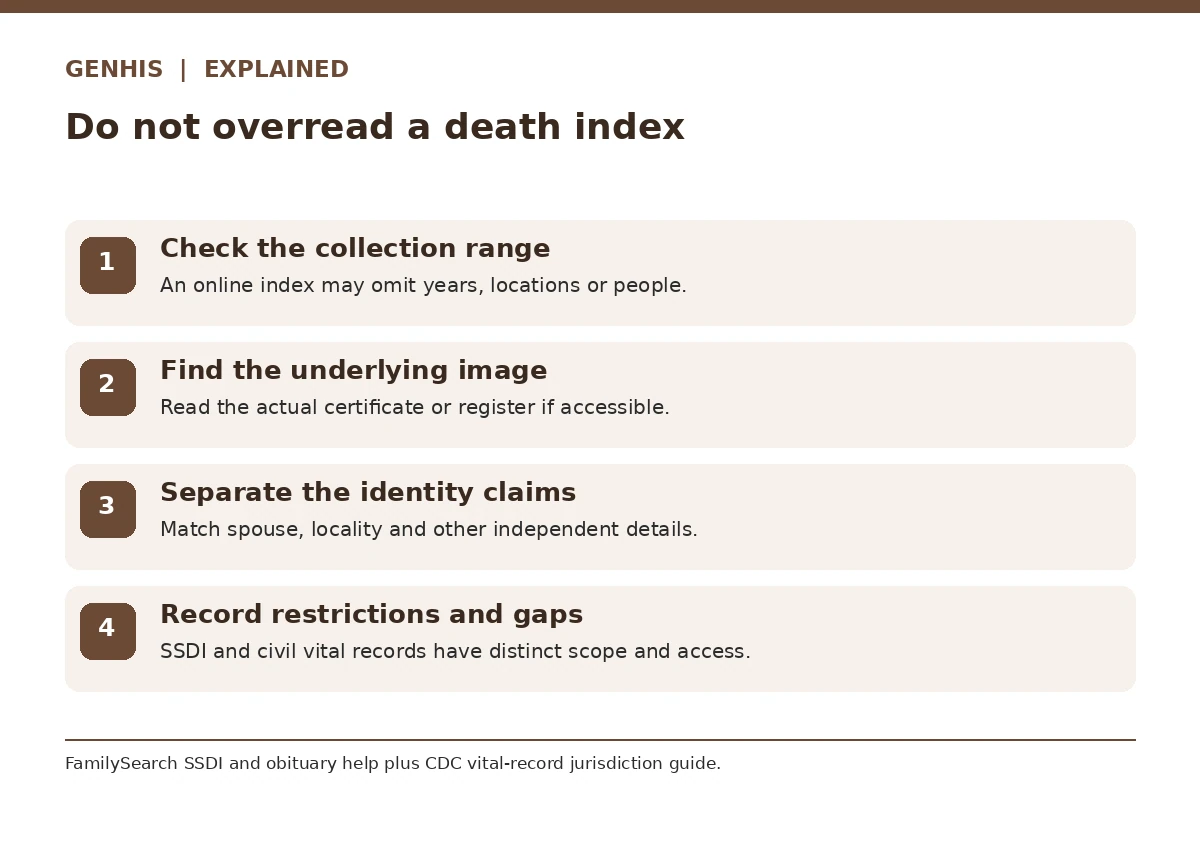
Search variant names, surname changes, approximate years and both likely death and burial localities. When a record search provides a collection title, open its description to check coverage, source creator, whether images exist and what its geographic scope excludes. FamilySearch supplies record-type filters and recommends checking images where possible; an index hit is a pointer, not a substitute for the original document. If an online collection lacks the person, search original ledgers or newspaper runs through repositories that held the relevant years.
The Social Security Death Index is one optional clue for some U.S. deaths, but not a universal record of deceased people. FamilySearch’s current help explains that its SSDI collection was last updated in 2014 and that access to more recent Death Master File data changed. Do not represent a negative SSDI search as evidence that a death never occurred or claim an index gives every detail on a certificate. A dedicated SSDI guide is a separate next research task; this article compares several types of death evidence and focuses on finding the correct jurisdictional death record first.
Reconcile conflicting dates, places and identities
Make a three-date comparison: reported death date, document registration or publication date, and burial date when available. A difference may arise from reporting delays, calendar conventions, errors or distinct events. Keep the original language and avoid converting uncertain phrases such as “about 1905” into a precise day. If two same-name people died in the same region, match spouse, household, occupation, address, cemetery plot context and other independent identifiers before linking either death to your ancestor.
Suppose a death certificate names a parent different from a person’s contemporary marriage record. Both claims deserve examination; the informants may have had different knowledge, and either record may be wrong. Do not suppress one result or infer a new biological relationship without further evidence. A cemetery transcription made many years after a stone was erected is one more transmission step. Favor the photograph or actual register where legally and practically accessible, but recognize that a modern image of a stone does not automatically make the underlying birth detail firsthand.
Record a source-specific death search conclusion
Use a worksheet containing the deceased person’s proposed identity, event range, searched geographic area, registration jurisdiction, indexes used, original-image availability, issuing office, document number and any restrictions. For a negative result, name the exact collection and year span searched, not “no death record exists.” The next action might be requesting a register copy, checking probate, locating an obituary issue or consulting another locality. Those alternatives are purposeful tests of a particular missing assertion.
Keep deaths of living people’s close relatives and other sensitive family matters respectful. A public obituary may include details unsuitable for republishing as a modern family profile. Avoid speculation about medical cause of death or hereditary conditions; genealogical record discovery is not a health assessment. A trustworthy conclusion can be modest: “death reported before [date], precise place not yet verified.” That conclusion is more useful than a fabricated certificate or a falsely precise date pasted into a family tree.
How We Research: testing date types and custody
We checked the National Archives’ explanation of who keeps vital records, the CDC’s state contact routes, and FamilySearch guidance for obituaries, searchable images and its SSDI collection. These sources support a strategy for finding records; they do not prove a particular local record survived. Fictional examples are labeled as such. Recheck each archive’s current coverage, eligibility and access policy before requesting records. See our affiliate disclosure; there are no paid recommendations or unconfirmed affiliate services in this article.
More Records and Archives Guides
Official sources and record coverage notes
National Archives — Vital Records — Births, deaths and marriages are generally state/local documents, not federal NARA holdings.
CDC — Where to Write for Vital Records — State-by-state contact directory and federal limitations for certificates and index requests.
FamilySearch — Find Obituaries — Scope and limitations of obituaries and searching indexed or browse-only historical collections.
FamilySearch — Social Security Death Index — SSDI collection last updated in 2014 and limited post-2014 Death Master File access.
USAGov: Death Certificate — USAGov explains where to request state death certificates and that eligibility and public-access timing vary.
No. Burial or interment may occur after death and is a distinct documented event.
No. It is a biographical notice that may supply valuable leads from an informant.
No. SSDI coverage and public access are not a complete registry of everyone who died.
Generally not. U.S. vital records are chiefly maintained by state and local authorities.
Use privacy-sensitive judgment and do not extrapolate medical or genetic conclusions from a historical entry.