
To find an Orkney death record, choose the source by the event date first. For deaths from 1855 onward, Scotland’s statutory civil registers are the main starting point; for earlier events, surviving church burial entries and local documents require a parish-by-parish search. ScotlandsPeople’s Orkney county guide provides a route into statutory districts, Old Parish Registers and related evidence. Neither an index match nor a nearby stone proves identity, and an entry for burial does not necessarily state the date of death.
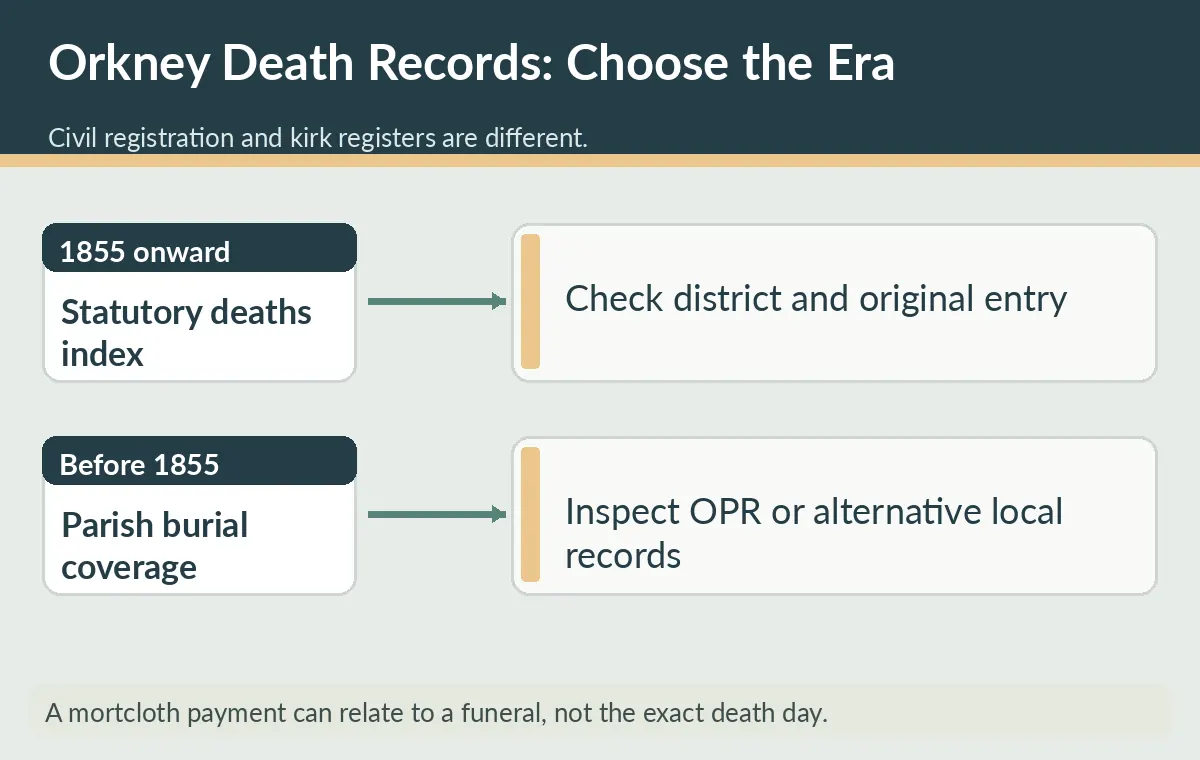
Place the event on the 1855 Scottish registration boundary
Scotland began compulsory civil registration of deaths on 1 January 1855, making this a decisive boundary for an Orkney search. Determine the best-supported event year, not a year copied from an online family tree. If a death was said to occur around 1854–1856, search both civil and parish routes until a contemporary document resolves which year is intended. Search for the recorded district name as well as the island or parish: an ancestral locality in family correspondence may be more specific than the registration district used by the record.
The statutory death guide explains historical image access and certificate routes. In October 2026 the site describes online digital images of deaths through 1974, with more recent records handled under different access rules. Check those rules at search time; never attempt to expose a living person or request a restricted document under a historical pretext. Treat an index as a locator that needs comparison with the original entry whenever access and eligibility permit.
Search the statutory index with island and district context
Start with surname variants and a realistic date range, then narrow by registration district, reported age and other known facts. Orkney surname spellings can vary across parish records, census pages and later certificates. Record both the queried spelling and the literal spelling on any matching civil entry. A guessed married surname should not silently replace an earlier name form. If several candidates have the same forename and surname, keep them separate until an age, informant, residence or other distinctive detail agrees with independent evidence.
Once you view a death entry, transcribe the fields actually present; do not assume all years and formats provide exactly the same details. Separate the death event and registration date, the informant’s report and any later family reconstruction. For example, a reported parent name may help test ancestry but can be wrong when the informant lacked first-hand knowledge. State that the register records what was reported, not that every relationship in the entry has been independently proven. Cite the year, district and entry reference from the actual image.
For pre-1855 deaths, inspect Old Parish Register coverage
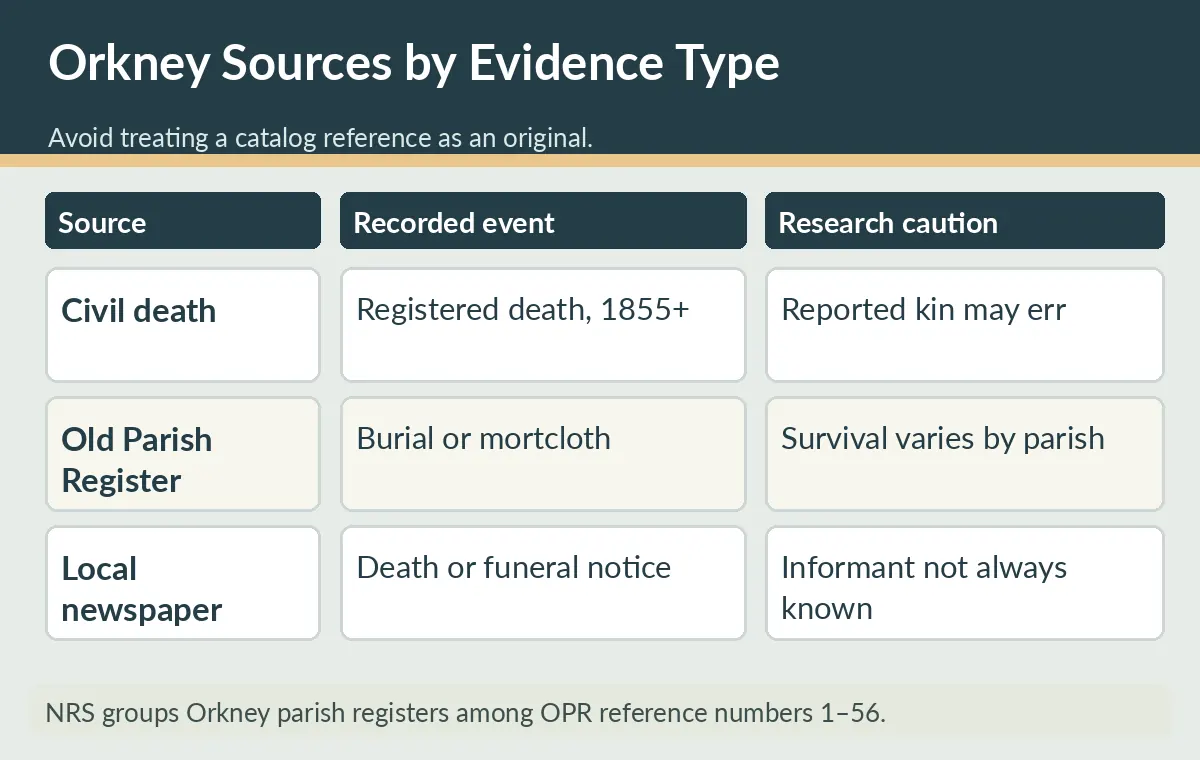
Before statutory registration, ministers and session clerks recorded events with inconsistent regularity. The National Records of Scotland OPR coverage guide places Orkney with Shetland in its OPR 1–56 reference group and warns that parish survival is incomplete. Find the historical parish and inspect the detailed coverage list for the specific type and years. An apparent missing death book is a different situation from an existing book containing no matching line. Neither should be glossed over as ‘no death in Orkney.’
Old Parish Registers may contain a burial or a mortcloth payment rather than a formal death notice. Even a dated entry can refer to a fee or funeral practice, not the day the person died. The absence of a burial entry is common; NRS notes that many Scottish parishes lack surviving death and burial registers. Browse nearby entries for handwriting, names and place references where the register is available, but do not fill gaps from assumptions. Consider a surviving kirk session minute or a monument transcript as a different source, not the lost page magically recreated.
Use Kirkwall holdings to supplement the parish trail
Orkney Archive in Kirkwall holds local-government and private collections, newspapers, Old Parish Register microfilm, school records and photographs. Its research value goes beyond vital dates: a deceased person’s estate, occupation or residence can be traced through other records when an event entry is ambiguous or missing. Search the archive catalogue by place, family and document creator rather than expecting a single all-people surname index. Make a request using the parish, approximate date, and the specific document class you seek.
Newspapers and probate are indirect tools, not interchangeable with a civil death certificate. A newspaper announcement may reflect second-hand reporting and can be printed after the event; an estate confirmation usually has a different legal date. An archived school register may establish residence or attendance, not death. Build a timeline with distinct columns for the reported event and each source’s production date. If you encounter a farm name or Gaelic/Norn-influenced locality spelling, preserve the wording and research historical place variants instead of silently translating it.
Decide whether two matching deaths describe the same person
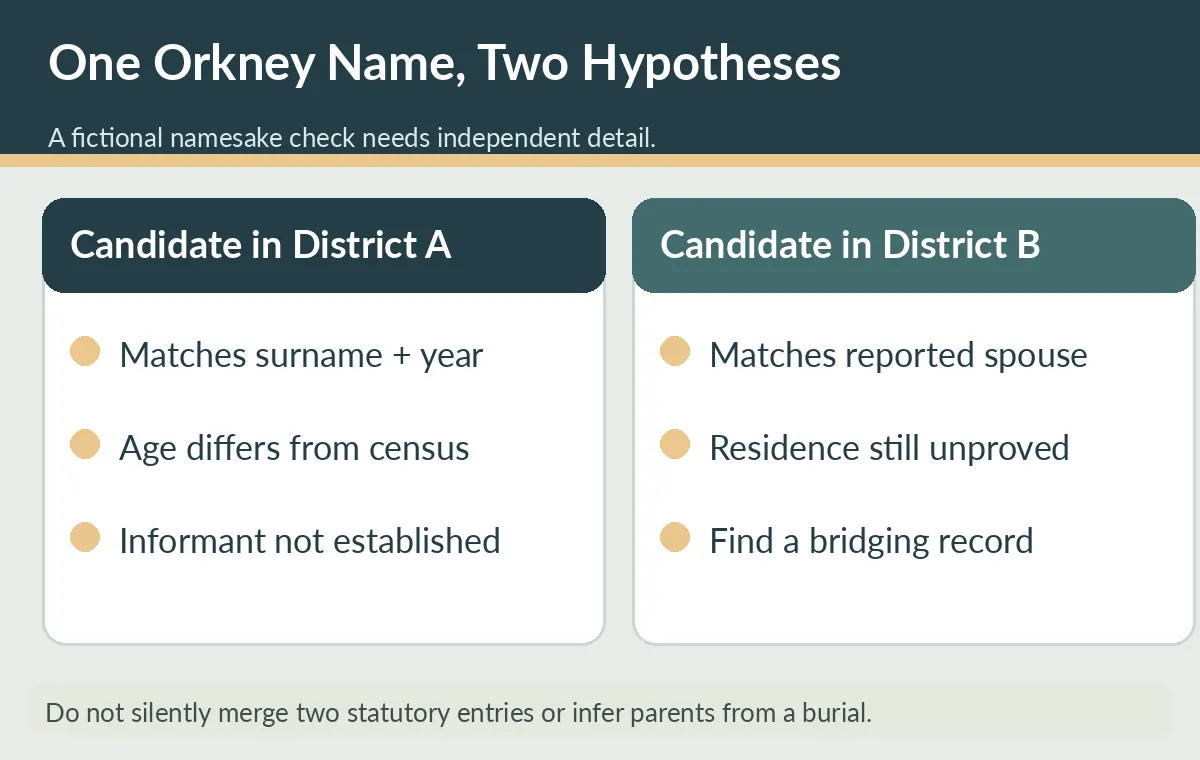
Consider a fictional search for two James Rendalls in different Orkney districts within a decade. One is the age expected from a census; the other shares a reported occupation. Neither single coincidence is a proof. Make a candidate table including age, district, spouse, recorded residence, informant, burial evidence and household history. When a record lacks a needed field, leave it unknown. Search intermediate census returns, a known marriage or a local notice to disambiguate, and write an explicit reason for rejecting each false candidate.
A family-tree entry may collapse the two people because one has the ‘better’ date. Resist that tendency. A statutory image supports one particular registered death; linking that death to an earlier child requires bridging evidence. Pre-1855 burial clues can establish that someone was buried in the parish but may not identify parents or even the death day. If no bridge survives, give the candidate as a hypothesis with a clear confidence level, rather than a complete pedigree. This also helps later researchers revisit conflicting accounts fairly.
Log the coverage gap and cite each layer of evidence
For a negative search, write down the parish or district, year range, spelling variants, database, original coverage check and date. An index with no hit is not the same as a parish volume known to be lost. If an alternative newspaper notice is found, preserve its title, issue date and page while describing the claim it makes. Maintain independent citations for a ScotlandsPeople index, its underlying register and any Orkney Archive document. If two indexes point to the same parish page, they are not automatically two independent witnesses.
Use the research note to record what would change your conclusion: a matching civil death informant, a probate identification, an exact churchyard plot record or a second household link. Distinguish a local archive’s catalog description from consultation of the physical item. Respect any current access limits, and do not invent page numbers for books not yet inspected. This guide is informational and contains no endorsed paid lookup. Review the GenHis affiliate disclosure if considering third-party services.
More Records and Archives Guides
How We Research This Collection
We checked the Orkney county guidance and statutory-death access policy on ScotlandsPeople, the NRS OPR survival and register guides, and Orkney Archive’s published holdings. Our date fork reflects separate record systems; pre-1855 mortcloth entries were deliberately not illustrated as death certificates. The same-name example is fictional, designed to demonstrate what independent evidence is still needed.
In 1855, under the Scotland-wide system of statutory registration.
Sometimes extra detail appears, but many entries are burial or mortcloth payments; do not assume the date is death.
Use the NRS Old Parish Register coverage guide and its detailed parish descriptions.
It identifies a candidate registered event; the original entry and outside identity evidence must be checked.
Its microfilms, newspapers and local collections may supply independent context, but do not replace a missing register.