
DeadFred’s Genealogy Photo Archive is a searchable collection of historic identified and mystery photographs, not an official register of genealogical relationships. Its homepage provides surname, detailed, mystery and keyword search routes. Search broadly, save the archive record and transcribe the original description, then compare dates, places, photographic features and independent family evidence. A caption can be useful without being correct. Do not copy a picture into a public tree merely because its surname looks familiar, and do not interpret an unlabelled portrait as proof of descent.
Search by surname, then branch into mystery and keyword routes
Begin at the DeadFred homepage and try the surname alphabetical list or detailed search for the known family name. Because surnames can be misspelled, anglicized or changed at marriage, record every variant you try. Use the keyword search for a known town, studio imprint, school, regiment or photographer rather than repeatedly guessing a forename. If a photo is anonymous, the mystery section may contain a matching location or family album context. Each search path is a way to generate candidates, not a certification of whom a picture depicts.
On a candidate page, capture the record reference, title or filename supplied by the site, caption wording, contributor information if available, the photo’s reported place and time, and the date you viewed it. Distinguish a place written on the back of the photograph from one later supplied by a submitter. Do not infer a family relationship merely because a surname appears in the caption. A broad keyword might retrieve another family with the same hometown, or even a studio label rather than the sitter’s actual residence.

Understand how the archive describes submitted photographs
DeadFred’s submission page currently asks for photographs taken before 1965 whose subjects are deceased and says only JPG uploads are accepted. The site’s older FAQ uses somewhat different cutoff wording, so the live submission terms should govern any actual submission; the discrepancy should not be silently resolved by inventing a single timeless rule. For a search article the crucial point is that contributions are described, curated and sometimes revised by people with varying amounts of identifying evidence.
An archive profile can include a reported name and age without an attached original birth record. A donor may have inherited an album from a distant relative, read handwritten pencil notes many decades later, or made a thoughtful identification without documenting the reasoning. Note the stated basis of identification when it is visible, and leave it unknown otherwise. A historical photo of a deceased person is not automatically free of copyright or donor conditions; verify permission, attribution and the permitted form of reuse. Avoid requesting information about living people merely to complete a speculative identification.
Compare sitter evidence without overreading photographic style
Make a comparison card with the face, clothing, studio mount, photographer’s location, handwriting, physical format, reported date and other people shown. Clothing and studio styles can suggest broad ranges but rarely fix a date on their own. A photograph taken in 1900 might have been copied, retouched or reprinted decades later. Compare both the age the sitter appears to be and the independent life chronology, while acknowledging that perceived age is subjective. The printed studio town shows where the portrait was made or processed, not necessarily the sitter’s birthplace.
A fictional example: a record is captioned ‘E. Thompson, 1898’ while family notes mention an Elizabeth Thompson in Wisconsin. There may be many candidates. Before treating the photograph as Elizabeth, seek a studio imprint associated with her residence, a dated letter referring to the portrait, an album page that identifies her siblings, or a demonstrable chain of custody. Similar hairstyles and family resemblance are insufficient, and an archive’s date may be an estimate. The outcome can properly remain ‘possible identification.’
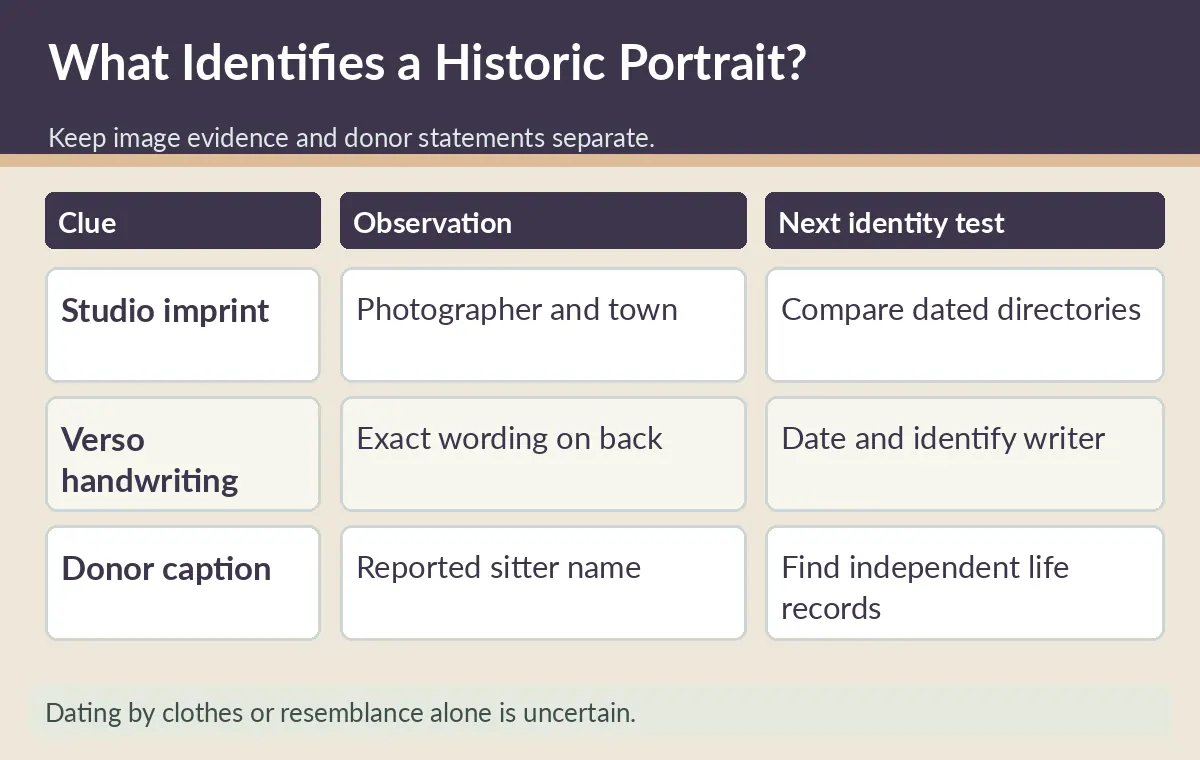
Keep the physical photograph and catalog metadata distinct
An online scan is a representation of a physical object that may have a verso, mount, sleeve or album ordering not visible in the uploaded image. Ask whether the contributor has transcribed writing from the back and whether the print is an original or a copy. A high-resolution scan can reveal faded lettering without proving the writer’s date or knowledge. Capture the archive’s exact record details and note what you personally observed on the image, what was reported by the contributor, and which physical features you have not inspected.
If a group image displays several surnames, create a separate candidate identification for every person rather than assuming the caption applies to the whole row. Where a caption gives only a surname, treat the event as unidentified. Keep copies of public descriptions for your private research notes where lawful, but do not remove site attribution or watermarks when sharing. An editor can create an original explanatory diagram of the investigation instead of reproducing a potentially restricted historical photograph.
What to do when a photo has no surname or has a false match
The archive’s mystery-photo pathway is useful when an album has a place, school or studio name but no confirmed sitter. Search those surviving clues, then compare recognizable backgrounds or inscriptions; do not submit a guess as a definitive identification. If several record profiles reuse the same image, ask whether they descend from one uploaded item or are independent physical prints. Duplicated digital copies do not independently corroborate a name. Record an archive record ID or stable locator before contacting the service so the precise item can be discussed.
If a matching surname seems wrong, make a short exclusion note explaining why: the photographer opened years after the relative died, the date window conflicts with a military service record, or the region differs without a documented migration route. Do not overwrite the original caption merely because your alternative story seems more interesting. An honest conclusion may state that the picture appears relevant to the family network but remains unidentified. That can still support targeted searches of a local historical society, directory or newspaper advertisement.

Preserve an ethical citation and understand contribution terms
Cite a DeadFred image using the archive’s name, displayed item description, record identifier or stable URL, any named contributor and the date viewed. Quote uncertain caption wording exactly and label any correction you propose as your interpretation. If the photo is reused under permission, include the agreed credit and a statement of what you have independently confirmed. A public family tree should not identify a living descendant who did not consent merely because a historical caption offers a potential connection.
If you intend to submit original family photographs, read the current submit page carefully. It states that mailed donations cannot be returned and become archive property, and it has restrictions on image type and eligible subjects. Do not send irreplaceable prints without considering those terms and keeping preservation-quality scans and associated back-of-photo information. A search can be free while rights to publish or redistribute a specific photograph remain restricted. Read the GenHis disclosure policy; no commercial endorsement is implied by this research guide.
More Genealogy Tool Guides
How We Research This Collection
We used DeadFred’s current landing page, FAQ and submission terms to document distinct search routes and limitations. Because the site currently phrases its photo date cutoff differently in two places, we recommend the live submission instructions rather than asserting a universal rule. The fictional Thompson example deliberately avoids identifying a real pictured person; the illustrated objects are conceptual and not reproductions of archive photos.
Use surname, keyword and mystery-photo routes, and record original place or studio clues.
No. Check the contributor’s information and seek independent documents or chain-of-custody evidence.
Its current submission instructions limit entries to historic photos of deceased subjects; read the current site terms.
Do not assume permission. Check ownership, terms, attribution and reuse rights for the specific image.
No. Place, photographer, inscriptions and album order can guide a targeted identification attempt.