
A rack of vacuum tubes and a technician near a test bench may look like a finished military communications system, yet an experimental photograph records appearance rather than performance. The National Archives describes 71 photographs of experimental electronic equipment in the Army Staff records, RG 319 series LP, dated 1956–1957. These photographs can help identify hardware or reconstruct a laboratory context, but they do not prove an invention passed its trials, entered Army service or was built by a named family member. Begin with the archival description and exactly what the image shows.
RG 319 also includes a larger series of communications equipment and other electronic devices under AESC, dated 1931–1957, as well as a CF file that contains personnel and data-processing scenes. The LP group is narrower and specifically labeled experimental electronic equipment. A modern illustration, manufacturer catalog or archive repost might use the phrase “Army electronics” for any of these. Retain LP and its item number in a working citation instead of borrowing an AESC description simply because the apparatus looks similar.
Choose an Archival Route That Matches the Claim
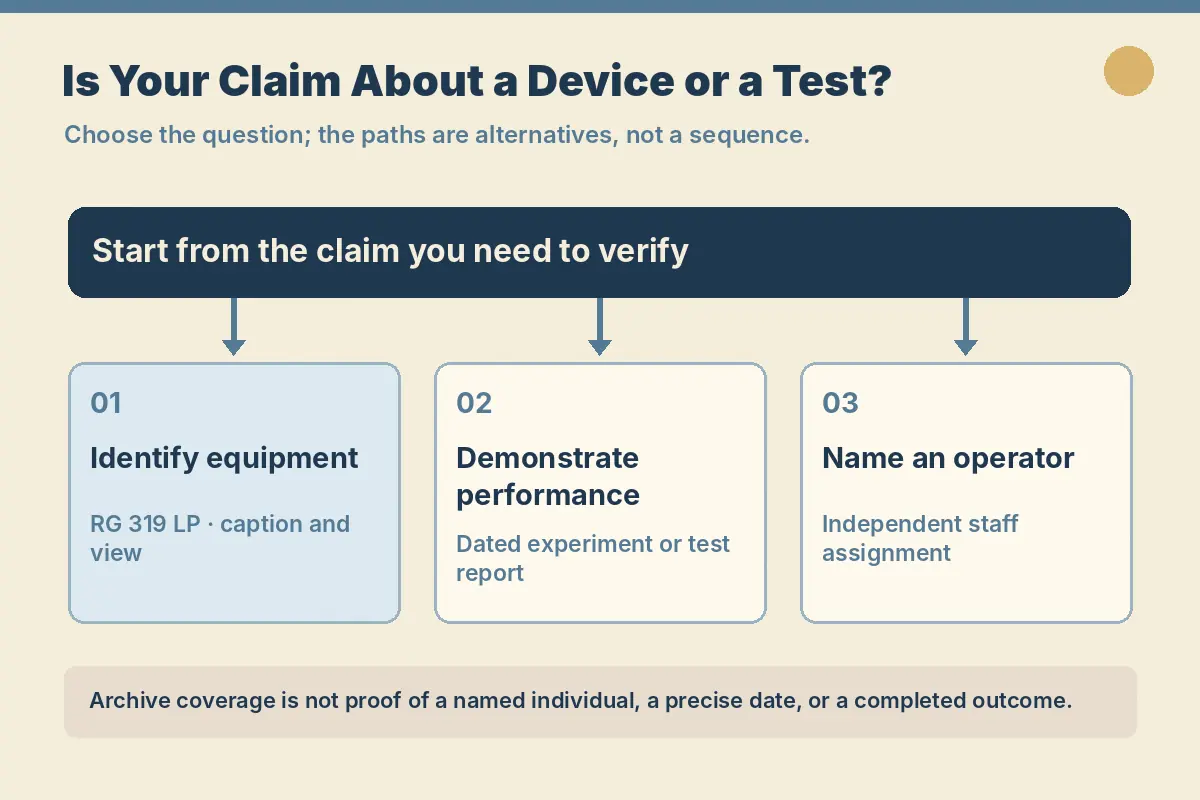
Start by identifying the question: is the object a prototype, did a trial meet a performance specification, or did troops eventually use it? An LP image may show the front panel, test cables, cabinets, dials or instrument layout. A test report is needed for measured accuracy, signal range, power draw or reliability, where those values were recorded. Procurement or unit records are required for later field use. A family claim that someone invented the system demands named laboratory correspondence, patent documentation or employment records, not a generic technician silhouette.
Read controls and labels cautiously. A photograph may have been staged for documentation and a metal cabinet may be only a housing without its final internal circuitry. A handwritten tag can be a laboratory number, a temporary experiment code or a later cataloging aid. Do not turn an unlabeled dial into a specific operating frequency; no photograph can measure performance unless the reading is plainly visible and its conditions are established. Keep a distinction between a visible feature and an expert’s possible technical interpretation.
The National Archives guide identifies 71 photographs in RG 319, series LP, for 1956–1957. That is series-level information. It is not an item-by-item inventory, proof that everything is digitized, or confirmation of a particular person. Record the archival hierarchy before copying a citation: repository, record group, series, actual item identifier and the original descriptive wording. A photograph, lithograph or publicity artifact may have been reproduced or annotated later; those later actions are not identical to the historical event represented.
Date the Source Before Dating the Historical Event
The 1956–1957 span applies to the described LP group; it is not necessarily the invention date of a component or the date a design first became operational. A tube style can have been used for many years, and experimental setups can be photographed again when equipment is moved. Separate initial design, photo exposure, test date, contract award and deployment date. If a serial plate or caption includes one of these, transcribe it accurately without silently interpreting it as all the others.
NARA’s Army Staff guide describes several organizations and types of records in RG 319, but it does not establish which laboratory operated every LP apparatus. Locate item-level captions first, then research the named command, contractor or staff office for the relevant year. Where there is a project title, seek dated correspondence, drawings, technical memoranda and test reports that actually reference it. A similar-looking device in a later handbook may belong to a related model rather than the specific photographed equipment.
Separate What the Image Shows From What It Suggests

Distinguish research claims from military history claims. A workshop picture can document an engineering activity; it cannot prove a communications unit employed the device in a particular theater. Likewise a laboratory photo may depict an evaluation unit rather than equipment accepted by procurement officials. Trace the test article’s identification, the outcome of the trial and a later acquisition or deployment record as separate evidence gates. A negative test result can be historically meaningful, and a lack of surviving report does not mean no test occurred.
A useful evidence matrix records RG 319, LP, the image’s exact identifier, any visible tag, what the caption calls the apparatus, its physical configuration and date confidence. A separate column lists the test or technical file that supports each performance claim, and another lists an unresolved alternate identification. This structure stops a modern search result from converting one monochrome equipment photograph into an entire technology biography. Preserve measurements only when a genuine source states their units and conditions.
Build an Independent Chain of Evidence

Suppose a family story says an ancestor perfected an Army radio device in 1957. The LP image first has to match the device and project in the story. Next, an original test report must show the claimed improvement, not simply the existence of experimental work. Finally, a signed engineering note, roster or other person-specific source must connect the ancestor to that project. Without the latter connection, the correct statement is that the Army photographed equipment associated with the topic, not that the relative designed it.
A reliable working note has two statements, not one. The first is what the RG 319 LP source directly records or visibly depicts, with all uncertainty retained. The second is a proposed link to a particular family, person, site, transaction, or period; it needs evidence created for that purpose. The same caption repeated in a blog, social post and archive index is still one source. Keep a list of rejected alternatives, and never turn an unsuccessful catalog search into a claim that a historical event did not happen.
Write the Final Caption With Clear Evidence Limits
A final caption should state the archival item and the identification NARA actually supplies, with disputed model names identified as tentative. Where no test file was consulted, do not write “successful prototype” or “issued equipment.” The instrument illustration on this page is original educational artwork rather than an LP archive image; its controls and schematic lines are intentionally generic. Researchers should check full-resolution original photographs and any related official paperwork before assigning engineering functions to particular parts.
Check physical context as well as web metadata. A clipped thumbnail can hide a caption, the edge of a building or an original image number. Download or request the fullest lawful reproduction available; transcribe actual inscriptions without silently correcting them. Mark approximate dates as approximate and label any identification supplied by a later cataloger. Keep a copy of the source description used for research because catalog records and access conditions can change. Explain clearly when a newly made illustration accompanies a historical discussion rather than reproducing an object from the named archive.
More Genealogy Tool Guides
How We Research Archival Images and Their Limits
We consulted the National Archives RG 319 record-group description for the creator, media, series designation, number of items and date range. The NARA Still Picture Branch guidance describes research paths for original photographic and visual holdings; the general NARA research guide helps track descriptions to records. The supporting images on this page are original explanatory artwork, not facsimiles of the archival sources. See our affiliate disclosure.
NARA describes 71 photographs of experimental electronic equipment dated 1956–1957 in the Army Staff record group.
No. The guide lists communications and electronic devices in AESC separately from experimental electronic equipment in LP.
No. A dated test report, not the photograph alone, is needed to establish performance.
No. Development, testing, procurement, and field deployment are separate stages.
Not necessarily. Names or employment must be established from item captions and independent staff or project files.