
Start With 46 Images and the Correct Archival Question
The National Archives describes 46 views in RG 77 M showing shore batteries, power stations, portable electric lamps, blast meters, and gun emplacements from 1893 to 1906. This is a small, mixed photographic series in the records of the Office of the Chief of Engineers, not a comprehensive inventory of all coastal defenses or a list of men who worked at them. For historical research, the first task is to identify what the camera recorded rather than attach an unverified military biography to a structure.
A single view can be unusually valuable when it shows a distinctive building, electrical apparatus, shore profile, or piece of measuring equipment. Yet the caption, photographed object, claimed location, and a soldier’s service are four separate claims. Record them in separate fields. NARA also describes a much larger RG 77 Activities File under A and AA–AL; do not treat that neighboring file as an additional chronological segment of the M series.
Locate RG 77 M Without Mixing the Activities File
The RG 77 federal records guide describes M as miscellaneous photographic prints and glass negatives with 46 views dated 1893–1906. The entry includes several kinds of subjects rather than one named battery or installation. Make the exact designation part of every inquiry, because a search for “engineer photographs” can retrieve a much broader A and AA–AL general collection. A topical similarity is not an archival series identification, and a photograph of a bridge in another grouping is not evidence from M.
Begin an item log with the record group, series letters, complete item or container reference, caption, physical medium, any marks on the mounting, and the source of the date. If only a derivative web image is available, label the reference provisional until the original caption and local identifier can be confirmed. You can ask the still-picture staff whether a series-level description corresponds to a full item list, contact sheet, or finding aid; never presume that all 46 photographs are freely digitized.
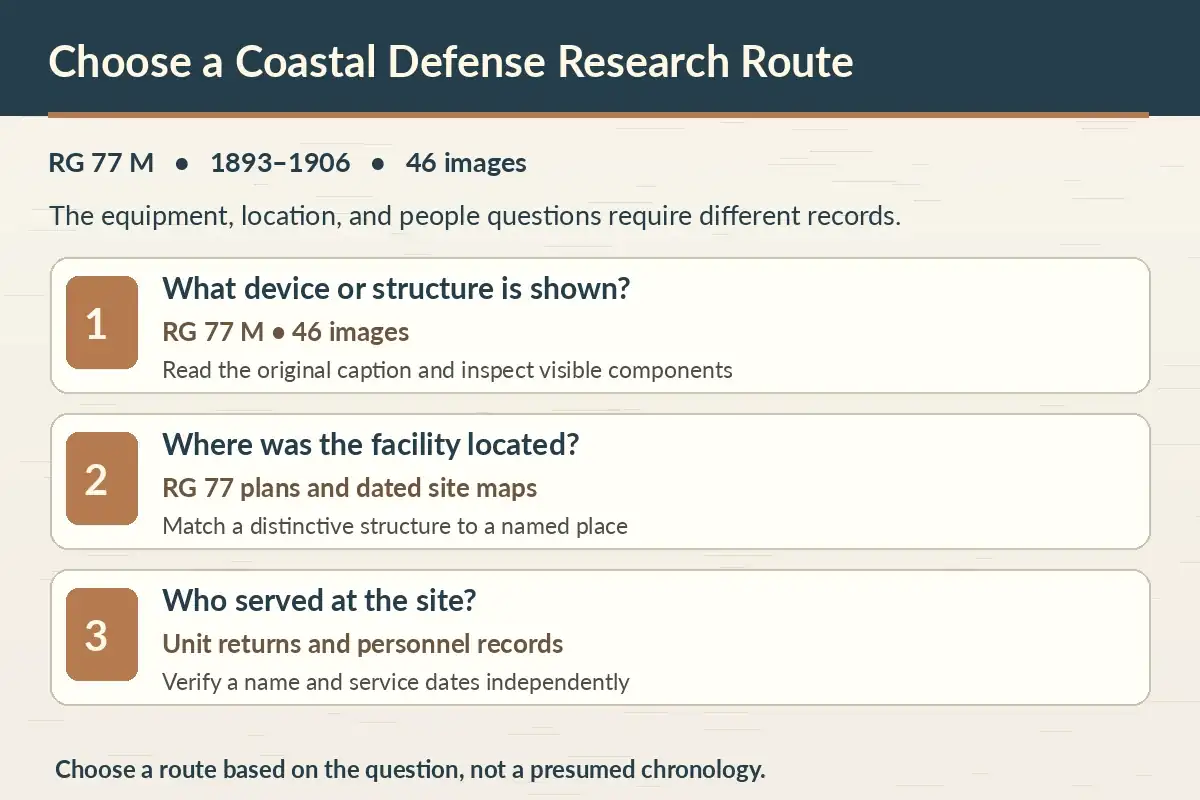
Distinguish Machinery Identification From Site Identification
An electric lamp or blast meter can be a study subject in its own right. Its presence in the same archival series as a battery does not prove that both objects stood at a single fort. Compare recognizable shapes, mounting points, engineering labels, and contemporary technical vocabulary only after you have the archive caption. The safe conclusion may be “portable electric lamp shown in an engineer collection,” not “lamp installed at a particular coastal battery.”
To identify a facility, turn to dated engineering plans, site drawings, harbor maps, or construction correspondence. These sources can establish a name or designed arrangement, but an undated plan may record a proposal rather than the finished installation. When several possible sites had similar electrical layouts, rank matches by independent landmarks and surviving architectural features. Keep unsupported guesses as hypotheses, not parenthetical facts quietly inserted into an image caption.
Read the 1893–1906 Date Range Correctly
NARA’s series dates describe subjects covered by the holdings and do not automatically date the exposure of each glass plate or print. An equipment view may have been copied, mounted, or compiled later. A caption may supply a year, while a plan may have an issue date and a later revision. These are separate timestamps. List exposure date, creation of the item, caption date, and later catalog date individually wherever the evidence provides them.
When an apparent site name or device type is tied to a particular year, test it with an independently dated document. One useful worksheet puts the photographic claim beside a construction entry and a map revision; use a blank when one date is unknown. Avoid assuming the earliest equipment illustration in a folder marks the year of installation, commissioning, or personnel arrival. It might document a test, a demonstration, a workshop, or a later reproduction.
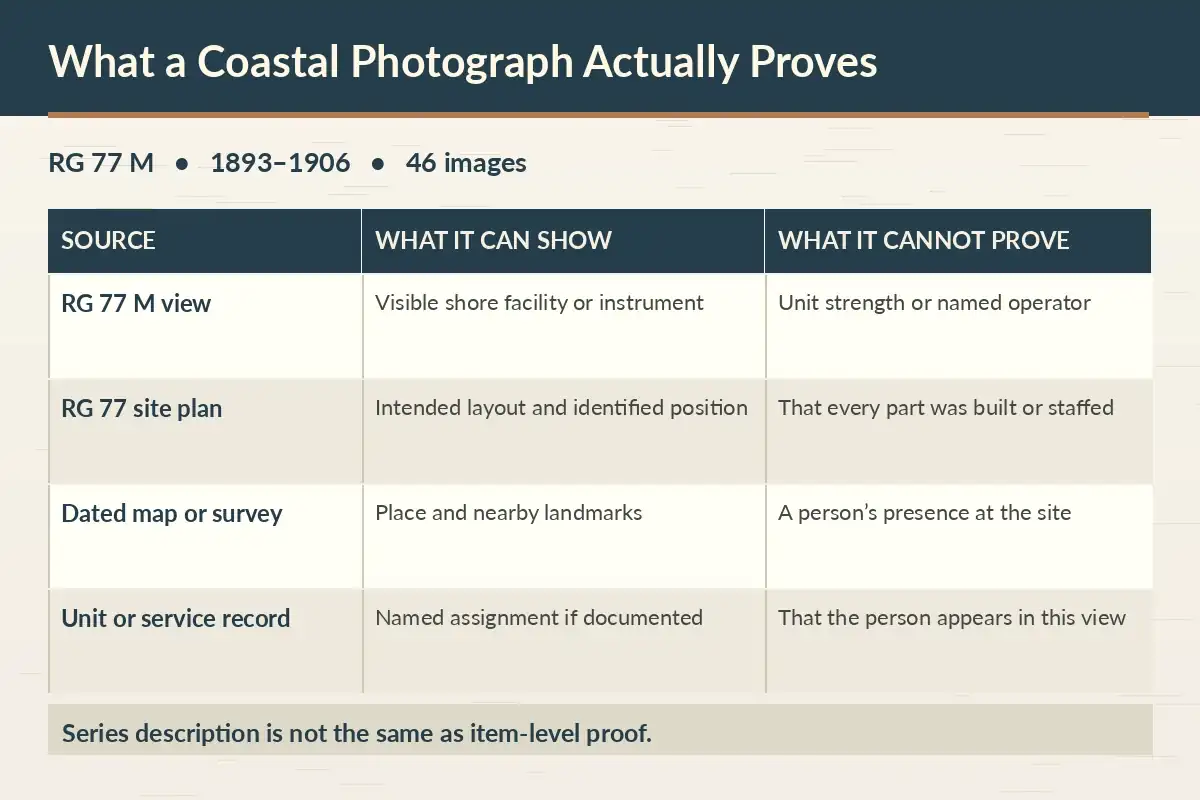
Use Plans and Engineering Correspondence as Conditional Evidence
An engineering plan answers how a structure was drawn or proposed; the image answers how something appeared from the camera’s viewpoint. A completion report, maintenance record, or measured survey can be needed to reconcile them. Do not draw a simple arrow from “plan” to “constructed” unless there is independent confirmation. A field photograph might expose alterations absent from an older drawing or might show an apparatus temporarily arranged for demonstration.
For a named installation, record plan title, drawing date, revision marks, geographic references, and the exact view orientation. Compare the shore profile and building proportions before asserting a match. If map coordinates and direction cannot be reconciled, report the unresolved discrepancy. The research benefit is still real: you have narrowed a broad equipment image to a smaller set of possible sites without presenting the best-looking match as certainty.
Investigate Soldiers and Workers Without Reading Faces as Names
Even when a photograph includes operators, the picture alone seldom gives full names or service status. Civilian engineers, contractors, visiting officers, maintenance staff, and enlisted soldiers may have occupied the same site at different times. Do not translate a uniform, a tool, or a probable duty into a proven assignment. Find a named return, muster, personnel file, pay document, or contemporary correspondence associated with the precise site and relevant period.
If family testimony places an ancestor at a coastal station, search alternate unit designations and nearby place names before comparing them to a photo. Separate “served in the geographic district” from “assigned to this battery” and from “identifiable in this image.” A surname match in a regional military record can be a research lead, not evidence of an exact camera appearance. The working ledger should show which part of the family claim remains unproven.
Write a Citation That Preserves the Evidentiary Limit
A publication-ready citation should identify the National Archives, RG 77, M series, the item reference and original title or caption if available. Add the viewing medium, date as established, and the repository or stable catalog identifier. The broad group guide confirms the series exists; it does not give precise titles or item numbers for every view. Avoid inventing these missing identifiers for the sake of a complete-looking citation.
Use restrained language: “A photograph cataloged within the 1893–1906 RG 77 M group shows an engineer-related coastal installation; a separate dated drawing is needed to identify its exact position.” When the correspondence and a unit return agree, strengthen the claim and cite those records as distinct sources. Preserve contrary observations, uncertainties, and alternative locations in the final notes so another researcher can reproduce the reasoning.

More House and Local History Guides
How We Research This Archival Collection
The factual series description comes from the National Archives, cross-checked against a second official or archival source and NARA item-level citation guidance on November 16, 2026. Series-level descriptions establish the scope and custodial context, not the identity of every person, the exposure date of every frame, or the existence of a digital copy. The illustrations and diagrams here are original editorial artwork, not reproductions of historical photographs. No unverified commercial services are recommended. Review the affiliate disclosure for the site’s general policies.
The federal records guide identifies 46 views in series M, covering shore batteries, power stations, portable electric lamps, blast meters, and gun emplacements.
No. The guide groups several subjects; the item caption and an independently dated site document must establish an exact location.
No. The larger general Activities File is separately described; it should not be cited as RG 77 M.
Not on its own. A dated named unit or personnel record is needed for the person-level connection.
Include RG 77, series M, any local item reference, caption, and the specific scene or equipment you are trying to verify.