
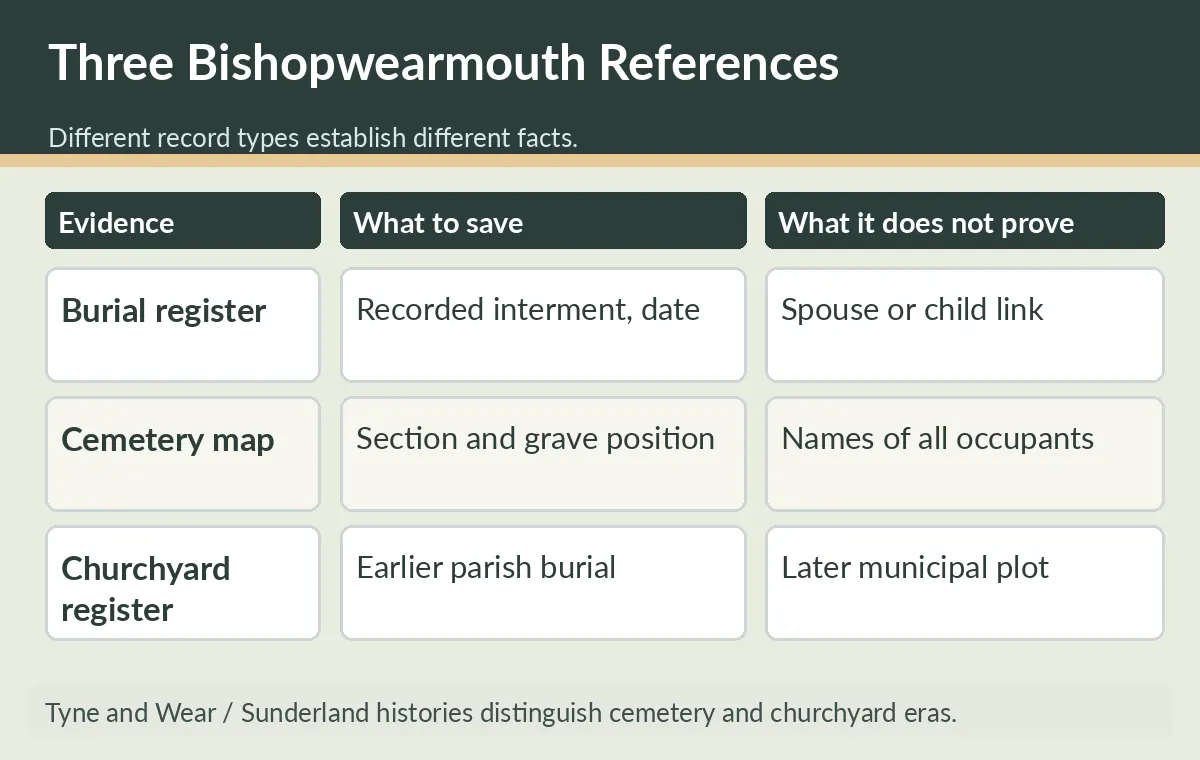
To find a person buried at Bishopwearmouth Cemetery in Sunderland, start with the Sunderland City Council family-history burial guidance. The municipal cemetery began receiving burials in the 1850s; an earlier burial may instead be in a churchyard, which requires a different keeper and record type. Obtain the exact cemetery, burial date and register reference before interpreting a map, stone or family story. A death record is not the same as a burial entry, and a cemetery entry alone cannot establish a relationship among people with the same surname.
Establish whether a municipal cemetery register is possible
Sunderland City Council explains that burials at Bishopwearmouth, Southwick and Mere Knolls cemeteries began in the 1850s. Therefore a death reportedly occurring much earlier cannot simply be searched in a Bishopwearmouth municipal burial ledger as though it covered every century. First record the deceased’s approximate death year and location. For an event before the municipal cemetery opened, investigate local parish churchyards and their custodians, not a modern cemetery name appearing in a later family note. An old family ‘buried in Sunderland’ tradition does not tell you which site received the remains.
Compare the event date with a death notice, parish entry or contemporaneous certificate where available. A marriage record that describes someone as ‘of Bishopwearmouth’ may indicate a parish or locality and does not establish eventual burial in Bishopwearmouth Cemetery. Avoid turning ‘Bishopwearmouth’ into one undifferentiated archive category. Write the form of the place name exactly as it appears in each source, then add the modern administrative interpretation as a separate note. This keeps the search aligned with the period in which the source was created.

Search the city burial records for the correct cemetery
The council family-history page directs researchers to cemetery burial records and describes a separate cremation register. Follow its current search route, keep the selected cemetery visible, and search known surname forms with a broad enough date range. A result from Southwick or Mere Knolls may be an important alternate lead, but it is not a Bishopwearmouth entry. Record each candidate’s displayed cemetery, name, date and any grave or register identifier rather than combining similar hits into a single family profile.
Write down whether a search result is an index record, scanned ledger or official extract; these sources differ in what can be independently verified. If the online service gives only a name and burial date, avoid inventing an age, parent or plot number. Where an original book can be consulted, note the volume and page along with the handwritten entry. If a clerk’s handwriting is ambiguous, compare neighboring entries and record alternatives. When you need more help, make a targeted enquiry specifying the cemetery, year, known name variants and the exact record needed.
Understand burial, death, cremation and plot rights
A civil death registration documents a reported death; a burial register records an interment; a plot-rights document records an administrative entitlement; and a memorial inscription records words chosen for a stone. These are different evidentiary objects. The same person can appear in more than one, but their dates and spellings may not match perfectly. Sunderland Crematorium opened in 1951, so references to an earlier ‘Sunderland cremation’ demand careful checking of where and when any cremation actually happened. Do not automatically associate crematorium entries with Bishopwearmouth graves.
A grave can contain multiple interments, and a purchased grave may have remained unused or later reused under applicable rules. A neighboring marker does not prove kinship. If a register gives a grave plot, transfer the identifier to the appropriate cemetery plan only after checking the section label. If a stone has the person’s name but the official interment cannot be located, record the stone as memorial evidence, not a fabricated burial. Ask which underlying register the council uses to clarify conflicts instead of relying only on a third-party transcription.

Differentiate a churchyard burial from a municipal burial
Before the 1850s, churchyard registers and monuments may be the relevant witnesses for Bishopwearmouth-area families. The church’s burial entry may use older spellings or reflect ecclesiastical boundaries that are not identical to today’s city neighborhoods. Find the historical parish or chapel of ease, confirm surviving register dates and ask the proper church or archive custodian for access. A parish burial book might cover several communities, while a modern memorial database might group stones by the present-day cemetery label. Keep the two collections distinct in search logs.
Consider a fictional ancestor remembered as ‘buried at Bishopwearmouth in 1838.’ The first action is not to scan cemetery plots. Ask whether family tradition actually means the Bishopwearmouth parish churchyard and identify surviving records for that site and date. A later burial of the ancestor’s child in the municipal cemetery could have inspired the confusion. Review local notices, parish material and documentary family chronology before drawing a link. The parish name is a jurisdictional clue, not a proof of interment in any particular modern cemetery ground.
Test two surname matches using dates and households
Imagine finding two George Taylors buried in Sunderland at different cemeteries within three years. Their common name alone is weak evidence, even if one grave contains someone of the same surname as your ancestor’s spouse. Rank each result by independent matching age, neighborhood, occupation, death registration and dated family notices. A person may have been buried in a neighboring cemetery while still being a long-term parish resident. Conversely, the chosen cemetery could reflect family preference rather than the person’s habitual residence.
Use a candidate table listing source wording, event date, repository, known fact matched and unanswered question. Mark relatives named only on stones as reported by an inscription until verified. If an obituary gives a funeral date, check whether the interment happened that day and whether the named cemetery is explicit. A difference of a day is not automatically an error: the event types and informants differ. Stop at a narrow, documented conclusion when the evidence does not permit a unique identification.
Request the correct document and preserve an honest citation
For a reproducible result, record Sunderland City Council as the cemetery-register source, the deceased’s name exactly as displayed, the burial date, cemetery, reference or grave identifier if supplied, and date of access. If you consulted an image, include the ledger and page. If you saw only an index, label it as such and do not pretend to have examined the original. For an early churchyard document, replace the municipal archive citation with the actual parish, register and custodian; those are not interchangeable collections.
A negative result should state the exact site, year range and name variants checked, then compare with the known 1850s start date. Check local churchyard records for older events, and city records for later ones as appropriate. If an interment record is located but family identity remains unproved, document the next test rather than converting the lead into a parent-child link. This article contains no paid lookup partnership; the GenHis disclosure page explains our policy toward third-party services.
More Records and Archives Guides
How We Research This Collection
We used Sunderland City Council’s family-history instructions to establish the mid-1850s cemetery threshold and 1951 crematorium date. We treat burial, civil death, churchyard entry, plot right and stone as separate sources, with a fictional two-candidate match to show the limits. Specific plot numbers are never invented; requests should use the references returned by the council’s own service.
Sunderland City Council places Bishopwearmouth municipal burials in the 1850s.
A burial that early likely requires relevant churchyard records; the municipal cemetery had not opened.
No. The council distinguishes them and dates the crematorium to 1951.
No. Use original interment evidence and independent civil or household documentation.
Council, cemetery, exact recorded name, burial date, reference if available, and access date.