
To trace a burial at Hanley Cemetery, do not start by assuming the city holds a surname-searchable grave index. Stoke-on-Trent City Council’s family-history guidance explains that Carmountside keeps burial lists for the city’s cemeteries in date order without a name index. Start by narrowing the likely burial date from a death registration or contemporary notice, then request a search of the relevant period and cemetery. A death certificate, entry in a burial ledger and physical marker each answer different questions.
Identify Hanley Cemetery rather than another Stoke burial ground
The council lists Hanley Cemetery at Cemetery Road, Shelton, Stoke-on-Trent, ST4 2DL. It also manages Burslem, Fenton, Longton, Stoke, Smallthorne and other burial grounds, so a family statement such as ‘buried in Stoke’ is not precise enough for a Hanley-only enquiry. Make a place worksheet with the literal place from the family source, probable cemetery, municipality and date of that statement. Distinguish residence, place of death, funeral church and place of interment; none automatically determines the others. A funeral advertised in Hanley might lead to another municipal cemetery.
The council’s Hanley Cemetery page describes earth burials, reopening of graves, cremated remains and a garden of remembrance. Those facilities do not imply that every memorial is a coffin grave or that cremated remains were buried in the same place as a person commemorated on a plaque. Write down the exact form of the event you are investigating: burial, ashes interment, scattering or memorial dedication. Historical arrangements can differ from modern practice, and a modern list of facilities must not be projected backward as a record of nineteenth-century events.

Turn an uncertain death date into a workable ledger search
The key obstacle is the order of the council’s burial lists. Because the registers are chronological without a name index, a request for all occurrences of a common surname across a century is poorly targeted. Establish a working date range using the General Register Office death index, a verified family document or a dated local newspaper funeral notice. A death recorded in one quarter does not provide an exact burial day; allow realistic time after death without inventing a fixed interval. Preserve the wording and dates of every underlying lead rather than reporting a guessed burial date as a fact.
Build a small search grid: person as named, alternative spellings, probable death date, source for that date, suspected cemetery and competing candidates. For a fictional Thomas Evans with a reported death in early March, a dated funeral notice can narrow the council search considerably more than an estimated birth year. Where the first window yields no entry, widen the window systematically, noting the dates actually examined. An unsuccessful request may reflect the wrong cemetery, date, name form or class of record; it is not proof that no burial took place.
Ask Carmountside for the specific entry rather than a family pedigree
Stoke-on-Trent’s family-history page directs burial enquiries to Carmountside Cemetery and Crematorium, the holder of the lists, and gives telephone contact instructions. In an enquiry, state the full recorded name, known variants, plausible burial-date interval, reason for associating the person with Hanley, and whether you need the burial-register particulars or a grave-location reference. Ask what parts of the chronological record can be searched and whether a copy or citation can be provided. Do not claim that the council offers unrestricted online images or a free comprehensive name lookup: its own guidance describes a different arrangement.
When you receive a result, copy the spelling and date exactly as provided. Record the authority, register or section if stated, the cemetery name and any locator supplied, and the date of the reply. If a clerk refers you to another Stoke cemetery, retain both the original question and the corrected site identification. The municipal record can document an interment without listing parents, household members or land ownership. A right-of-burial holder, if separately identified, is a distinct administrative role and need not be a relative of the deceased.
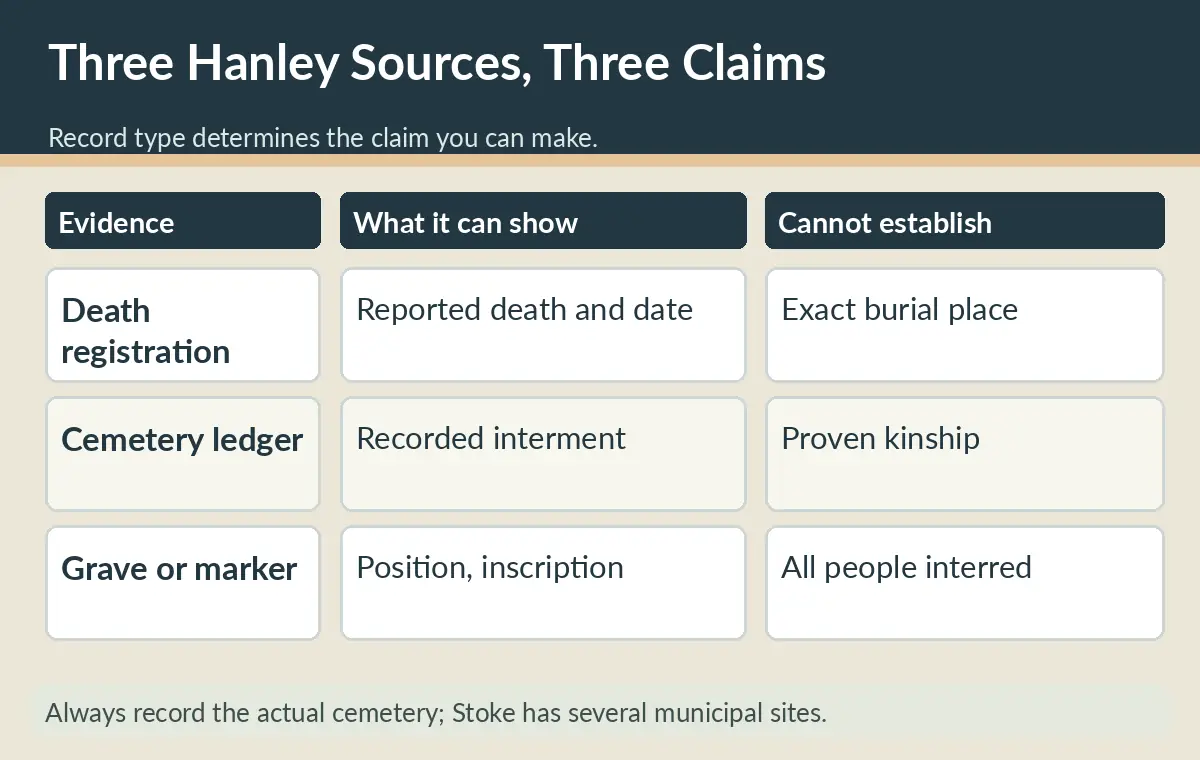
Separate burial registration, civil death and memorial evidence
A civil registration of death documents a reported death event and may identify an informant; a municipal burial register documents burial; a cemetery map identifies a physical position; and an inscription documents memorial wording. Even if all four concern the same person, they are not interchangeable. The year of a headstone dedication is not necessarily the burial year, and one gravestone can commemorate people interred in different places. If a grave holds more than one person, the placement cannot by itself establish that the occupants were spouses or children. Keep an evidence column for each separate proposition.
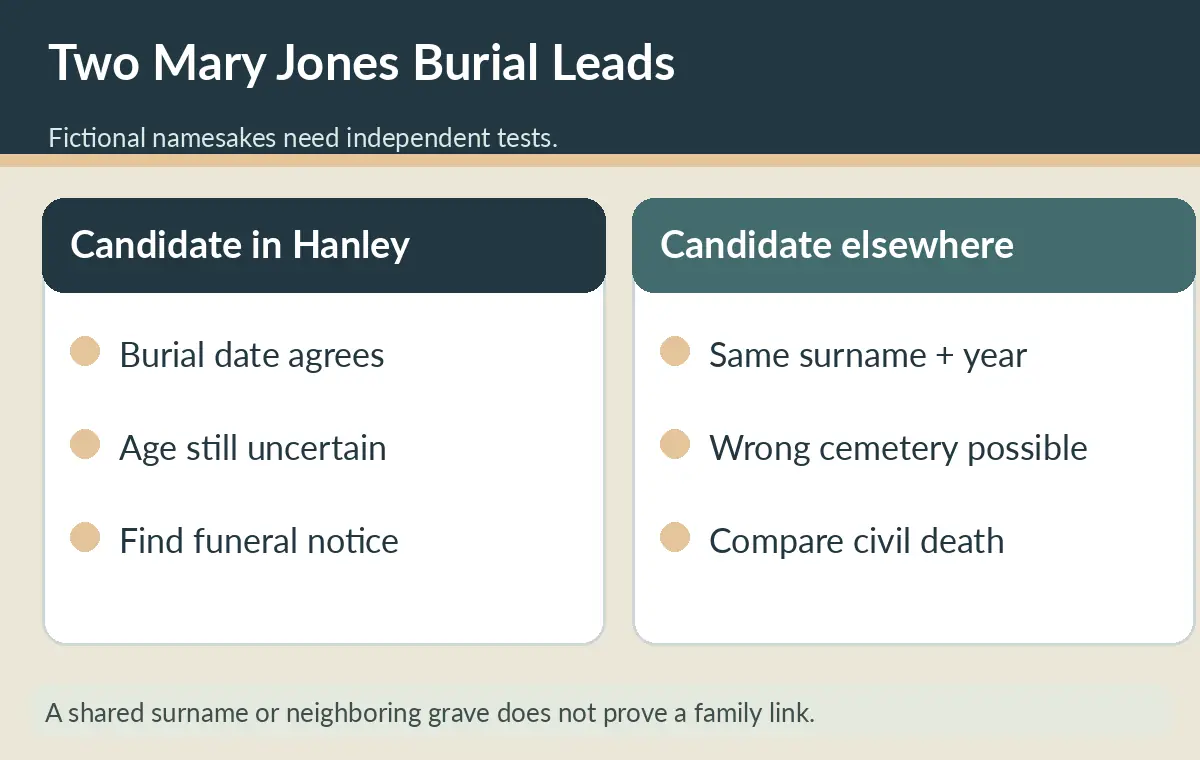
Suppose two women named Mary Jones have deaths recorded in the same year in the Stoke area. One council entry may be a tempting match because of the burial week, but age, former residence, spouse, family notices and a consistent chronology must distinguish the candidates. Draw two rows rather than silently joining the records. If you have only a clerk’s reference to a burial, say that the council reported it and preserve the date and search terms; do not claim you personally saw the handwritten original. A later record might resolve the uncertainty or might leave it open.
Use archives and church records for adjacent but different questions
For events before the start of central civil registration in England and Wales in 1837, parish registers may be more useful than a modern certificate service. The council’s family-history guidance distinguishes local registration from earlier Church of England baptisms, marriages and burials, many now held in archives. A churchyard burial may never appear in a municipal cemetery ledger. Check the event date and historical parish before contacting a church or archive; identifying an ancestor as ‘of Hanley’ does not guarantee burial at a named cemetery. Similarly, a chapel service is not always an interment record.
If the family moved between districts, consult nearby civil indexes, newspaper runs and directories to support the death-date estimate. Keep negative searches narrowly defined: ‘No entry reported for this surname at Hanley for this two-week window’ is stronger and more honest than ‘the ancestor is not buried in Stoke.’ Do not build a fabricated complete countywide cemetery database out of partial online lists. Where privacy or permission restricts access, limit the request to appropriately historic records and do not seek private details about living relatives.
Make the final Hanley claim retraceable
Write a citation that includes Stoke-on-Trent City Council or Carmountside as the responding custodian, Hanley as the specific cemetery, the entry’s recorded name and date, the register or grave reference if supplied, the medium consulted and the access date. Cite a civil record or death notice separately for the personal identity. Include competing namesakes in your notes and explicitly label unresolved questions. If you subsequently visit the grave, record the marker location and inscription as a separate observation, without treating it as an automatically complete list of interments.
A compact research summary can have three outcomes: the interment is located and independently linked to the ancestor; a likely burial is located but the identity is still uncertain; or the tested search window has no result and another cemetery or date range must be examined. Do not infer kinship from neighboring stones, presume cemetery ownership from an address or copy unsupported claims from memorial websites. No paid search provider is recommended here; see our affiliate disclosure for the site’s general policy.
More Records and Archives Guides
How We Research This Collection
We checked Stoke-on-Trent council’s date-ordered burial-record description against its separate Hanley Cemetery location and services page. The request path deliberately starts with an evidenced time window rather than promising name-search functionality. Our fictional examples are not real council entries; no grave locations or kinship links are invented. Check council search procedures again when submitting an enquiry.
The city council describes Carmountside burial lists as arranged by date without a name index; follow its current enquiry guidance.
Carmountside Cemetery and Crematorium holds chronological lists for Stoke-on-Trent municipal cemeteries.
No. The council manages several separate cemeteries; confirm the actual cemetery before assigning a site.
Not on its own. Compare a burial record with the memorial wording and any cemetery map or plot record.
Provide the best documented burial-date interval and the death record or notice that supports it.