
To investigate an ancestor said to be buried at Quinton Cemetery in Birmingham, start with the city’s municipal cemetery-search guidance. Search by the deceased’s name and a defensible date range, then record the burial date, cemetery identification, and register or grave reference if returned. Birmingham also holds microfilm indexes to municipal burial registers at its library. An index hit supports an administrative record candidate; it does not yet prove which modern headstone marks the grave or whether names on a monument belong to a single family. The useful next step depends on whether you need the burial entry, a mapped grave position, or a separate identity check.
Start with the Birmingham-wide burial search
The Birmingham City Council 2017 announcement identifies Quinton among the council cemeteries covered by its citywide burial and cremation database. The city described name, cemetery, and year filters, with free basic searching and additional record access subject to charges. Access arrangements and prices may change, so use the live service rather than relying on a historic fee quoted in an old guide. The council’s present Quinton Cemetery page links researchers toward cemetery records; it should be treated as the authoritative navigation point when an older deep link fails.
Begin with the person’s full recorded name, but do not require every possible detail at once. A woman may appear under a married surname not found on an earlier census; a child may have a shorter given name than in a family memory. Try an approximate year and then broaden both the name and the date. If the citywide service returns several Quinton candidates, record each separately, including any reference numbers rather than silently picking the first. Check whether the record describes burial or cremation, and keep the event type exactly as supplied by the database.

Follow burial-register numbers through library holdings
According to the Library of Birmingham’s burial guide, it holds microfilm copies of the indexes to burial registers of the city’s municipal cemeteries. An index typically gives the deceased’s name, burial date and register entry or grave register number. That reference is a retrieval aid, not automatically a section-and-row location for walking to a modern grave. Note the exact type of number and the issuing institution, since a register entry number and grave plot number can refer to different filing systems. Request the corresponding register information when you need to confirm an ambiguous identity.
A burial register commonly answers when and where an interment was recorded; a civil death certificate has another evidentiary purpose. If a record lists a person whose age disagrees with a family tree by ten years, compare more than the surname before declaring an index mistake. Obtain independent information about residence, spouse, occupation, or a dated newspaper funeral notice if available. A register may not contain every such detail, and its limited scope should be acknowledged. Make a small source log showing which entry was searched, what was read firsthand, and which fields remain unavailable because the underlying image was not inspected.
Move from a burial to the cemetery section map
The Quinton Cemetery site page says section maps are available in leaflet holders outside the office. A map is the correct companion to a documented grave plot reference, not a substitute for the identity check. On a visit, locate the cemetery’s relevant section first, then approach individual graves without assuming that contemporary path names or plot numbering existed when an older burial occurred. If the site is difficult to access, ask the cemetery office about the appropriate location documents rather than tracing a straight-line position from an unrelated online mapping service.
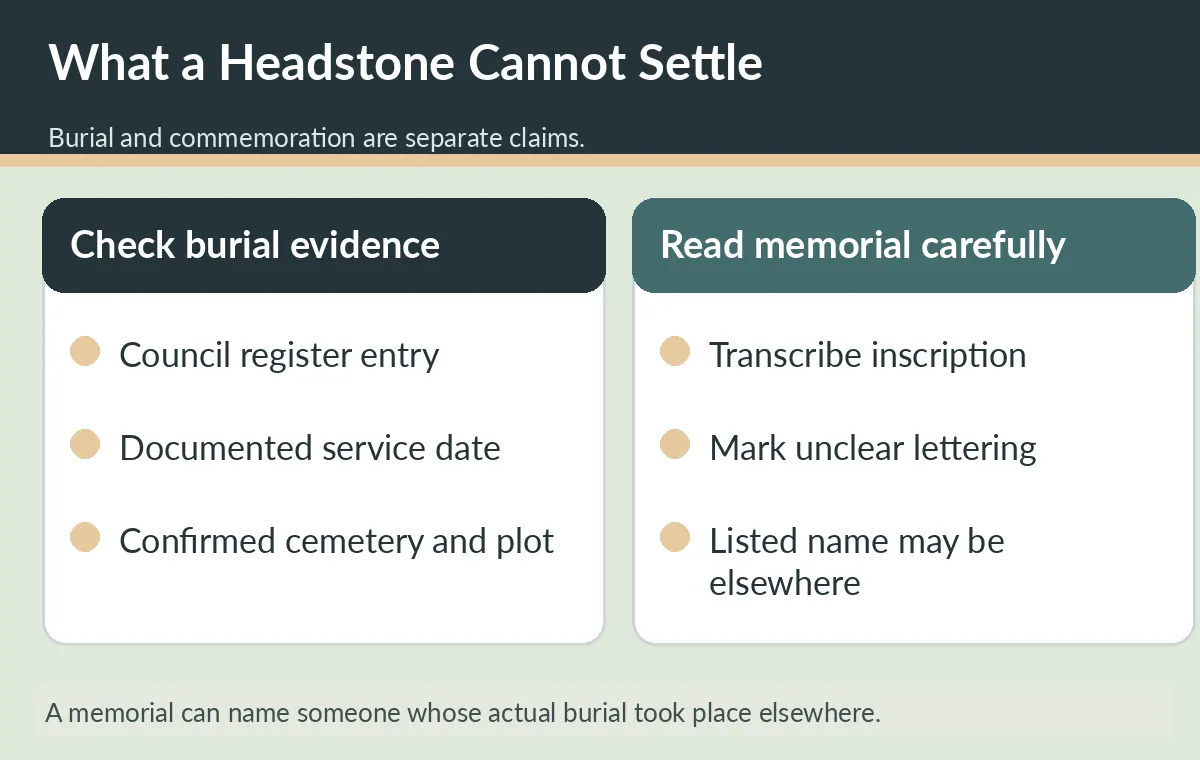
A grave may have no visible headstone, or it may display a later replacement marker. The council’s research guidance explicitly cautions that a person commemorated on a gravestone might not be buried in that grave. Record the exact words of an inscription and treat its named people as commemorated individuals until the burial register verifies their interment. Equally, absence of an inscription is not evidence that the council lacks a burial record. Photography, if undertaken, should respect cemetery rules and visitors.

Reconcile Quinton with churchyard and cremation possibilities
Quinton is only one possible burial location for someone who lived or died in western Birmingham. The city tracing guide distinguishes church burial grounds, municipal cemeteries, burial grounds of specific faiths, and crematoria. A death certificate can identify a final residential address, but an ancestor need not have been buried at the nearest ground. Families also reused plots in other neighborhoods. Before searching only Quinton, write down how the cemetery attribution arose: original funeral notice, family memory, a map, or a modern user-submitted memorial.
When the Quinton index is negative, enlarge the geography and explain the alternative: a service might have been held in a parish while interment occurred in a municipal cemetery, and cremation records follow separate administration. The Library of Birmingham provides related resources and can help identify the custodian of historic material. Keep an original death announcement distinct from a much later online transcription. A missing result after one surname query is a search outcome, not a formal negative-evidence argument about all Birmingham burial records.
Document a namesake decision before merging identities
Suppose two fictional Thomas Bennett entries appear in Birmingham’s database within five years of one another. One family lived near Quinton, but both men have a plausible age. First record each burial date, specific cemetery, available register number and any associated address, keeping the records separate. Then compare independent civil registration and household records against both. If only one matches the documented spouse and residence, state the reason with a citation. If both remain plausible, label the conclusion unresolved rather than using the geographical convenience of Quinton as decisive proof.
The same discipline applies when a photograph shows multiple Bennett names on one monument. An inscription establishes wording and commemorative intent, but does not make every listed person a confirmed burial, nor does it demonstrate how they were related. Where you can get a cemetery map and register copy, cite each document at its own granularity. A robust Quinton conclusion identifies the person, the burial-entry reference, the grave location if verified, and the evidence supporting any relationship written in a family narrative.
More Records and Archives Guides
How We Research This Collection
We distinguish the live council cemetery search from the Library of Birmingham’s historic microfilm indexes and the physical grave map. We record the exact reference type, the record’s event date, and the evidence needed to match a person rather than a name. The Quinton workflow never assumes that an inscription proves burial or that a municipal record covers nearby churchyards. Older fee announcements are used as historical background, not as a current price promise. See our affiliate disclosure; the governmental sources are cited for research rather than promotion.
Start from Birmingham City Council’s cemetery directory or tracing-a-burial guidance and use its citywide burial records service.
It can indicate a burial-register entry or grave register reference. Establish the kind of identifier before using it as a map plot number.
The council says cemetery section maps are available near the cemetery office. Verify an individual plot reference before visiting.
No. The Council warns that stones can memorialize people buried elsewhere; verify the individual burial entry.
Review spelling and date limits, then search other Birmingham cemetery, churchyard, or cremation sources as justified by the evidence.