
For a burial in Lower Hutt, New Zealand, begin with the Hutt City Council cemetery search, then compare the entry with the burial register and the mapped grave. Taitā Cemetery opened in 1892; its Old Monumental area and later Lawn Cemetery do not describe a single undifferentiated burial ground. The Council holds burial registers dated 1892–2003, but warns of gaps in early records and errors introduced during a system migration. An apparent namesake is a search candidate, not yet the ancestor. This guide shows which record to request next and which claims each document can support.
Identify the Old Monumental or Lawn Cemetery area
The Council’s historical description says Taitā’s first recorded interment was in March 1892; some of the earliest burials were not entered and registers have gaps. It identifies the original burial ground as the Old Monumental Cemetery, while a new Taitā Lawn Cemetery section opened in 1952. That is a useful chronology, not a rule that every later interment belongs to the lawn. Existing plots may receive subsequent burials, so the actual section and plot designation must come from the particular record, not from the year alone. Keep the old and lawn names in your search notes rather than standardizing them away.
Read the location in a search result exactly as returned, including section, block, row, or plot if provided. Match it against the Council cemetery map, which is an aid to locating a site rather than independent proof of every person in the grave. A family memorial can commemorate someone buried elsewhere; a plot may contain successive interments of people whose relationship remains unproved. If the person died before 1892, do not force a Taitā match. Look instead at the churchyards and other local burial grounds mentioned by the Council, taking care not to assume that a later compiled index is an original burial register.

Read the burial register before building a family claim
Hutt City states that its historic burial registers span 1892–2003. An entry may record the deceased’s name, age, address, occupation, birth or death date, funeral service date, grave location, religious community, or officiant, but not every entry has every field. Work from what is actually present on the individual image. Make a two-column transcription: literal wording on the left and carefully marked interpretations on the right. If the writing is ambiguous, retain a question mark and capture the surrounding register context rather than choosing the most familiar family spelling.
A burial-register date may reflect a service rather than the date of death. Compare that date to a New Zealand death registration, newspaper notice, or other independent record. A recorded address can identify a residence reported to the office, but does not prove ownership of that address. A religion or officiant does not independently establish lifetime affiliation. Keep the date of death, service, register entry, and monument inscription separate in a research log. They may legitimately differ by several days or many years depending on when a later memorial was installed.
Use plot grants without treating a payer as a child
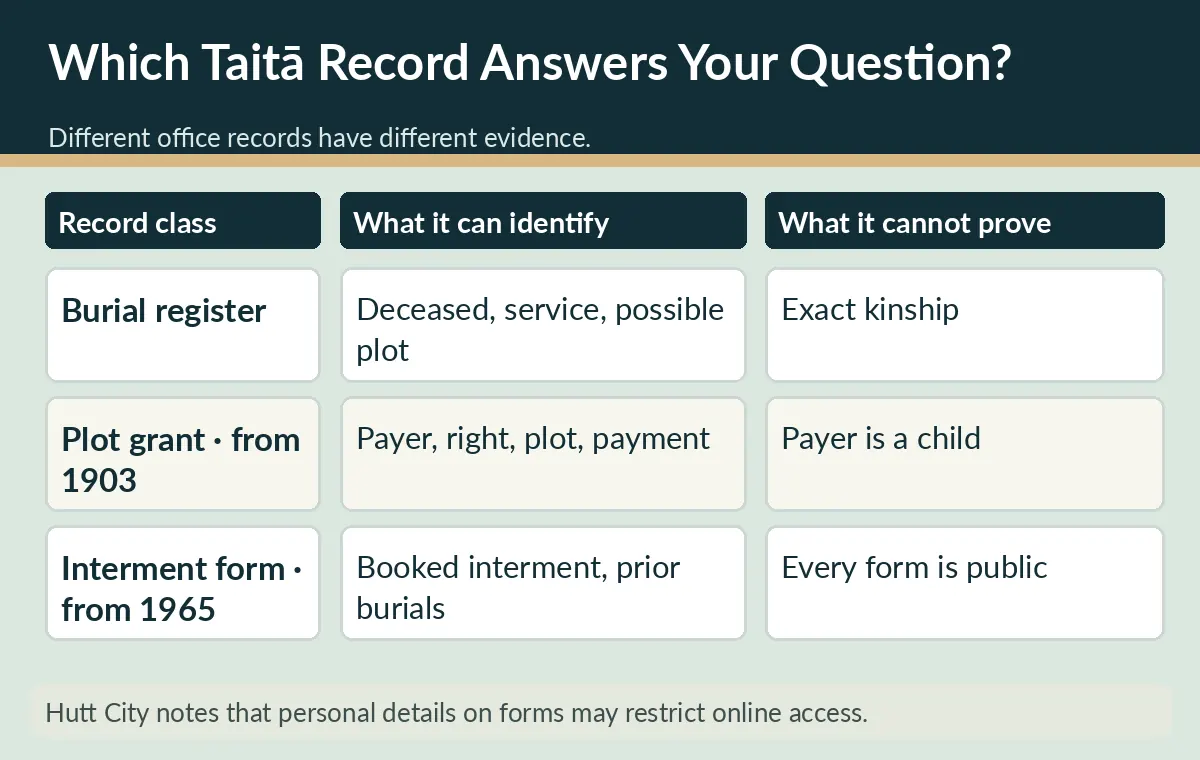
The Council describes plot-grant or plot-lease records beginning in 1903. A grant may name the payer, payment date and amount, grant number, and plot location. The payer may often be next of kin, but the record does not, by itself, specify the relationship. It is also possible to buy a plot in advance or settle fees after a funeral, so the grant date need not be the burial date. Record the payer’s name as a separate identity and seek a certificate, estate file, or another primary record before assigning the word ‘son’, ‘wife’, or ‘daughter’.
Do not assume every lease form is openly viewable: the Council says forms containing personal information are not freely available online. Its interment booking forms began in 1965 and may contain a next-of-kin contact or previous burials, but these too are restricted and vary over time. When requesting historical assistance, provide the deceased’s name, any known dates, grave location, the grant number if known, and the specific historical question. Avoid requesting details about living contacts that you do not need. There may be a distinction between what the Council holds and what it can release.
Recover missing names from local burial sources
A negative online search is not decisive in Lower Hutt. The Council expressly notes early register gaps and data-migration errors, and allows corrections to be reported with evidence. Try forename variants, family-name variants, an approximate death period, and a search without middle names. Check the Council’s historical alphabetical index compiled in 1965 and continuing to 1981. It includes names from some closed local cemeteries; the Council cautions that it does not hold the underlying original registers for those other Hutt Valley burial grounds. Treat a compiled citation as a route toward its stated source, not as an interchangeable burial certificate.
The former churchyards listed in the Council’s guidance include St James at Woburn Road, Christ Church at Taitā, and several other local grounds. A death notice may mention a funeral service or cemetery, while a headstone transcription may supply a memorial inscription. Neither necessarily demonstrates an actual interment in the named plot. If the person seems missing, write down which jurisdiction, period, spelling, and collection were checked. This makes a later follow-up useful instead of repeating the same broad name search with slightly different assumptions.
Test two people who share one surname
Consider a fictional example: two people named Ellen Fraser appear in Lower Hutt records, one with a burial service in the 1920s and another several decades later. The repeated name is not evidence that one record belongs to your ancestor. Construct an identity table with each person’s age, address, occupation, death date, register details, and the people named in independent civil or newspaper evidence. A close burial year may seem persuasive until you discover that the address belongs to the other household. Keep both candidate files open until a distinguishing detail eliminates one without contradiction.
If a memorial lists several Fraser surnames, transcribe its wording but leave the relationship column as ‘not proved’ unless another record identifies that link. ‘In the same plot’ and ‘member of the same family’ are different propositions. Likewise, the Services Cemetery and memorial-only options described by the Council mean a memorial location cannot automatically be interpreted as a body burial. A research conclusion should cite the individual register entry and explain any remaining uncertainty about physical location, memorialization, or identity.

More Records and Archives Guides
How We Research This Collection
We start with the Council’s cemetery history to establish the 1892 and 1952 context; check the online record against an image of the underlying register where available; and distinguish burial registers, grant books, and interment forms by what they were designed to record. For a contested identity we compare age, locality, and independent death evidence, preserve the original spelling and separate dates, then record a source-specific negative search when the register is incomplete. Our examples are hypothetical and do not describe identifiable people. For commercial transparency see our affiliate disclosure; the Council resources named here are cited as primary research links, not as paid recommendations.
It opened in 1892 and the Council identifies a first recorded interment in March of that year. Some early burials are unrecorded, so coverage is not complete.
No. The grant identifies a plot right and often a payer; the burial register concerns the deceased and service. The payer is not automatically a proven relative.
Start in the Council search, then record which section the individual result identifies. The Lawn section opened in 1952, but later burials can occur in older plots.
An early gap, transcription or migration error, spelling variation, or a burial at another cemetery can explain a negative result.
No. Hutt City describes memorial-only options. Verify whether the record states interment, ashes, or memorialization before making a burial claim.