
Use the Gisborne District Council cemetery search to find a Taruheru Cemetery entry, then check its plot in the Council’s Taruheru cemetery explorer. The council offers both a text search and a map-oriented route and warns that some historic entries may be incomplete or contain errors. A listed name, an optional headstone inscription, and a plotted site are three separate observations. They can support a burial identification, but do not alone establish a maiden surname, family relationship, or verified civil death date.
Select Taruheru rather than a different Gisborne-area cemetery
The Council database covers Taruheru as well as Makaraka, Ormond, Patutahi, Rakauroa, Motu and several coastal cemeteries. Starting with an unfiltered surname can surface a nearby but incorrect burial. Set the cemetery to Taruheru when a family source names that location and keep the cemetery field visible in every copied result. If no match appears, test broader Gisborne coverage only as an explicit second step. The Council’s earliest database records date to 1877 at Makaraka; that statement should not be misquoted as the opening year of Taruheru.
Use the council’s name search and inscription terms independently
The official cemetery database can be searched by surname, given name and, where available, words from a headstone inscription. First search a family name with spelling variants; then use a distinctive inscription word as a separate clue, not as a guaranteed part of every record. Inscriptions may commemorate another person, may be partially illegible, or may not exist at all. Write the displayed name and any administrative record identifier before attaching the result to a tree. Avoid assigning a relationship based only on two names appearing on one memorial.
Open the Taruheru plot explorer after finding a credible hit
The Taruheru explorer organizes plots by blocks and location codes. Use the block or plot reference returned by the text record to navigate the matching section, or start with a known plot number if a historical document supplies one. The plot map is a spatial reference; a mapped square does not promise a headstone, and a number may designate a memorial or ashes space rather than a standard grave. Capture the full block and plot expression before following a map link to prevent confusion between similarly numbered blocks.

Keep death, funeral, burial, and inscription dates separate
A family tree often collapses the date of death, a newspaper notice, the funeral service and the burial into one “death” event. A cemetery entry may specify some of these but not all, so copy each field with its own label. Where an inscription gives an age or death date, it may reflect family wording installed later. Seek the New Zealand historical death registration or a dated obituary to corroborate. A difference of a few days may reflect ordinary funeral timing; a difference of years or names warrants investigation, not automatic correction. For the next step, our guide “New Zealand Cemetery Records” explains how to find a burial and verify the grave.
Cross-check the person using newspaper and electoral evidence
Gisborne District Council recommends checking funeral directors’ papers, death notices, electoral rolls and New Zealand Society of Genealogists transcripts when the cemetery data is uncertain. Such sources have different provenance. A funeral notice may establish the announced location, an electoral roll an approximate earlier residence, and a civil death registration a recorded event. Do not convert the overlap of surnames into parent-child proof. Write a short evidence table with the source date, exact name, reported place and whether the statement was contemporary or added long afterward.

Treat historic transcription problems as a search-recovery issue
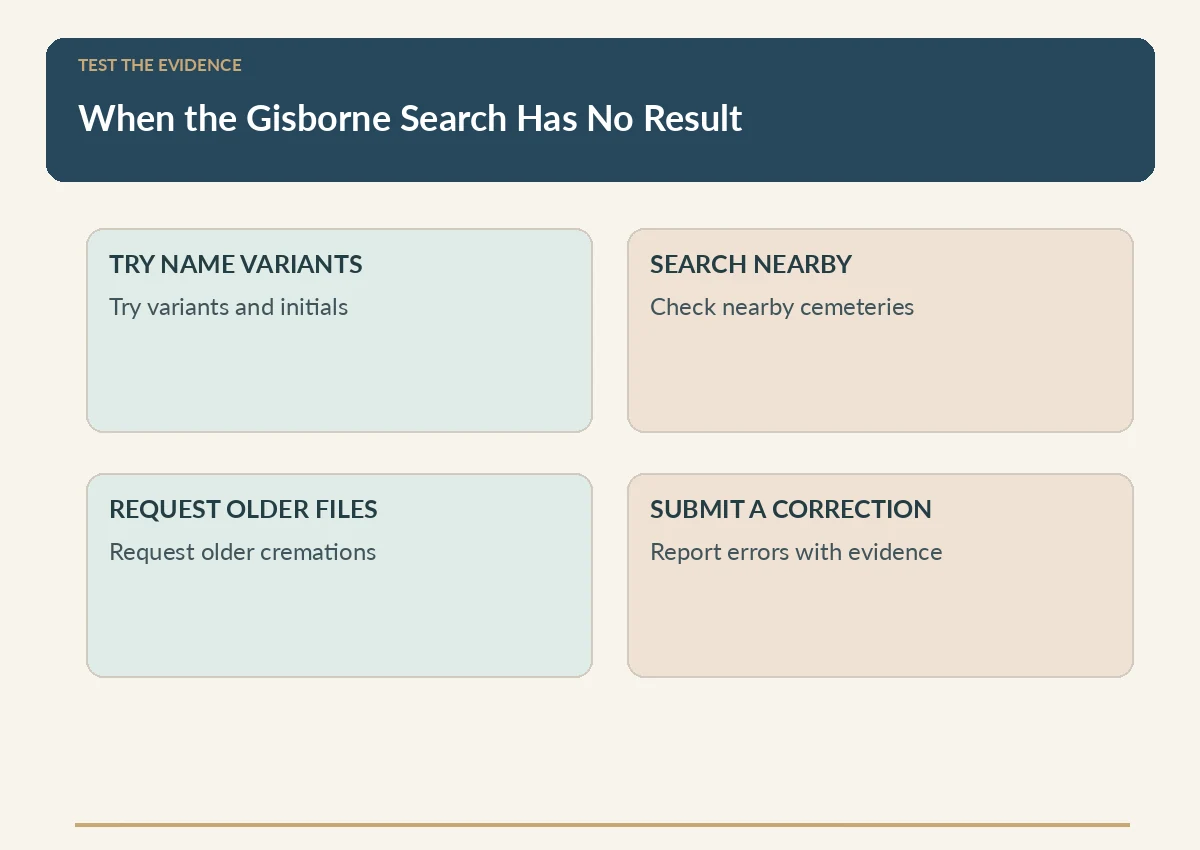
The Council expressly warns that historic cemetery records may have omissions and errors. If a surname yields nothing, search another spelling, initials, known plot code or inscription keyword. Broaden to the other Gisborne-area cemetery listings only after recording the Taruheru-specific attempt. Try earlier or later death dates and nearby service dates as appropriate; some index values are transcribed inaccurately. A no-result response should be logged with the actual filters and date checked, not treated as proof that the deceased was buried elsewhere. For a related choice, see our guide “Abney Park Cemetery Records”.
| Search result | Evidence available | Do not infer |
|---|---|---|
| Name database | Indexed cemetery entry | Proven family relationship |
| Headstone image | Visible inscription | Civil death registration |
| Block-and-plot map | Administrative location | Existing readable marker |
Know the difference between a memorial and a mapped burial
An inscription can mention a loved one whose remains are somewhere else. A shared grave or a neighboring plot can hold people who are not biological relatives. Conversely, a public interment record may exist even if the stone has disappeared or no photograph is supplied. When the council shows a headstone photo, compare its lettering to the text transcription and record uncertain readings. Keep memorial wording, administrative burial data and independently verified civil details in separate columns so a plausible but unsupported family connection is not accidentally treated as proven.
Ask for older cremation records or corrections through the official form
The Council notes that cremation records before April 1998 may require a request rather than appearing in the regular public search. It also provides a correction or information request form for missing entries, asking for supporting evidence. If your research depends on an omitted date or a disputed spelling, provide the person’s name, likely event date, and a citation to the corroborating death record rather than an unsourced online pedigree. Current response times and available copies can change; use the official service page rather than promising an immediate or guaranteed result. Our guide “St Kilda Cemetery Records” covers a related question.
Save an exact citation and a map verification record
For a reproducible reference retain “Gisborne District Council Cemetery Database,” the Taruheru filter, the indexed full name, dates, block and plot code, any displayed inscription, and the date accessed. Cite the map explorer separately if it supplies location information beyond the name result. If the search used a memorial photo, label that observation as a photo of a marker, not proof of the original burial event. Another researcher should be able to repeat your query or know precisely which council entry you requested when a detail is corrected. Our guide “Te Henui Cemetery Records” covers a related question.
More Records and Archives Guides
How We Research the Taruheru records
We checked the Gisborne Council search instructions, the active name and inscription search, and the Taruheru block-and-plot explorer. We explicitly separated the Makaraka earliest-record date from Taruheru’s own coverage and the pre-April-1998 cremation request pathway from ordinary burial hits. No commercial memorial service is endorsed here. Our affiliate disclosure describes the site policy.
Yes. Gisborne District Council provides name and inscription searches with a cemetery filter.
Yes. The official cemetery explorer lists blocks and plot identifiers with map options.
No. The Council warns that historical records can contain omissions and errors.
The Council directs researchers to request those earlier cremation details through its records service.
No. It is memorial testimony; check civil, newspaper, and other contemporary records before asserting kinship.