
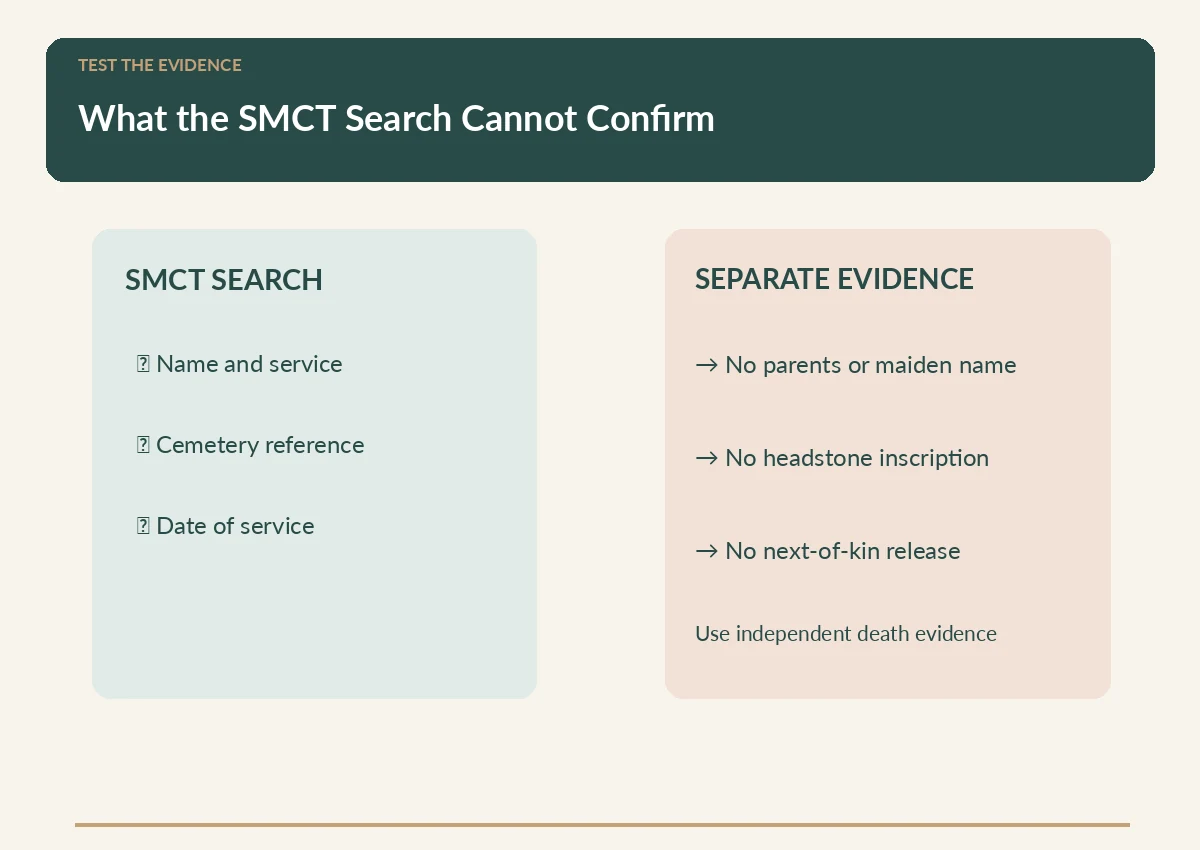
St Kilda Cemetery, established in 1855, is one of the cemeteries included in the Southern Metropolitan Cemeteries Trust (SMCT) Deceased Search. Filter the official database to St Kilda, look for the deceased person by name, and inspect the result for a service category, relevant date, and reference or location. This is a starting point for identifying a burial, cremation commemoration, or memorial entry. It is not a record of the deceased person’s parents, descendants, maiden name, ownership rights, or whether a headstone is still visible. SMCT’s cemetery page confirms the site’s identity and historical setting.
Begin with the correct St Kilda Cemetery and date
SMCT describes St Kilda Cemetery in St Kilda East, Victoria, with an 1855 establishment date. A death in the nineteenth century may fit that period, but not every Victorian family member was buried there. Distinguish the St Kilda institution from the suburb or nearby cemeteries. Record where the burial was reported—a family letter, funeral notice, civil death entry, or later tree—and how certain that locality is. Search all SMCT locations only as a fallback when a St Kilda-specific filter yields no result, and retain the cemetery name returned with each candidate. For a related choice, see our guide “Keilor Cemetery Records”.
Use the SMCT deceased search instead of relying on a memorial tree
Open SMCT Deceased Search, select St Kilda Cemetery, and begin with the surname and a flexible given name. The official guide explains that the search can be narrowed by service type, service date, date of birth or death, grave location, or reference number. Try alternate spellings and initials; an unusually common surname should be tested against a middle name and a plausible date. An independent memorial website may reproduce an entry or introduce an error, so treat the cemetery custodian’s result as the preferred administrative source.
Separate a burial, cremation, and memorial listing
The official search distinguishes categories of service; they do not all describe a conventional grave containing remains. Write the exact category returned rather than substituting “buried” for every result. A person commemorated at St Kilda may have an inscription or memorial arrangement but the online result alone cannot tell the entire story. Also separate date of death from date of service, which can be later. When only the service date is visible, do not copy it as a death date into a family tree without checking a civil death registration or contemporaneous notice.

Copy the cemetery reference before opening a map
A location or reference number is an administrative locator. Retain it in the format displayed by SMCT, along with the deceased name, cemetery, service type, and search date. SMCT’s St Kilda page links to a visitor map; that map may show areas and paths without pinpointing every plot. Cemetery section labels can change or be difficult to identify in older grounds, so check the operator’s directions before an on-site visit. Never invent a grave location from a neighboring memorial or an unverified online photograph. Our guide “Brighton General Cemetery Records” covers a related question.
Know which family-history facts SMCT does not disclose
SMCT explicitly says that the deceased-search facility does not supply maiden names, parents, siblings, immigration details, or headstone/plaque inscriptions. It also restricts information about authorized rights holders and next of kin. A researcher hoping to identify a mother, spouse, or immigration ship must pursue those questions in Victoria’s civil registrations, newspaper notices, probate, or other independent documents. Do not mistake the database’s silence as evidence that the deceased had no relatives. Some older administrative records contain fewer details than recent ones.

Test same-name records with independent dates and associates
Imagine two candidates sharing a surname and initials, one buried in St Kilda and another commemorated elsewhere in metropolitan Melbourne. Compare the death or service date, age or birth date where given, full name, and independent residence. Use a dated funeral notice or death registration to decide which result matches the target. Shared burial grounds, a similar name, or a plot in a nearby section do not prove a family link. Preserve both candidates until the external evidence supports one or shows that neither is correct.
| Source | Supports | Does not establish |
|---|---|---|
| SMCT name result | A listed deceased person | A unique family identity |
| Service type | Burial or memorial category | Death date unless shown |
| Location reference | Administrative place | A visible headstone |
Create a four-level evidence ladder for the suspected grave
Keep four observations separate: a database result naming a person; a recorded service category; a mapped administrative plot or memorial location; and a physically verified marker or plaque. An older grave may have no legible headstone, while a recorded plot may exist without a marker visible today. The SMCT search does not promise inscription text; ask the operator about additional information and any fee before expecting a photograph. This ladder stops a memorial image from being used as proof of an interment when the administrative file says otherwise.
Use an independent Victorian record to confirm the event
Start with a death certificate or official historical index for the right date, then compare the deceased’s residence and reported age to the cemetery entry. Newspaper funeral notices can provide a cemetery name, but the advertisement may reflect an intention rather than the completed interment. A civil death registration identifies a recorded death, not a grave number. Record each document’s informant and the date it was made. If the reported death and service dates disagree, do not silently replace one; investigate a transcription mistake, delayed service, or different namesake. For a related choice, see our guide “Taruheru Cemetery Records”.
Cite a SMCT result and document an unsuccessful search
Record the database title, cemetery filter, name and date queried, reference number if shown, and the exact fields in the returned result. Note the original operator, Southern Metropolitan Cemeteries Trust, and the date accessed. For a failed result log the name variants, date range, location filter, and whether the site returned zero matches or an error. Contact SMCT for unresolved historic coverage instead of equating no online hit with no burial. Privacy and record completeness can affect what the public interface shows.
More Records and Archives Guides
How We Research St Kilda Cemetery entries
We reviewed SMCT’s official deceased-search instructions, the St Kilda cemetery profile, and the current search entry point. The record-to-plot checklist deliberately excludes family relationships, inscriptions, and ownership that the operator says its public records do not supply. We do not recommend a paid third-party memorial search. Our affiliate disclosure explains the site-wide policy.
SMCT describes its official Deceased Search as free; additional information or images may involve fees.
No. SMCT says its deceased-search facility does not provide headstone or plaque inscription details.
Record the service type exactly and ask the operator about the memorial arrangement before asserting a physical interment.
No. SMCT says these genealogical details are not provided in the deceased-search facility.
Compare service and death dates with an independent Victorian death record and contemporary funeral notice.