
Glasnevin Cemetery research begins with a burial index, but the key genealogical evidence is often the grave number, address and original register entry. Dublin Cemeteries Trust lets researchers search by name and death year, with an address filter and paid options for individual details, other people in the same grave and some original register images. Shared burial does not automatically prove kinship. Treat every result as a lead to corroborate with death registration, family records and dated residence information.
Check That You Are Searching the Right Dublin Cemetery
Dublin Cemeteries Trust search includes Glasnevin and several other cemeteries under its care. A surname result can belong to a different burial ground, so check the named cemetery rather than assuming every Trust search hit is at Glasnevin. The cemetery’s own site traces interments there from 1832. A person who died earlier cannot be assigned a Glasnevin burial merely because descendants later used a family plot. Record the actual cemetery, burial date and grave reference from the selected result.
Combine a Name With Death Year and Last Address
Enter the first name and surname as known, then use an approximate death year rather than a false exact date. The Trust explains how to expand the year range and filter by age and other recorded characteristics. An address can be especially powerful for common Irish surnames, but it represents the detail on the burial record, not proof of birthplace. Try initials, anglicized or Gaelic forms, and married surnames when supported. Retain all plausible hits until cross-checked with an independent death notice or registry entry.
Choose Standard, Extended or Register-Image Evidence
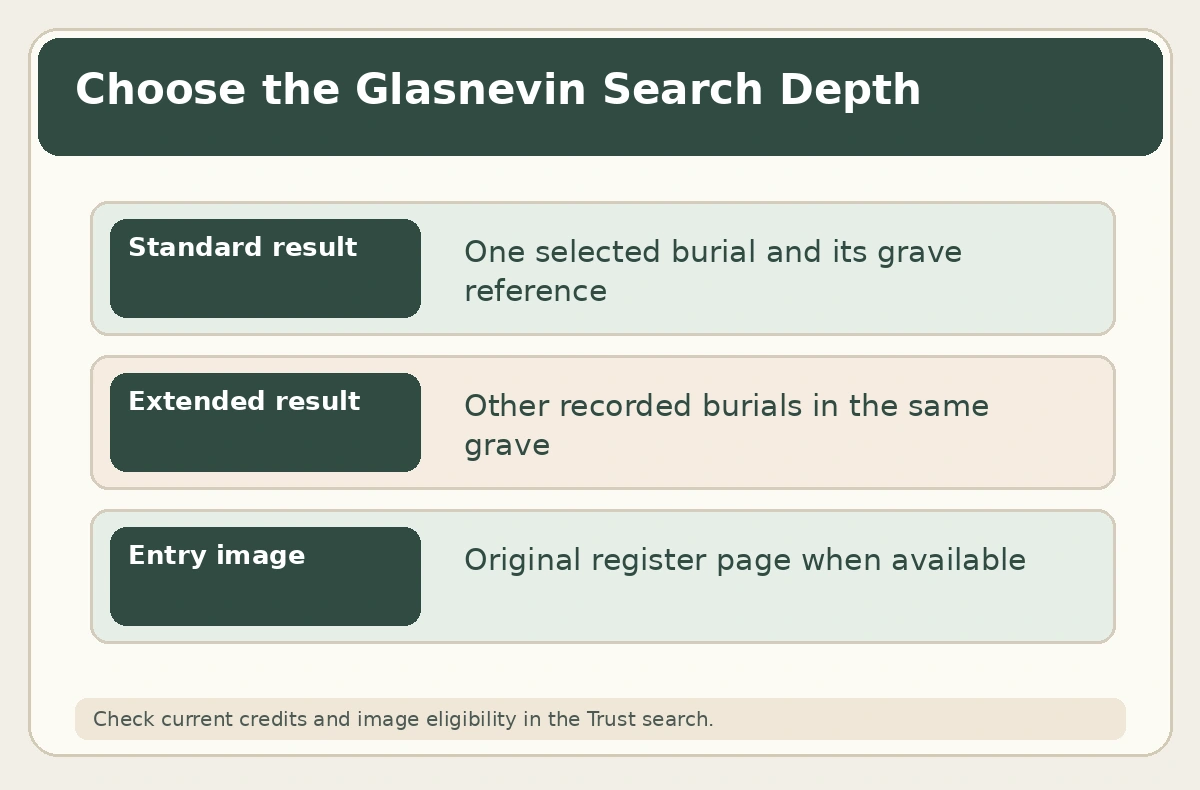
The search service separates standard record details from extended information about everyone buried in a grave. Original entry images may be offered where surviving registers and digitization allow. The Trust describes credit-based purchases, so do not imply every detail is freely visible or quote a price as permanently fixed. First buy only what answers the research question: an individual’s grave reference may be enough to locate a burial, while an extended record can reveal candidates for a wider household hypothesis.

Read What a Burial Register Actually States
The Trust explains that its registers consistently identify the person interred, address, age, burial date and grave number; other particulars, such as date or cause of death, vary by period. Treat burial date separately from death date and register address separately from lifetime residence. A date-of-death field is informative if present, but never fill it from the neighboring burial date as though the register said so. Original page headings and columns control what an old entry means.
Do Not Turn Shared Grave Space Into Automatic Kinship
A grave may contain members of one family, unrelated people, or individuals connected by ownership and burial arrangements rather than blood. Even when the extended search lists several names, the register alone may not specify each relationship. Create separate rows for each occupant with age, burial date and address, then seek independent marriage, birth and death evidence for proposed links. Coinciding surnames are suggestive but not a genealogy proof; a named grave owner also need not be physically buried there.
| Record | What you learn | Still unknown |
|---|---|---|
| Name hit | Candidate burial | Verified identity |
| Grave number | Burial location | Relationship to others |
| Other occupants | People sharing space | Why they share it |
| Register image | Period wording | Unrecorded life events |
Distinguish a Grave Location From a Headstone
A grave number and a marker are different facts. Cemetery administration can locate a burial without any surviving memorial, and a stone can memorialize someone buried elsewhere. If you want to visit, use the Trust’s grave-location support, giving the name, approximate death year and last address rather than requesting a speculative plot. Ask whether a precise section or plot can be located using the record supplied. Respect cemetery safety, privacy and visitor rules.
Understand the Coverage of Original Register Images
The Trust website describes additional entry images only for qualifying historical entries; the exact advertised year range has differed across its own online pages. Therefore check the available image option for the particular search result instead of promising an original scan for every historical burial. A transcription or purchased search result can still be cited if the image is unavailable, but name it accurately. Archive digitization is not a promise that all documents from the same burial are searchable.
Cross-Check a Dublin Address Across Sources
An address in a Glasnevin register may help reconcile a person with a city directory, census, newspaper notice or civil death registration. Build a short address timeline because street names, house numbers and tenancies can change. If a death notice identifies surviving family members, treat those claims as separately sourced, not facts transferred into the burial ledger. When the address fits but age differs, keep the conflict explicit and seek a second dated document before accepting a match.
Illustrative Two-Occupant Grave Comparison
Imagine an extended grave result showing two people with the same surname but burials thirty years apart. The tempting inference is parent and child; an equally possible explanation is a married relative, a cousin or a separate later use of the same grave. Record each person’s age and address independently and ask whether a civil marriage or birth document names both in a demonstrable relationship. If the burial addresses differ, that is a clue to investigate rather than grounds for rejecting or accepting the pairing immediately. A purchased group result can support an association, but the family link remains a hypothesis until other records bridge it.
Record the Search and Its Remaining Uncertainty
For each candidate save the search name, alternative spelling, year filter, cemetery, grave number and the level of details actually examined. If purchasing extended results, record which occupants are listed and whether any are merely possible relatives. A negative search under one surname is weak evidence unless other names and possible burial grounds have been considered. The strongest outcome may be a well-supported burial identity with unknown parentage; that is an honest research result. For a related choice, see our guide “Abney Park Cemetery Records”.

More Records and Archives Guides
How We Research Glasnevin Burial Evidence
We read the Dublin Cemeteries Trust search instructions, archive description and grave-location service together. Because its pages differ on the historical range of entry-image availability, the article uses a result-specific image check rather than a single guaranteed date range. No shared grave is presented as proof of a family relationship, and all sample comparisons are hypothetical.
Official custodial documentation reviewed: Dublin Cemeteries Trust search, standard and extended results, image option. Official archive explanation of burial-register fields and variations. Search names and death-year filters, cemetery coverage and extended results. The links are research sources, not paid endorsements. Our affiliate disclosure explains the site-wide policy.
The Trust provides a name search, while detailed standard or extended results and eligible register images use its credit-based service.
No. Shared burial location is an association that needs independent birth, marriage or death evidence before a relationship can be stated.
A burial date and grave number are primary register fields. Date of death appears in some periods but should not be assumed present in every entry.
The Trust offers grave-location support; provide name, approximate death date and last known address to narrow common-name searches.
No. Original entry images depend on the record and online offering; confirm availability for the particular result.