
To locate someone at Coburg Pine Ridge Cemetery in Melbourne, search the Greater Metropolitan Cemeteries Trust (GMCT) deceased records and then confirm the relevant location on the interactive cemetery map. Coburg Pine Ridge began in 1856, but a nineteenth-century surname alone is not enough to identify one person. GMCT allows both form search and map-based search; its own guide warns that some older entries are incomplete or contain small errors. This article focuses on converting a candidate name result into a traceable, corroborated grave-location claim, rather than copying an unsourced memorial into a family tree.
Keep the historic Coburg name and the modern site distinct
The operator’s Coburg Pine Ridge page dates cemetery service to 1856 and identifies the site at Bell and Elizabeth Streets, Preston, Victoria. A cemetery commonly called ‘Coburg Cemetery’ can therefore appear in modern searches under the fuller name ‘Coburg Pine Ridge Cemetery.’ Record both forms without assuming they denote two sites. When reviewing an old death notice, identify its date and wording before searching modern place labels. A burial at a similarly named location, or a person’s final residence in Coburg, does not by itself prove that their grave lies at this cemetery.
The cemetery’s administrative context matters. GMCT’s public search spans several Melbourne cemeteries and memorial parks, so the correct starting filter depends on what you actually know. If a burial location is only family tradition, begin with ‘All locations’ as the operator suggests. If the notice explicitly identifies Coburg, filter to that cemetery and inspect all plausible names. Switching to a single cemetery too early can hide a nearby result where the historical site name, operator classification, or family recollection differs. This is especially important when a person lived in one suburb but was interred in a different district.
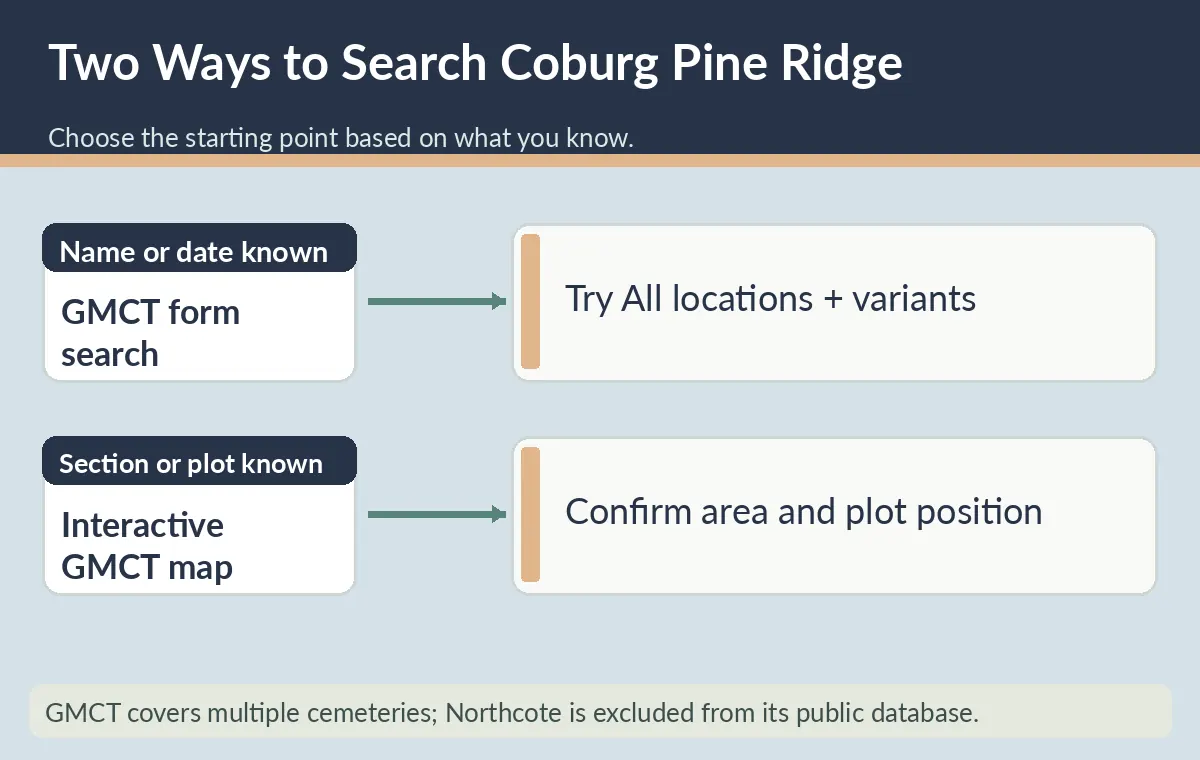
Choose the form search or the interactive cemetery map
Use the GMCT form when you have a name and a possible death or burial period. Enter confirmed details first and avoid guessing a middle name or a particular day. Its family-history guidance explicitly recommends alternative spellings such as Catherine and Katherine and searching with fewer fields if a strict combination returns nothing. Keep a short query log noting the exact filters and date range you used. Search failures may show a query mismatch rather than a gap in underlying registers, so do not describe a missing hit as proof that the burial never occurred.
Use the interactive cemetery map when a person’s entry supplies a grave area or plot reference, or when you need to distinguish multiple memorial positions. GMCT says map searches can use a name, plot, cemetery, or area. Write down the location as shown, then compare it with the map’s boundaries and section labels. A map pin is useful to navigate but cannot prove parentage or the legal holder of interment rights. Likewise, nearby surname matches may be neighbors rather than relatives. Print or save the resulting citation information with the date of your lookup in case the operator’s interface changes.
Verify a burial against Victorian civil records
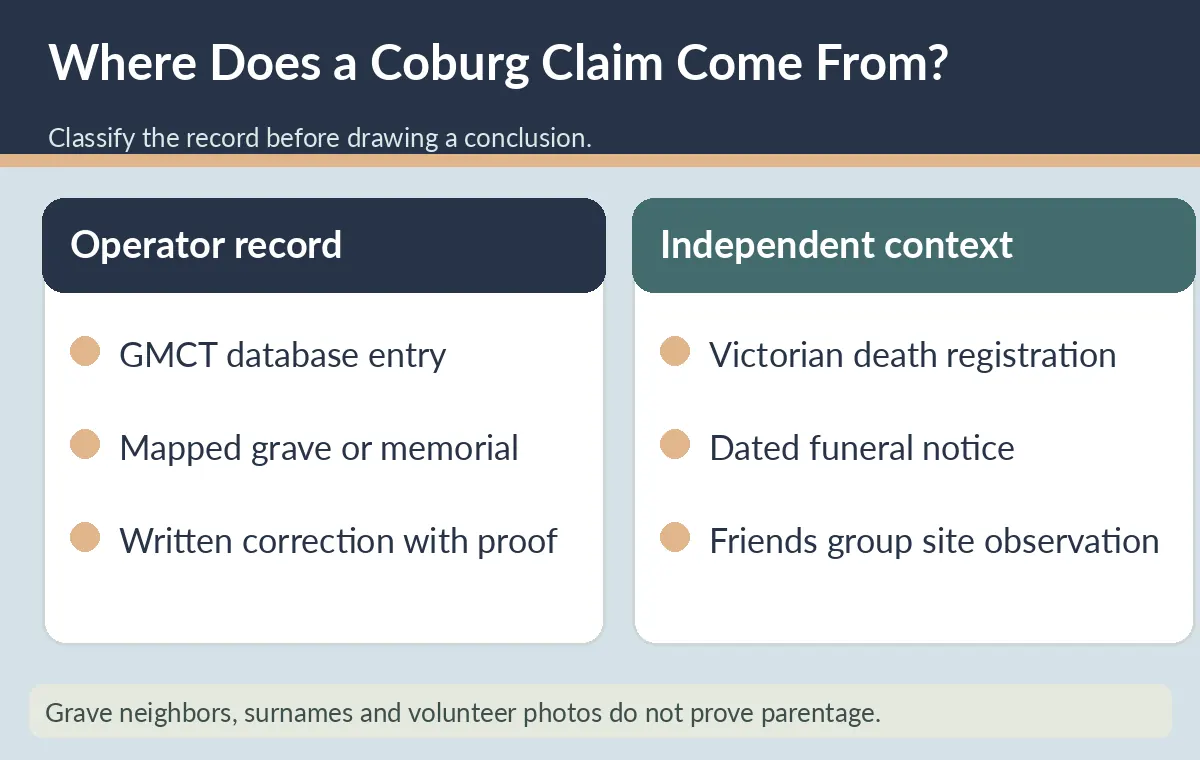
A cemetery record and a death registration arise from different processes. A death notice might list a funeral date; an entry in GMCT might identify a burial or cremation memorial, and the Victorian Registry of Births, Deaths and Marriages concerns the civil event. To resolve a conflict, compare age, last known address, burial date, and any accessible registration details without flattening them into one uncertain ‘death date.’ If a recorded person is an infant, also check whether the memorial records an adult family member’s later inscription. A single grave marker may be updated over many years.
The GMCT genealogy guide links to the Victorian BDM registry, the Public Record Office Victoria, and Trove for related evidence. Use each according to its purpose: government registration for an event, newspapers for attributed reports, and the cemetery register for its own administrative information. Search variant surnames deliberately and consider whether two people with the same name lived during overlapping decades. A matching burial and newspaper notice can reinforce an identification only when place, date and other distinguishing details agree.

Ask local volunteers for physical-site clarification
The independent Friends of Coburg Cemetery operates a grave-search assistance form and may help with locating a grave or photographing a memorial. This is a distinct service from GMCT’s authoritative administrative records. Give volunteers a bounded request: the exact name or variants, approximate dates, the operator’s grave location if known, and what visual question remains. Clarify whether you need a marker photograph, a row-level location check, or a transcription, because each is a different task. Do not send private information about living relatives without need or permission.
Volunteers can add on-the-ground observations, but an unmarked plot cannot be ruled out simply because no headstone was visible during a visit. Older stones may be damaged, displaced, or unreadable. If a memorial is found, transcribe every line while identifying weathered or ambiguous letters. Record the visit or photo date; compare inscriptions to GMCT and civil information. Volunteer recollections and later biographies are valuable leads but remain a separate evidence class from a contemporaneous burial register.
Build an audit trail for two namesakes
Imagine two nineteenth-century John Harris entries returned by a broad search, one from Coburg and another from a different GMCT cemetery. Your family’s John Harris lived near Coburg, but location alone cannot adjudicate identity. Make a candidate grid listing each burial date, age, site, section and independent death-registration clue. A plot labeled ‘Harris’ may predate the later interment and be associated with a different branch. Keep the person identifier separate from the plot identifier in your notes, so one change in an operator database does not silently merge two people.
GMCT cautions that long-running cemetery datasets can contain incomplete or erroneous historical entries and offers a correction route supported by government evidence. A correction request is not proof that the family account is right. Before sending one, cite the exact entry, show the discrepancy, and attach the independent primary document on which your proposed correction rests. This cautious process makes the result reproducible and keeps an attractive headstone photograph from becoming an unsupported family connection.
More Records and Archives Guides
How We Research This Collection
We identify the cemetery through GMCT’s official location page and verify the actual date and site before attempting a name match. We reproduce the operator’s two search modes, keep filters and variants in a log, and distinguish cemetery-record data, map coordinates, independent civil registration and volunteer observations. Where the records are ambiguous we preserve competing candidates and do not assign relationships on surname or grave adjacency alone. The volunteer service is identified separately from the operator and we do not assume a particular response or fee. Our affiliate disclosure explains GenHis’s general policy; links in this guide are research references.
The operator uses Coburg Pine Ridge Cemetery for the historic Melbourne site, which opened in 1856. Preserve the historic name quoted in older notices.
If the cemetery is uncertain, GMCT recommends beginning with All locations. Narrow to Coburg when independent evidence supports that choice.
They are two ways GMCT presents its cemetery records. Use the form for name/date filtering and the map for area and plot verification.
No. A photograph records an inscription or marker at a time; relationship claims require independent evidence.
GMCT handles its administrative records and the Friends of Coburg Cemetery offers volunteer grave-location and photo assistance.