
Historical Des Moines city directories provide an edition-by-edition route to an Iowa resident’s reported address or occupation between censuses. The Des Moines Public Library has digitized directory volumes covering 1866–1922, including specified editions produced by R. L. Polk & Co. Those dates describe a local digital collection—not a promise that every year or every neighborhood is present, or that all volumes had the same publisher. First identify an actual edition, then examine its alphabetical and street sections. A printed listing is evidence of information compiled for that directory, not proof of legal property ownership or a complete list of everyone in the home.
Choose a specific Des Moines edition rather than a date range
The Des Moines Public Library historic directory index groups digitized volumes by decade for years between 1866 and 1922 and identifies particular 1890s, 1900s, 1910s and 1920–1922 publications from R. L. Polk & Co. It also holds print directories from 1910 onward and microfilm directories from 1866 to 1935. These are different access formats with overlapping—but not identical—coverage. Browse the actual year link and opening pages before assuming a particular name is indexed. A decades page is a finding aid, not itself a census of residents or an original residence statement.
Begin with a known event year, such as a documented marriage in 1912. Check the 1911, 1912 and 1913 editions if those particular items are held, noting missing or inaccessible titles. The library lists individual years within its decade groups rather than representing every annual volume as continuously digitized. If you see a gap, record it as ‘edition not found in this digital list’ and consult print or microfilm holdings before asserting that no directory was published. A city might be included with nearby communities in a joint volume, so the edition’s title and coverage pages matter as much as the year printed on its spine.

Identify the R. L. Polk publisher and coverage area
The Minnesota Historical Society directory guide dates the establishment of the R. L. Polk Company to 1870 and describes its importance as a major city-directory publisher. Therefore a Des Moines digital collection extending back to 1866 necessarily spans directories that cannot all have been published by that firm. Record the publisher printed in the exact edition; do not retroactively call every city directory a Polk volume. The Des Moines library’s catalog description also refers to directories for Des Moines and Polk County, Iowa, so check each edition’s town list and geographic scope before interpreting a missing suburb.
A volume may offer an alphabetical personal section, a commercial section, a street-and-avenue guide, public institutions and other reference listings. The Des Moines library quotes a publisher description naming these distinct parts. Search both a known surname and a documented business name, but do not infer that two matching entries automatically describe the same person. A name can be abbreviated differently in a trade listing and a residential entry. Record the occupation, business affiliation, address and page number on which each statement appears. The edition itself may define abbreviations for homeowner, householder, residence or boarding status; use that printed legend rather than assumptions from a different year.
Read directory dates and household exclusions carefully
Directories are published privately and may rely on information canvassed before the title-page year. The New York Public Library’s methodology guide explains door-to-door canvassing and the imperfect coverage of these lists, with historical differences in who was included. A person who died or moved shortly before publication may still appear; another resident might be missing because the publisher did not receive information. When comparing a name in a 1910 census with a 1910 directory, note the separate reference dates instead of treating both as observations made on the same day. This matters when a family moved often or a widow’s name began appearing in place of her spouse.
Directory listings often name household heads, employees, or businesses but do not necessarily enumerate minor children, guests and all other residents. The Minnesota Historical Society notes that children’s inclusion was limited and that spouse names appear in many twentieth-century publications. Before reconstructing a household, compare civil records and actual census rows rather than merging all people with the same surname in an alphabetical column. If an entry says ‘Mrs.’ or abbreviates an occupation, preserve the original form in your transcription. Do not silently expand it into a maiden name or a specific employer that the publisher did not write.

Move from a surname listing to the street guide
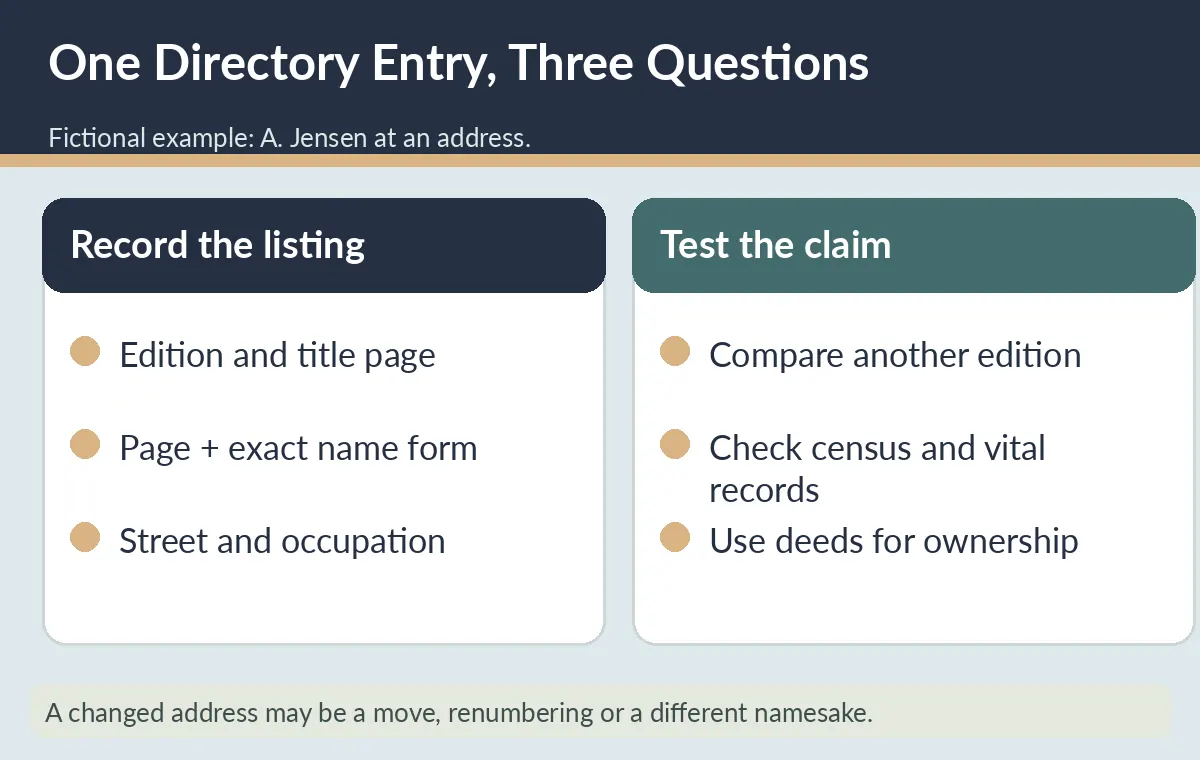
Suppose a fictional entry reads ‘A. Jensen, painter, 412 Example Avenue.’ Save the year, page, full transcription and edition title. Then turn to the street guide within that same volume if one is included. Examine the block numbers and adjacent listings, but remember that ‘Example Avenue’ is a fictional placeholder, not an attested Des Moines street. Nearby entries can lead to hypotheses about neighbors or businesses, not proof that people were relatives or co-owners. A change in building numbers or street names between editions can produce apparent migration even if the building never moved. Verify such changes with a dated street map or municipal record.
The Library of Congress directory guide explains that format and holdings differ widely by place and era. If the Des Moines digital scan has an unreadable gutter, cross-check the library’s microfilm or print copy where available before inventing letters. OCR searching is convenient but not exhaustive; reverse from address to alphabetical listing or browse the page sequence when a name fails. Keep separate fields for the city, publication year, directory publisher, page, street and address—without losing the spelling printed at the time.
Compare two editions without inventing a move or title
A useful continuity worksheet compares three distinct years with columns for exact name form, printed address, occupation, spouse abbreviation, edition and page. If a hypothetical Joseph Ryan appears at one address in 1908 and a Joseph Ryan at another in 1910, do not immediately write ‘moved in 1909.’ First determine whether the records refer to the same person and whether the directory canvass dates, neighborhood boundaries and street renumbering changed. Find an independent marriage registration, census, deed or tax record that can distinguish people with the same name. A directory is a dated report, not a dated lease or deed.
If one edition lists a business at the same address as a person, describe the association precisely. Occupation is not a legal employment contract; a business listing does not make the proprietor the real-estate owner. To prove ownership, locate the applicable county deed chain. To prove the identity of a spouse or child, seek vital or religious records. When the evidence remains ambiguous, retain two candidate profiles with separate source citations. The point of the Polk editions is to strengthen an evidence-led chronology, not to replace the documents needed for each independent family-history claim.
More Records and Archives Guides
How We Research This Collection
We checked Des Moines Public Library’s actual decade-by-decade listing of digitized city directories and its separate print and microfilm coverage, then compared the independent Minnesota Historical Society account of the Polk publisher with the Library of Congress and NYPL research instructions. Our workflow requires the title page, exact edition, street guide, abbreviations and page citation before accepting a name hit. We distinguish publication from canvass time, residence from property title and a reported spouse from proven parentage. The examples are fictional and the library’s directory links are included solely as research sources. Read our affiliate disclosure for general transparency.
No. The digitized Des Moines series spans publishers and years; confirm R. L. Polk & Co. on the specific title page.
Do not assume that. The public library lists individual digitized editions, with separate print and microfilm coverage.
No. An address listing is evidence of a directory report; verify property title with a deed or other original ownership record.
Check the year, alternative spelling, other index sections, image browsing and the library’s nondigitized holdings.
Only as a hypothesis. First establish that both entries name the same person and check canvass dates and street renumbering.