
Search Freedom of the City of London records by a documented name, admission date and route of entry, then test the company, apprenticeship or parent claim in its own original record. Freedom was a civic status, not a census of London residents. Review the site’s affiliate disclosure before following any research-service links.
Begin With the Historical Meaning of Freedom
In the City of London, being a freeman historically conferred civic and commercial privileges associated with trade and membership of guild or livery organizations. It was not equivalent to being an owner of all property, a voter in every election or a resident of the wider metropolitan area. The City of London explanation describes how the meaning evolved from medieval trading rights into a civic distinction.
Start with the event you are trying to prove: admission to the Freedom, membership of a named company, completion of an apprenticeship, or a relationship claimed through a parent. Each question can require a different record despite the overlapping terminology.
Know Which Historical Records Survive and Where
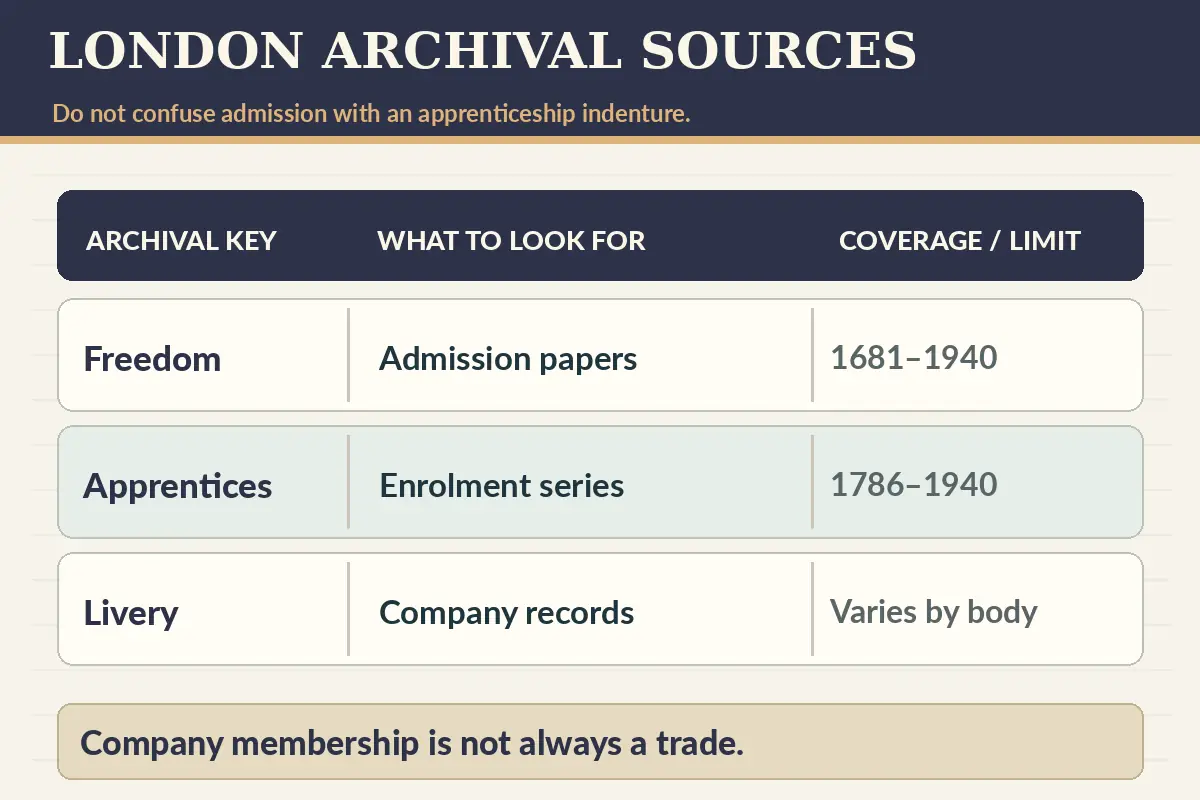
The Guildhall Library’s official apprenticeship guide reports Freedom of the City records for 1681–1940 and enrolments of apprentices for 1786–1940 at The London Archives, with some material searchable through a commercial partner. Those dates are the stated holding ranges of specific bodies of material, not a guarantee of an individual admission in every year. Note which dataset, index or original paper supplies a claim.
A printed company history can be a lead, while an actual admission paper or company minute is stronger evidence for a dated event. Search for the original livery company name where known, because company names can resemble occupations without proving a person’s working trade.
Compare Servitude, Patrimony and Nomination Routes
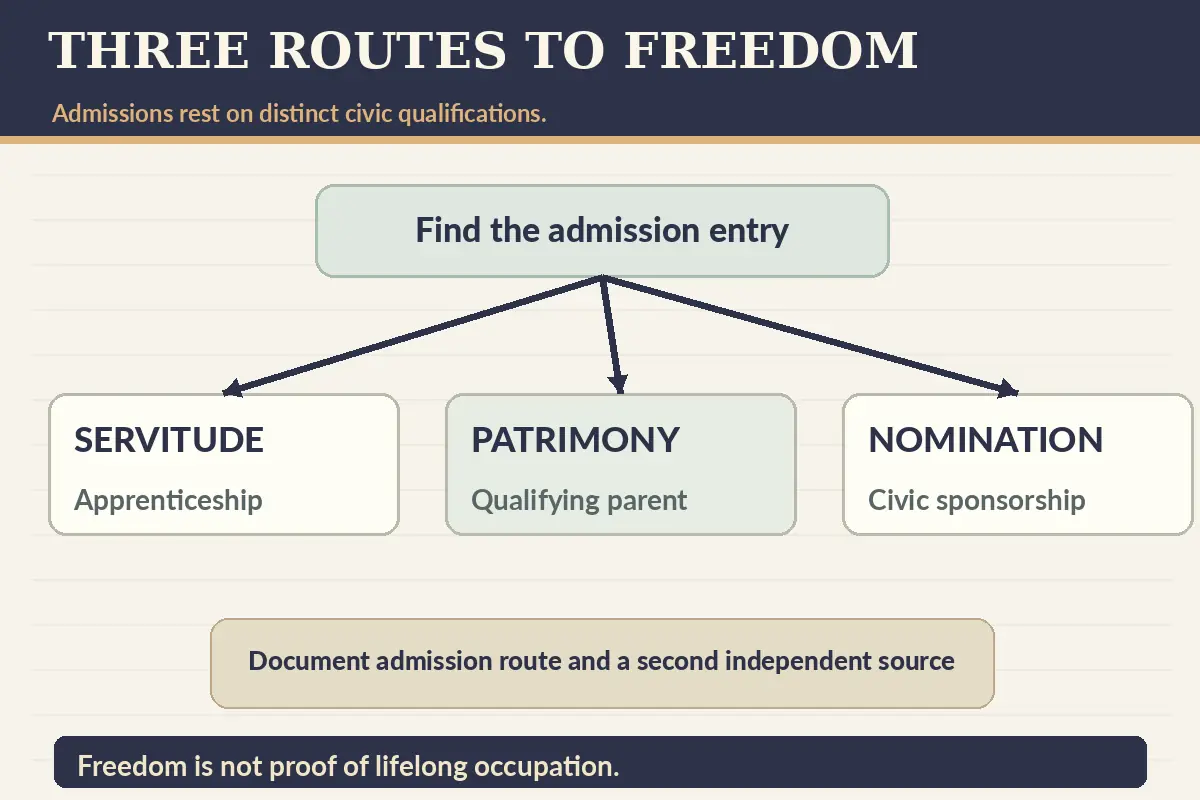
A person could qualify through different processes. Servitude concerns completion of an eligible apprenticeship; patrimony relates to a qualifying parental Freedom; and nomination involves the relevant sponsors or civic approval. The City continues to distinguish these routes.
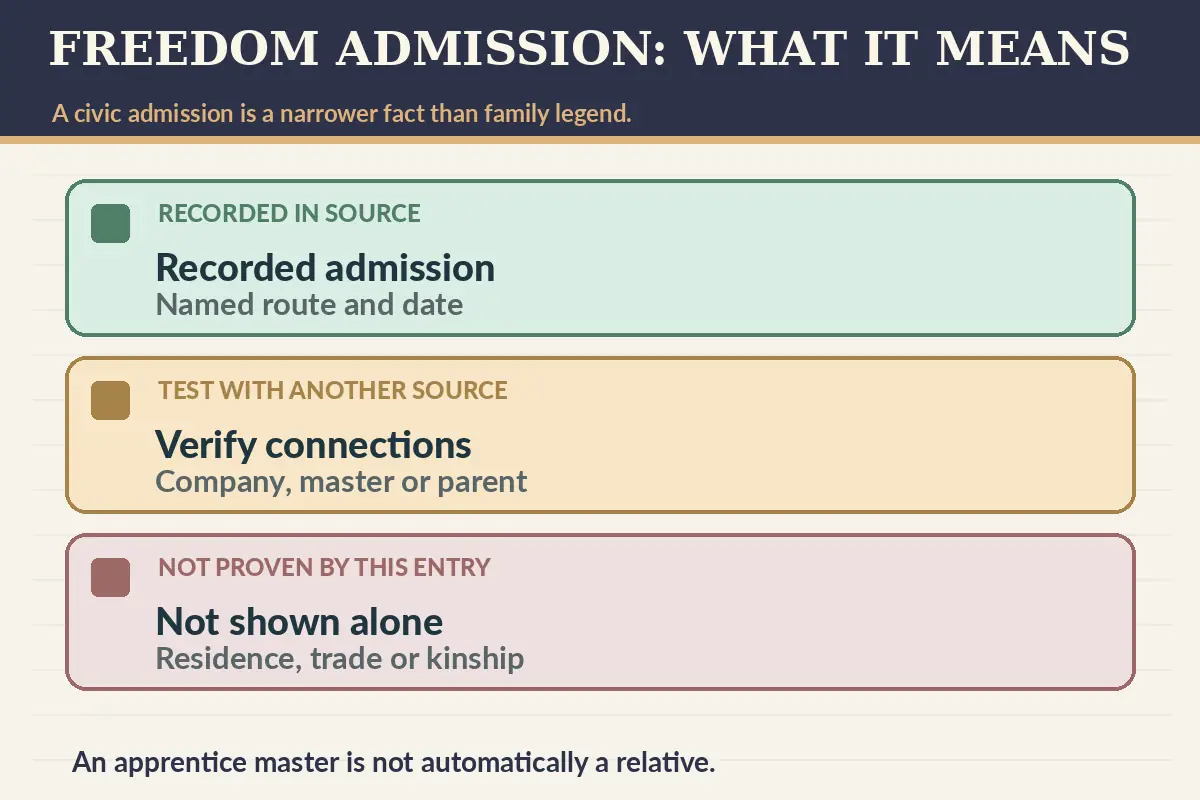
An admission record mentioning patrimony is a legal route claim that still needs to be linked to a securely identified parent, not a general certificate of every generation in the pedigree. An admission by servitude does not automatically supply the full original apprenticeship indenture or show that the apprentice later practiced the company’s trade. Copy the stated route and the contemporaneous rules before interpreting a sparse database field.
Find an Apprentice Without Assuming the Master Is Kin
Guildhall explains that apprenticeship was typically a private transaction involving apprentice, guardians and a master or mistress. Not every original agreement was deposited in a single surviving central archive. Some company registers record bindings, enrolments or freedoms, while records of apprenticeship-tax duty are a separate national source.
Start with a company’s own registers where a company is named, recording the apprentice’s name, binding date, master and any father or guardian actually listed. Do not silently turn an employer into an uncle because the surnames coincide. Where an index lists only an apprentice and master, search for the detailed paper or minute before asserting the place of birth or exact relationship.
Understand Company Membership and the Actual Trade
By the nineteenth century, Guildhall notes that London livery companies often had ceased to regulate the trades named in their titles. Membership in the Worshipful Company of a specific craft does not therefore prove a matching lifetime occupation. Compare a freedom admission with directories, tax records, wills and company minutes if trade or residence is the family-history question.
Company archives usually concern the City and its vicinity, not everyone practicing that occupation throughout Greater London. A surname in a company roll may indicate a civic connection with a corporate body rather than ownership of a shop. Preserve the official spelling and class of membership as stated.
Record Access Limits and the Search Interface
Some historical Freedom papers are indexed through Ancestry, while the custodial archive remains The London Archives. Checking a name index is not the same as viewing a scanned application or company source. The City of London’s current privacy notice describes restrictions affecting much more recent Freedom papers, so do not promise unrestricted public access across all dates.
Access conditions should be verified for the exact historical material. When a copy is unavailable online, record its custody, exact admission date and reference, then follow the archive’s current procedures. Do not seek or share sensitive information about living applicants.
Test a Claimed Father-and-Son Freedom Sequence
Imagine fictional men named Edward Collins in two generations. A younger Edward’s admission by patrimony might name a father with the same name, but it is still essential to check dates and the correct parent. Compare both admission papers, any company registers and an independent baptism or other parent-child source.
If the earlier Edward gained his freedom after the younger one’s birth, the historical eligibility rule becomes particularly important. A second Edward Collins in a different company is a competing candidate, not an inconvenient record to discard. Keep a dated table of each admission, named company, route, associated people and the exact claim supported by the paper.
More Records and Archives Guides
How We Research Freedom and Apprenticeship Claims
We begin with the documented civic status, not a romantic assumption about medieval guild ancestry. Each discovery is assigned a source class: database index, admission paper, company minute or apprenticeship agreement. Then we check the route to Freedom, likely company jurisdiction and the dates of any named masters or parents.
A separate identity worksheet compares full name, approximate birth, company, witnesses, address and independent family evidence. The result states that a named individual gained civic Freedom under a specific recorded route where proven; it does not automatically establish an occupation, continuous London residence or genetic relationship. Unavailable material and modern closures are documented transparently.
A good archive request identifies the exact company and admission year if known, because ‘London guild records’ can encompass numerous separate organizations and centuries. Where surnames change spelling, preserve the original form with later variants in a separate field. An apprentice can transfer masters or later appear in another company’s records, so a first binding is not necessarily the end of the training story. Conversely, not all freemen entered by apprenticeship. If a family account mentions a ceremonial parchment, check the date and admissibility route on that document, then seek the official corresponding admission record. Treat a later commemorative copy as a different source from the original minute. These distinctions protect the small but valuable evidence contained in a historic civic record.
No. It records civic status under a stated route, not residence in the wider city throughout life.
Many papers from the historical collection are searchable in partner indexes, but original papers and access must be checked.
It is admission linked to a qualifying apprenticeship, not automatic proof of a parent-child relationship.
Not necessarily. Livery company membership and actual trade need separate evidence, especially in later periods.
It may identify a claimed qualifying parent; verify the parent-child link with the underlying records and independent sources.