
Begin With the Child’s Number, Not Only a Birth Name
The London Foundling Hospital kept registers and linked documents for children received into care beginning in 1741. Children could be assigned a new name and a number, so searching only a modern family surname may miss the connected material. Coram’s Foundling Hospital Archive explains how the surviving books span the institution’s history and how historical records can now be searched online. Start with an approximate admission period, the child’s number if known and any later apprentice or household identity. A person’s hospital name and birth identity may be separate evidence questions. Do not infer that every name on a petition belongs to a child actually admitted.
Separate the Free Digitized Portion From the Whole Archive
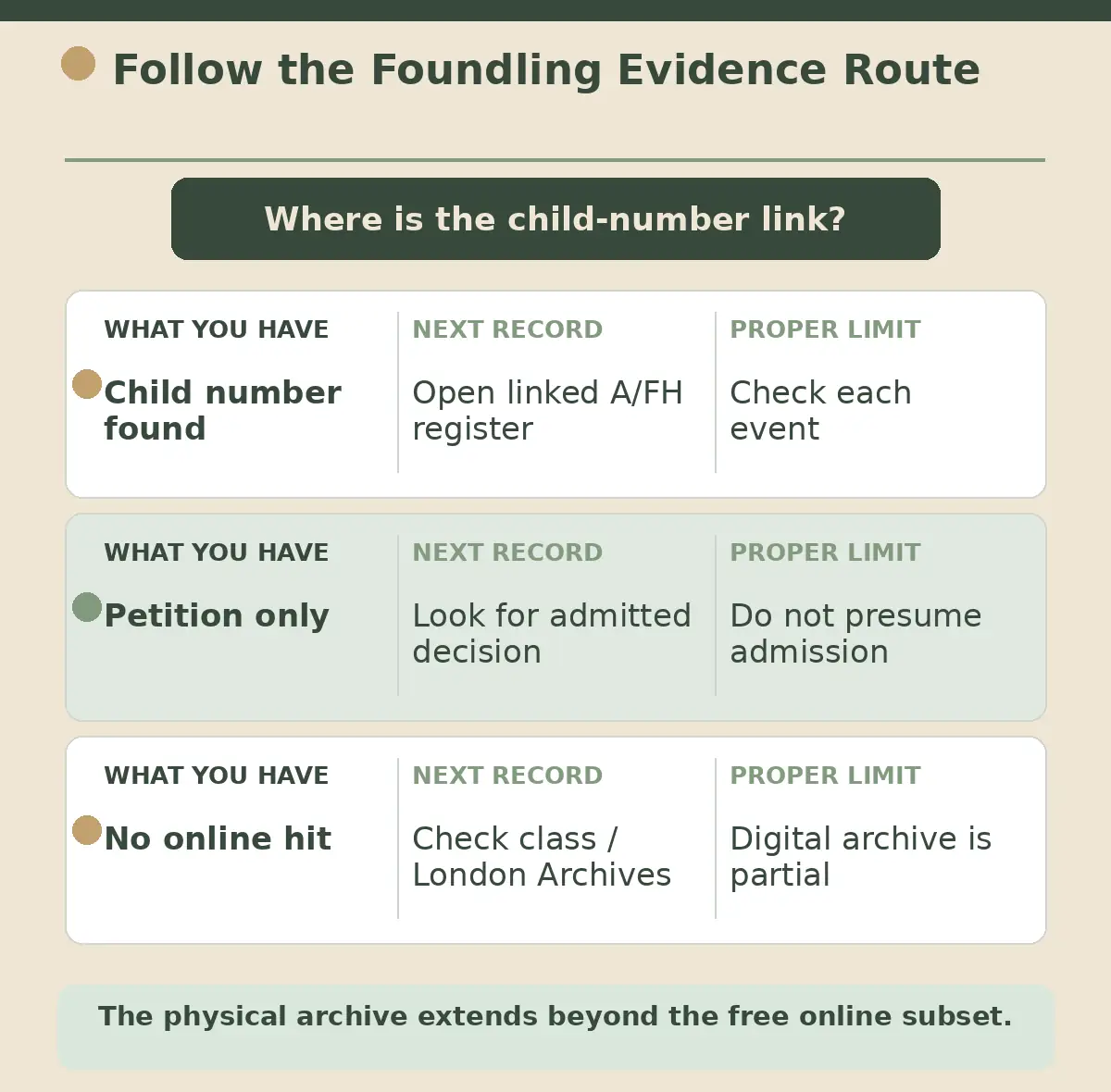
Coram reports that 405 historical volumes dated 1739–1899 have been digitized and transcribed, providing nearly 100,000 pages online for free. That is only about 23 percent of the physical archive, not a searchable image set for every year through 1954. Its research description also gives the broader archive range 1739–1954, when the residential school closed. Record whether a result is a digitized image, volunteer transcription, catalogue entry or an item not online. A no-result in the digital portal cannot prove that a particular child was never at the institution. Always check what record class and date window the portal actually contains.
Use Admission, Baptism and General Registers to Fix Identity
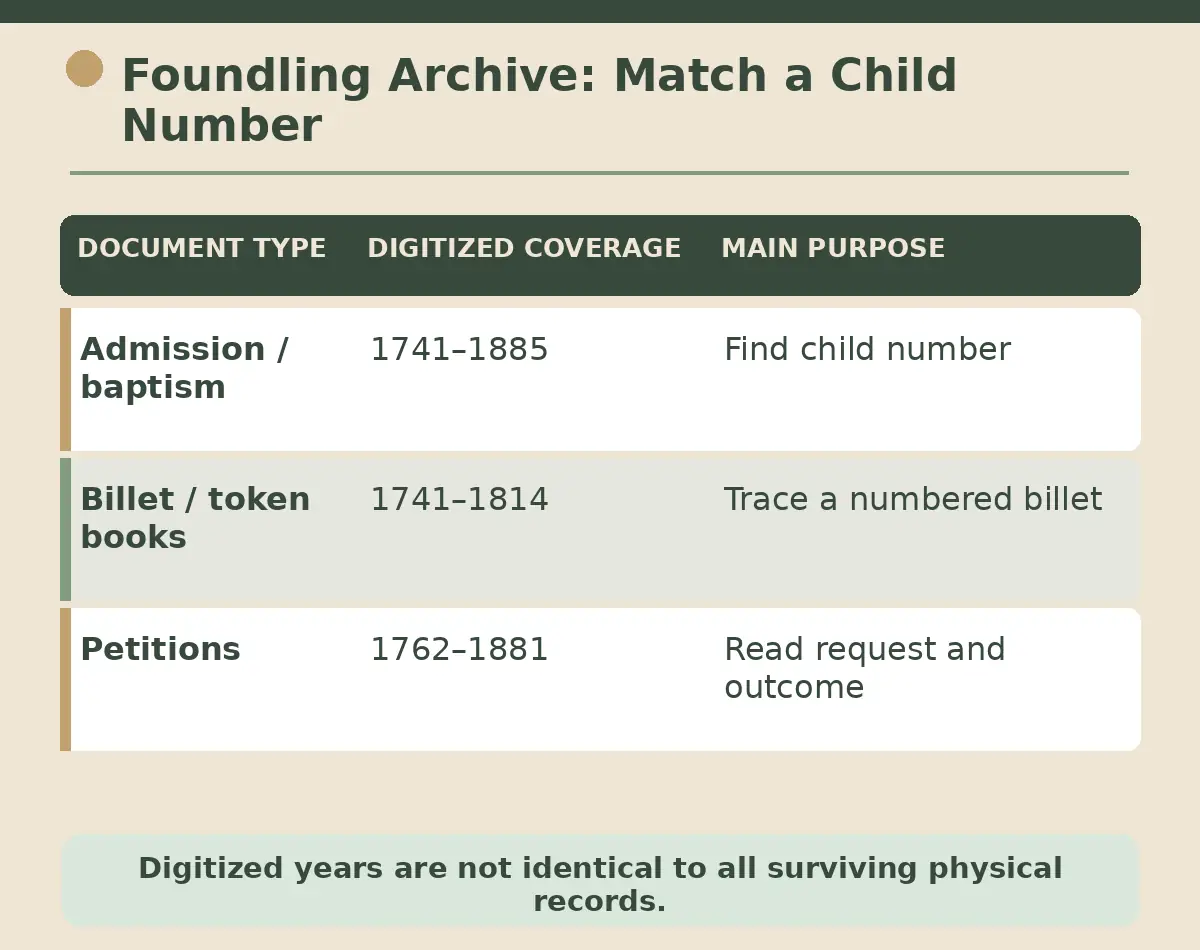
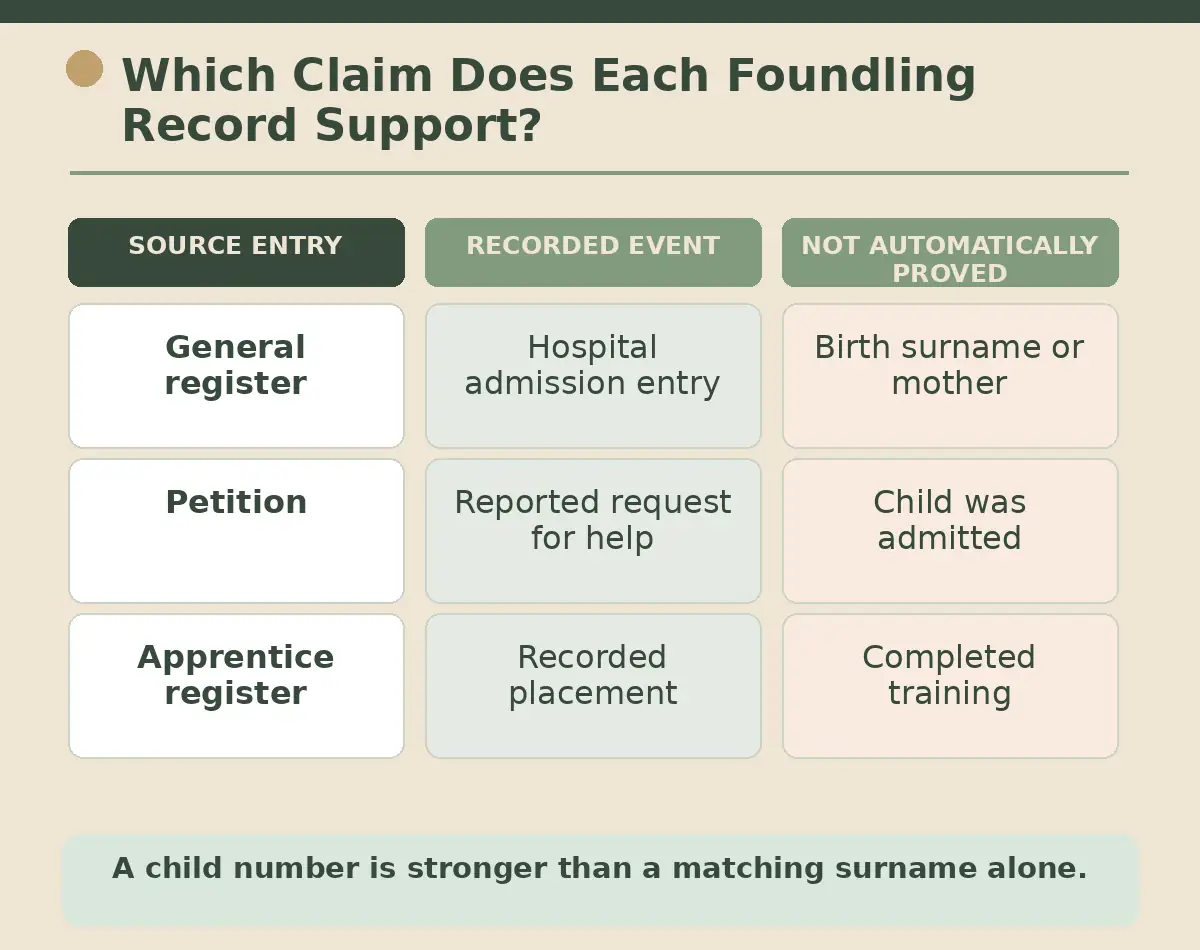
The digital collections include admission and baptism registers, with a Coram-listed digitized range of 1741–1885. The London Archives identifies general registers within A/FH/A/09/002 and baptism records within A/FH/A/14/004. Find the relevant entry and copy the child number, hospital name, date, parish or other recorded identifiers exactly. Do not invent the child’s pre-admission name if the entry lacks it. An admission date marks the institutional event, not necessarily birth or baptism; each date must be stored separately. The register may tell you which further book to consult but does not, by itself, settle the circumstances of placement.
Connect a Numbered Billet to Its Historical Context
Coram’s digitized collections include 203 billet books dating from 1741 to 1814, and The London Archives references them under A/FH/A/09/001. Some preserved billets include small tokens or fabric samples connected with the circumstances of a child’s admission. Record the number, book reference, image and literal description, avoiding dramatic interpretations of a surviving object. A token can help link administrative entries to one child; it is not a genetic test or independent proof of every maternal relationship reported elsewhere. Because the series ends in 1814, do not assume later children had the same kind of surviving billet. Missing tokens and damaged material should be documented as gaps.
Compare Petitions Without Assuming Every Request Was Accepted
The London Archives lists several petition classes, including admitted and rejected petitions, and Coram’s online set includes petitions from mothers and others dated 1762–1881. A petition expresses what the petitioner reported or requested, not necessarily what the institution decided. Read any decision or ballot outcome separately from a statement of need or kinship. Two similar names on petitions could represent different family situations, and a rejected petition should not be assigned an admission number unless a source documents the connection. Keep the petitioner’s reported circumstances in attributed language. Avoid treating the institution’s moral or social classifications as objective descriptions of parents or children.
Follow Nurses, Branch Homes and Apprenticeships as Separate Stages
Coram lists digitized registers of country nurses and inspectors (1749–1812), branch hospitals (1757–1772) and apprenticeships (1751–1898). These record categories answer different questions: a child’s movement into nursing care, placement at a branch institution or later training. The London Archives provides their specific archival series in its Foundling Hospital reference guide. Follow the established child number or explicit cross-reference rather than matching only a later first name. An apprenticeship entry does not prove completion of training; a nursing record does not independently establish who the birth mother was. Preserve placement, change and exit dates as separate events.
Respect Restricted Records and the Needs of Living Families
The complete physical archive is held by The London Archives. Coram says records already digitized are closed for onsite handling, while the remaining records up to 1910 can generally be consulted with a reader’s ticket; most twentieth-century documents have data-protection restrictions. Confirm current access before visiting or asking for a copy. Do not attempt to reconstruct private identifying details from restricted records about potentially living people. An historical search can be documented accurately without publishing details of descendants, adoptees or other individuals who did not consent. Respect the emotional significance of placement records while making cautious claims about what their contemporary creators actually knew.
Build a Child-Number Crosswalk and Cite Each Source
Create a simple table: child number; hospital name; entry date; register and folio; billet number; petition reference and outcome; nurse or branch register; apprenticeship entry; evidence status. For each item, save the original A/FH reference when supplied and the image or transcription locator. If a petition and an admission share a plausible surname but no explicit number or contextual connection, label the link hypothetical. The Foundling Museum research guide can help orient a pupil search, but the original document must settle the entry’s wording. If a child is renamed, preserve both recorded forms and explain the documented transition instead of silently replacing one with the other.
Test Competing Matches Without Erasing an Earlier Name
Imagine two children named Mary appearing in records near the same year. One is attached to an admission number and an apprentice record; the other appears in a petition that was rejected. These cannot be merged merely because their names and dates seem close. Follow the first child’s number through the general register and subsequent books. Read the second petition’s outcome and search for independent evidence if the family connection remains uncertain. Separate events with explicit cross-references from events linked only by inference, and report the result as unresolved where the archival trail ends. This process protects the identity of both children and the people named in their records.
More Records and Archives Guides
How We Research the Foundling Hospital Archive
We start with Coram’s record-class coverage and The London Archives’ A/FH catalogue references, then seek a child number in an actual admission or general register. Each alleged connection to a petition, billet, nurse or apprentice book is checked for a shared identifier and correct date; volunteer transcription is compared with the available original image. We distinguish administrative acceptance from a mother’s reported circumstances and do not extrapolate beyond the digitized portion. Access restrictions and privacy matter for later records. See the GenHis affiliate disclosure; no institutional partnership is implied.
The London Archives holds the physical archive, while Coram offers a substantial free digital subset.
No. Its digitized subset consists of selected volumes mainly dated 1739–1899, not the whole physical collection.
It can connect a hospital name and admission register to billets, petitions and later records.
No. Some petitions were rejected, and an admission must be independently confirmed.
Not generally. Coram notes data-protection restrictions for most twentieth-century material.