
DT 33 is a route into British hospital and nursing-school administration rather than a general register of patients or nurses. The National Archives describes hospital inspectors’ reports and papers from approximately 1938 to 1970. Earlier files tend to concern named hospitals, their condition, history and training schemes; later ones tend to examine schools of nursing serving multiple hospitals. That change of scale is crucial when a researcher cannot find the institution under the name used in a family story.
The National Archives guide to doctors and nurses notes that some inspection reports include lists of staff, but it does not promise a complete list in every file. An inspector may have visited a hospital or reviewed a training program without preparing a full roster. Begin with a narrow question: what was the training or institutional arrangement at a particular date? Only then ask whether a person can be linked to it.
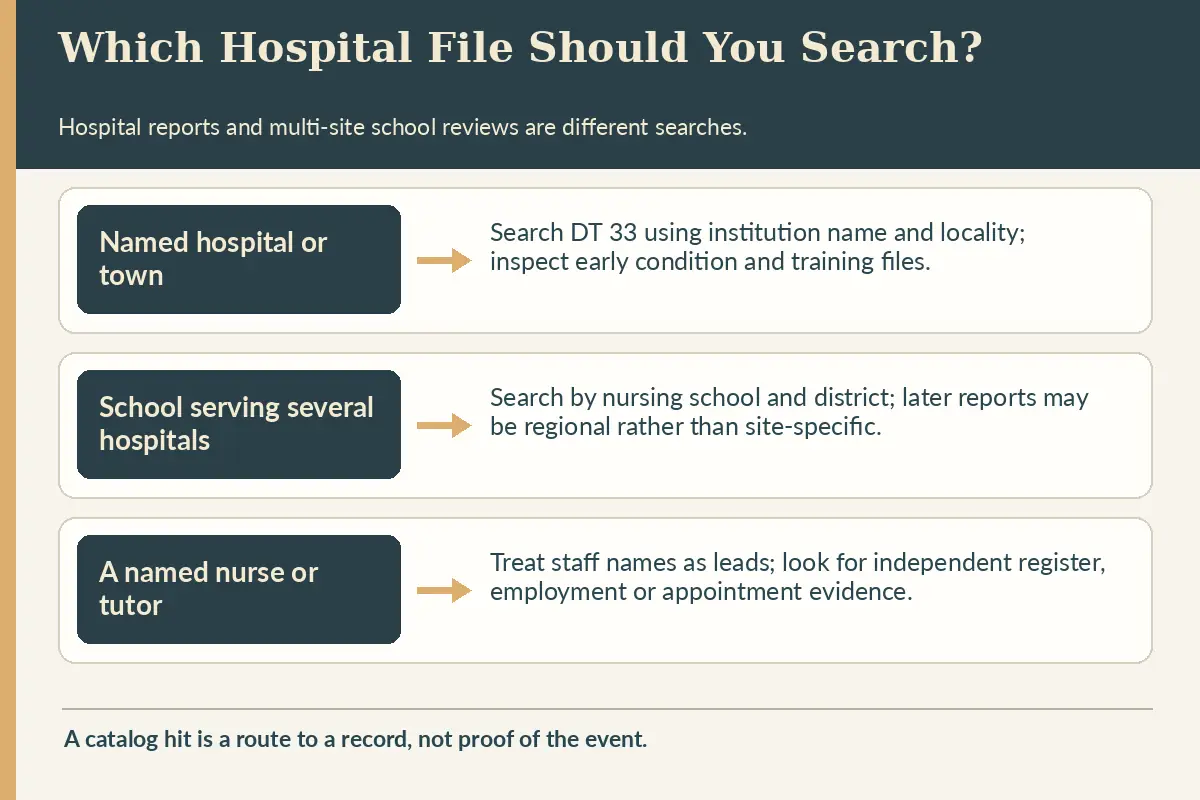
Choose the hospital or nursing school as the search unit
Write down the exact historical institution name, the locality, a possible alternate spelling and the decade of interest. A nursing school may be named for a district or a combination of hospitals, and a hospital may have changed its title. Search Discovery within DT 33 using both the institution and the place. If the result is catalogued only at a wider level, note that coverage instead of treating the missing name as proof that no report exists.
Separate early hospital-focused inspections from later school-focused material. A 1940s hospital building report and a 1960s report on nurse education answer different questions. The former might describe wards and training facilities; the latter may consider regional training arrangements. An apparently related report should not be assigned to a specific institution without checking which hospitals are actually included.
Read what the inspector actually observed
An inspection report often has multiple voices: observations by an inspector, information supplied by administrators and recommendations about future improvement. Mark those voices separately in your notes. A statement that a school required more accommodation is not proof that new accommodation was subsequently provided. A reported shortage of qualified staff does not identify each person who worked there. Use the report’s own visit date rather than the broad catalogue date of the file.
Create a simple evidence ledger with columns for date, location, speaker, claim, page and proof limit. Compare a recommendation with later meeting minutes or documented work. Even where inspectors describe practical defects with authority, the document records an assessment at a particular time; conditions can change. If the file contains photographs or plans, inspect captions and the relationship to the written report before using them to date a room.
Connect staff references without inventing a career
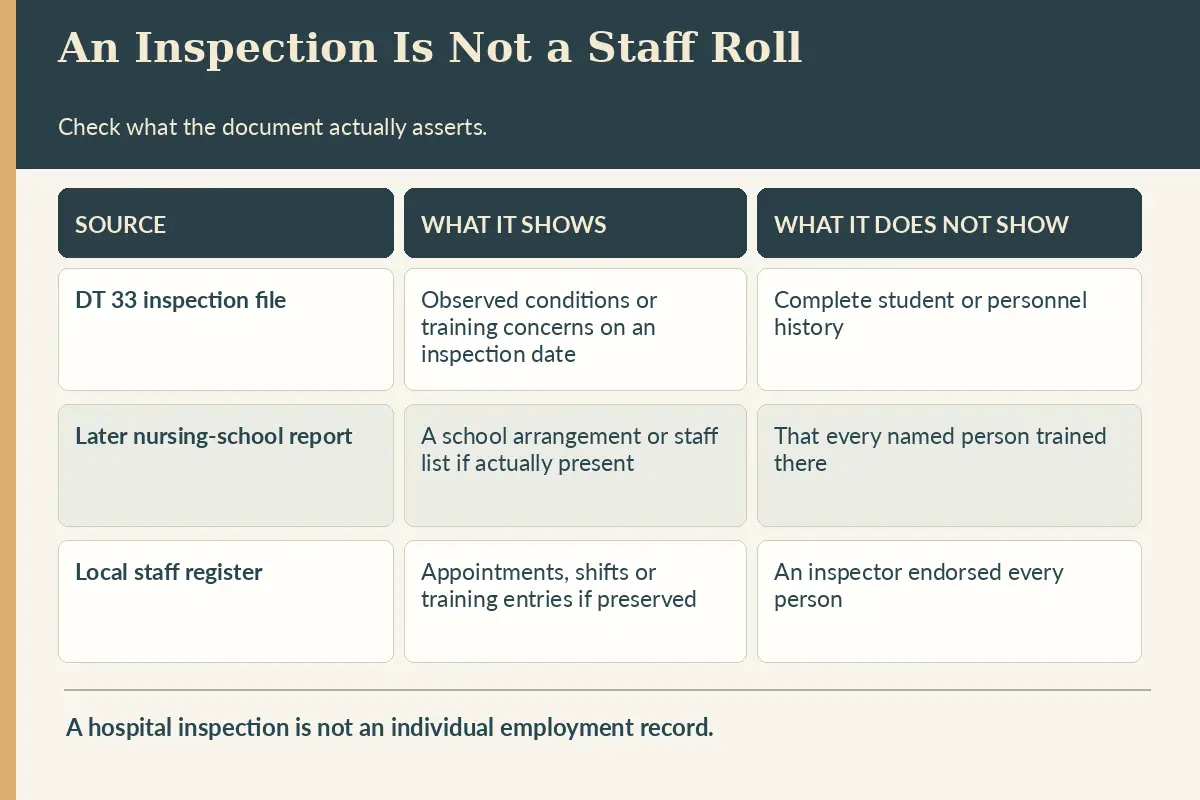
A staff list may supply a name, title or departmental role, and can be extremely useful as a locator. It does not establish date of birth, every appointment, family relationships or attendance at the nursing school. Compare the entry with contemporaneous nursing registers, employment papers held locally, professional directories and other documents that actually identify the person. Note if a list is a snapshot rather than an annual roll.
Imagine a family account that an aunt trained at a provincial hospital in 1958. A DT 33 report discussing the hospital’s nursing school that year verifies the school’s institutional context, not her attendance. A named trainee in a local register would be stronger individual evidence. If the report instead names a matron, the matron cannot be silently treated as the trainee’s teacher without a link in the training documentation.
Understand access, survival and misleading negatives
Most historical records at The National Archives are not individually searchable online by every person named inside them. A Discovery result may be a description of a box or file, not the digitized inspection. Check the repository, access information and piece reference; where needed, arrange to visit or order a copy. An unsuccessful keyword search can be caused by incomplete indexing or a naming change. Keep the exact terms searched and the source consulted.
Do not extrapolate DT 33 to all hospitals or all decades. The archive’s guidance gives an approximate span rather than a guarantee of uniform local coverage. Local hospital archives, municipal collections, national health service records and professional registers may hold material not transferred to the central series. Recent files can have access restrictions; avoid claims about living people based on sensitive material that cannot be inspected responsibly.
Write a defensible hospital-history finding
A concise conclusion might state that an inspection report described a school arrangement at a named hospital in a particular year, then cite the original DT 33 piece and page. The next sentence should explain whether a separate source links the ancestor to the school. Keep those statements separate even when the chronology seems persuasive. This makes the finding useful to a family historian and a local historian alike.
When citing the file, include The National Archives, DT 33, the full piece number, the report title or institution, date and relevant folio or page. Save the catalogue description as a finding aid, not as a substitute for the report. If you have inspected only a digital summary, label your conclusion provisional until you can inspect the underlying document.

More Records and Archives Guides
How We Research and Verify the Archival Claims
Our research starts with the National Archives collection guidance and its actual statement of series purpose, date range and limitations. We compare that guidance with Discovery search practice, retaining repository, series, piece and page. A series description is a finding aid rather than proof of every fact in an individual record. Each claim in this guide distinguishes contemporary document wording from our interpretation and identifies the independent record that could confirm an added inference.
Our visual charts are original research aids, not scans of original registers, passport forms, inspection reports or photographs. Descriptions of sample holdings and approximate series dates are not guarantees of complete survival. Before using any paid copying service, read our affiliate disclosure; no commercial relationship is claimed by this guide.
The National Archives describes hospital inspection reports and papers from roughly 1938 to 1970; check the dates of the exact file.
Some reports include staff lists, but they are not complete career or training registers.
Later inspections may be organised around regional nursing schools covering several hospitals or under a changed institution name.
No. Look for a subsequent report, board decision or independently recorded alteration.
Record the full DT 33 piece, report date, hospital or school title and specific page after checking the original.