
ADM 68 holds accounts and ledgers associated with Greenwich Hospital. Among them are books used by shipping historians to investigate contributions known as seamen’s sixpences. A ship name, port and amount in an account can document a financial entry; it does not automatically identify the men whose wages produced that sum. Nor does it prove a particular sailor entered Greenwich Hospital or received a pension. The useful research question is whether you can identify the exact vessel and account period, then locate independent records for a named seafarer.
Classify the Greenwich Hospital Entry Before Naming Anyone
Greenwich Hospital was connected with naval support and pensions, but not every ADM 68 volume records the same administrative activity. Some books contain receipts, others general expenditures or institutional accounts. Before treating a record as a maritime trace, read the title page, period covered and arrangement. A figure reported by a port office may be a summary, not an individual payroll. If only a total appears, do not divide it by sixpence to invent a fixed crew size.
Seamen’s sixpence accounts can be useful to maritime history because collections were associated with the contribution system. Yet an amount remitted can reflect several voyages, accounting delays or administrative practice. A payment date is not necessarily a sailing date. If the record names a ship and master, transcribe them exactly but do not assume a master named there remained in command throughout the year. The original’s column headings control the claim you make.
Begin a vessel identity register with seven fields: original ship spelling, stated port, date span, ledger reference, any master named, account heading, and uncertainty. Separate a named vessel from an inferred same-name vessel. A ship called Hope may have counterparts in several ports, and the same ship might change master or registry. Compare port and time before attaching a crew or family story to the entry.

Move From a Ship Amount to a Verifiable Vessel
Use The National Archives guidance on merchant-ship registration to understand why port is essential. For later merchant ships, port registration and official number are major identifiers; earlier records require different ways of comparing a vessel. Do not project a nineteenth-century ship official number backward into an eighteenth-century account. When a reference is known, cite its complete ADM 68 piece and the page, rather than the series alone.
Correlate a plausible ship with an independent ship register, port book or shipping notice from roughly the same period. Match more than the name: look for the master, port, vessel type, tonnage or trading context, depending on what the sources actually give. If details conflict, retain separate candidates. A change in ship name can be plausible but needs evidence; the fact that two vessels both brought in contributions never proves that they were identical.

For a hypothetical account that mentions a vessel named Mary at a southern port, report only that this ledger records Mary under that heading. Next find a dated registration or port entry and check the master or size. Only then consider whether a known ancestor might have served aboard. This is an illustration of how to test identities, not a claim about a specific real ship.
Find an Individual Crew Record Without Making One Up
If the real question concerns a merchant sailor, the crew-list research guide provides a separate route. BT 98 holds earlier muster and crew agreements, while BT 99 covers some later agreements, subject to survival rules. The appropriate series depends on dates and ship registration. A ship in ADM 68 does not create an invisible crew list in the financial account; nor does the total collected provide names, ages or places of birth.
Create a candidate grid for a named sailor containing independent personal identifiers, the proposed ship, the dates and an explicit source for each link. Keep a family recollection, a newspaper report and an actual agreement in different evidence categories. Where no nominal list survives, state that a maritime connection remains a hypothesis. There is no sound way to derive a household or family relationship from the financial receipt alone.
For a pension claim, switch questions. Greenwich Hospital pension records are covered by the separate TNA naval pensions guides, which describe ADM 73 and other relevant series. A ship contribution does not mean every seaman was a hospital resident or pensioner. Likewise, an out-pension and residence within the hospital are distinct claims. Verify the individual’s name, service and admission or payment record rather than extrapolating from institution accounts.
Interpret a Missing Ledger Entry Cautiously
A missing ship entry can reflect incomplete preservation, a different port, a volume beyond the search range, spelling or a different collection procedure. List the ADM 68 pieces actually examined and the years that they cover. A search confined to one digitized reference is not an exhaustive test of all Greenwich Hospital accounts. Do not silently equate a catalog no-hit with no vessel or no voyage.
When comparing years, use like-with-like accounts. A port total for one accounting period should not be treated as directly comparable with an individual vessel figure for another. If you want to chart change, annotate the unit, geography and calculation behind each number. Avoid statements about recruitment, mortality, maritime traffic or exact voyage count unless additional sources support them.
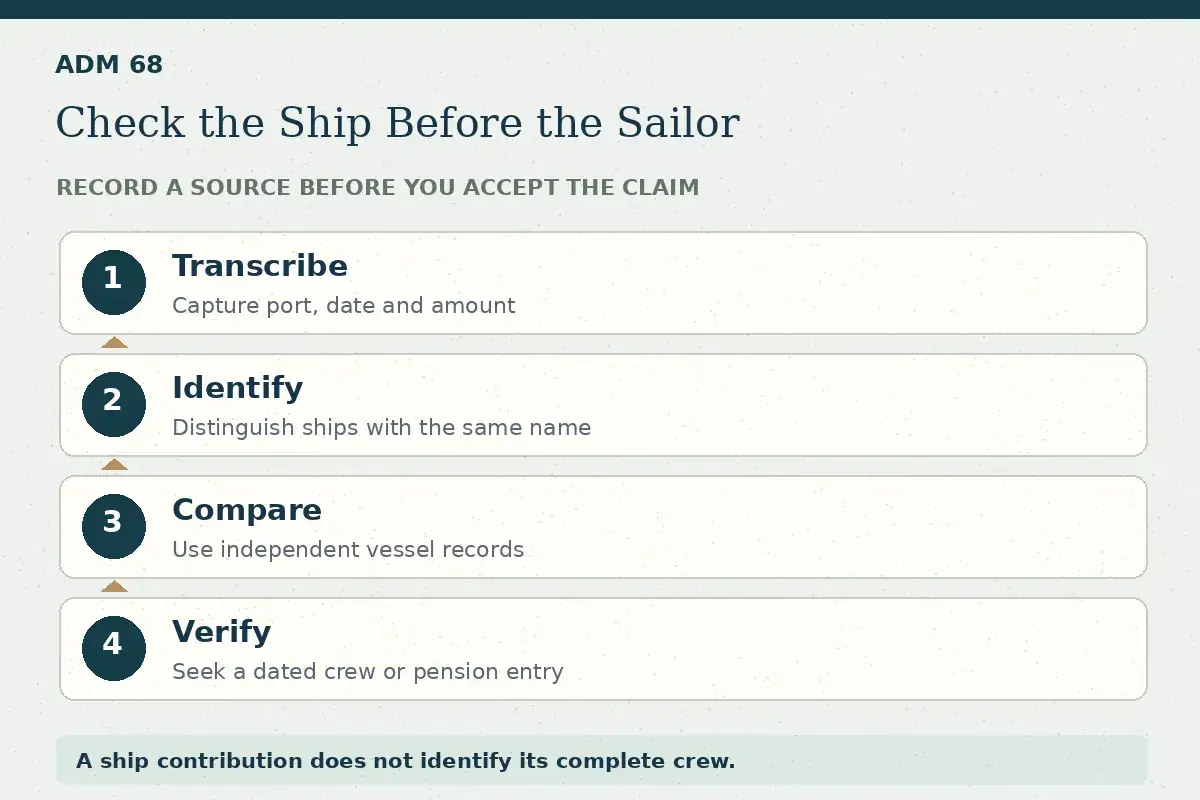
Finish with a three-level conclusion. Level one records the literal ADM 68 financial entry. Level two, if independently corroborated, identifies a probable vessel. Level three, only with individual documentation, can connect a particular sailor. Preserve unanswered questions in the working table. The method gives a meaningful family-history lead while respecting the difference between an institutional account and a personal record.
More Records and Archives Guides
How We Research Greenwich Hospital Shipping Accounts
We classify ADM 68 with the Dictionary of Canadian Biography archival bibliography and check vessel identifiers against The National Archives ship-registration guide. When a personal maritime claim arises, we consult the crew-list guide and the naval pension guide, rather than treating an account as a substitute for either.
The worked ship examples are hypothetical. References, date ranges and collection descriptions are sourced; no actual original ledger image has been silently transcribed from a catalog snippet. The research and relationship policy is described at our affiliate disclosure. We do not imply a commercial relationship with the repositories.
No. ADM 68 is a Greenwich Hospital financial series; separate crew agreements or musters are needed for named seafarers.
It may help document an account period, port, named vessel and a recorded payment, depending on the volume and its headings.
No. Pension eligibility and payment require separate person-level pension or service records.
Not reliably. Check the port, date, master and other independent identifiers to distinguish namesakes.
Specify the volumes, years, port scope and spellings searched; avoid claiming that the ship never sailed.