
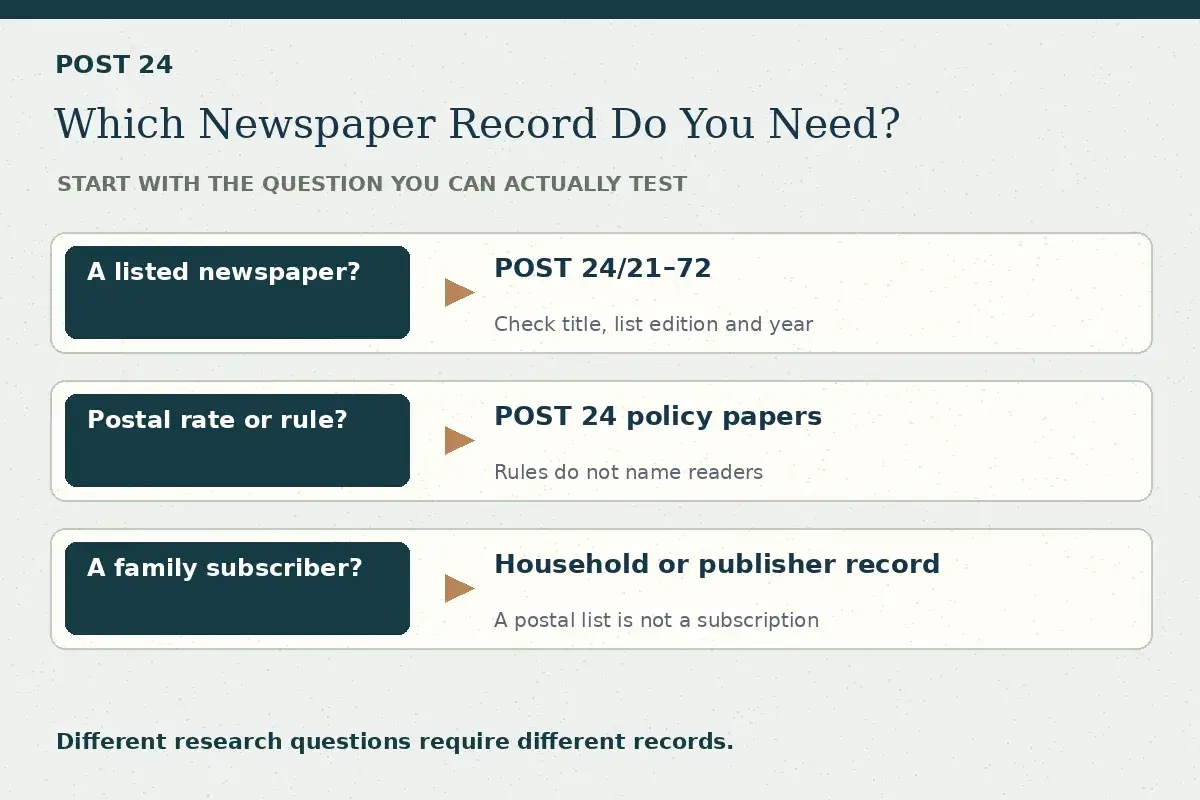
POST 24 is a Post Office record series for newspaper transmission, not a directory of readers. Its published lists of newspapers registered for carriage can help establish that a named title appeared in a particular postal-registration source. They cannot show that a specific issue reached a village, that a person bought the paper, or that every edition was printed. The Postal Museum catalog places the Newspaper Post series broadly in 1791–1966 and identifies the registered-title lists at POST 24/21–72. Begin with a newspaper title, a date window and a specific claim you need to test.
Choose a Registered Title, Not an Imagined Subscriber
Start by writing two questions separately: was this newspaper named in an official list, and did someone in the household read it? The first may be answered by POST 24; the second needs independent evidence. A registered title was eligible for a postal arrangement under the terms applying to that list. It is not a subscription form, a complete press census or a delivery ledger for a particular street. Keeping these questions apart protects family narratives from an attractive but unproven assumption.
The catalogd POST 24 class covers different material: newspaper-transmission regulations, postage rates, franking privileges and lists of registered titles. Do not read a file about a rate change as a register of publishers. The series date span is a container description, not an assertion that all titles survive for every year. Determine whether the piece is a published register, a policy paper or correspondence before extracting historical claims.
Record the title exactly as printed, including words such as Daily, Weekly, Chronicle or Gazette. Abbreviated names may collide across towns. Use a place, printer or publisher, known publication dates and changes in title to distinguish candidates. For a hypothetical family newspaper named the Herald, a catalog search for Herald alone is nearly meaningless. A contemporary imprint or library catalog narrows the candidate before you open a postal list.
Locate a POST 24 List and Record Its Edition
Use the Postal Museum archive description to identify the POST 24 class and then look for the list volumes in POST 24/21–72. Write down the precise piece, date range, issuing body, list title and edition if supplied. A bound register can contain material from more than one publication date. If a digital catalog entry offers only a broad description, distinguish having found a reference from having actually consulted the list or scan.
A productive search starts with an established newspaper title and approximate year. Inspect spelling variants, place qualifiers and revised titles, but do not merge two imprints merely because their mastheads resemble each other. If the expected year is not available, check adjacent editions and note the gap. Absence from a sampled list may be a catalog limitation or an issue of eligibility, rather than evidence the newspaper stopped publishing.
Take a reproducible transcription: title as printed, place, editor or publisher only if explicitly supplied, relevant postal category, page, date and call number. If the list concerns overseas transmission, do not silently turn it into inland registration. If it concerns postage rates, do not imply a complete list of titles. The label on the original source determines which fact can be stated in the family or local history.
Separate Postal Registration From Newspaper Circulation
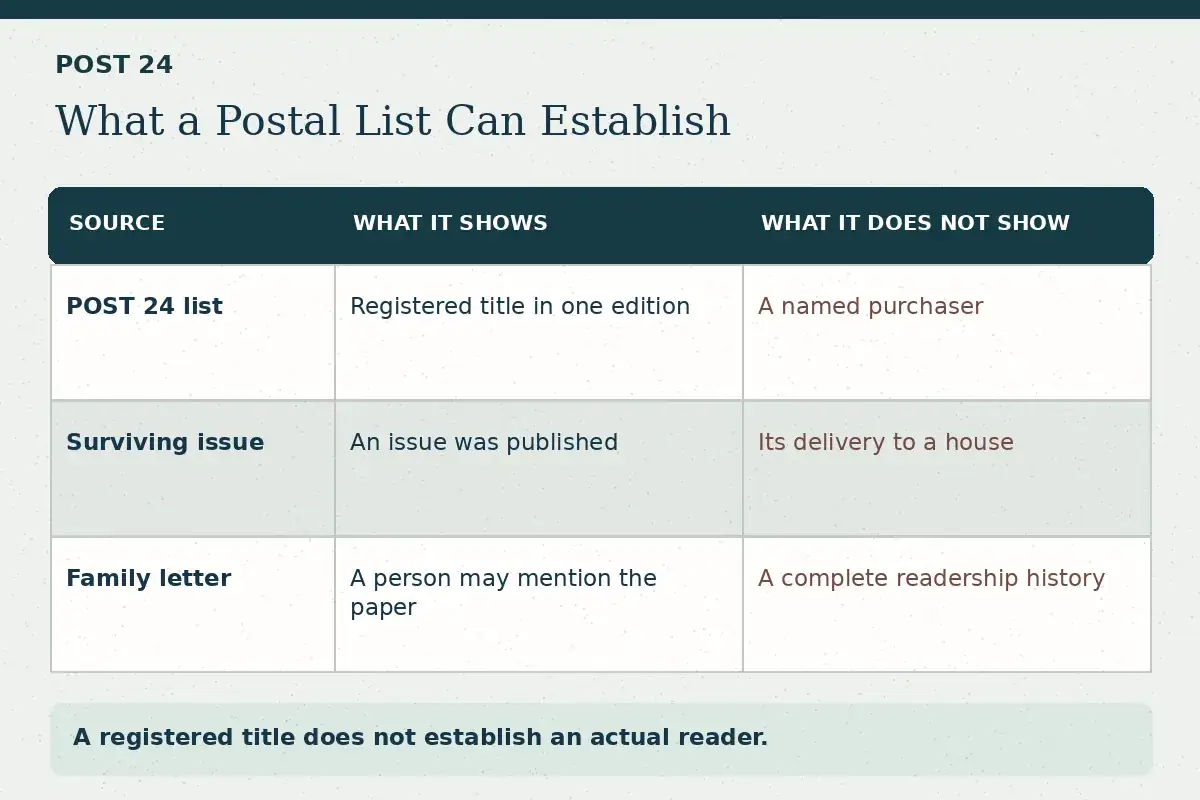
A registered postal title is not proof that an issue was produced, dispatched, delivered or read. Those events involve different actors and records. Search a newspaper repository for extant issues, and distinguish an issue dated on its masthead from the day an individual may have received it. A library’s holdings or digitized pages can confirm publication on particular dates but still do not tell you who subscribed.
If the research concerns an editor, seek a contemporaneous imprint, directory, publishing notice, legal record or another original naming that person. An entry bearing a newspaper’s title does not establish the identity of all editorial staff. When a family memory says a grandfather distributed newspapers, check his occupation on a census or directory and a dated employment or business record. The postal list can supply context, not a person-specific contract.
Use a three-column evidence ledger. Put the literal POST 24 entry under what the record says; put any inference about availability in a second column; and put delivery, employment and readership in the unresolved column. For every unresolved item name a specific test, such as a publisher account, distribution contract, family letter or surviving issue. Do not draw an automatic arrow from registered title to actual reader.
Build a Negative Search That Does Not Overclaim
A no-hit search has limited meaning unless the target title, years and source scope are known. Note whether you searched a metadata catalog, a published list index or the original pages. If you used optical character recognition, visually inspect nearby entries and common historical spellings; optical errors can hide a name. A title can also be listed under a different city or after a change in masthead.
Compare at least one independent newspaper catalog and surviving issue to the registration result. A title documented in a newspaper library but absent from one POST 24 volume could still have existed and circulated through other routes. Conversely, a listed title without a surviving issue remains documented as a listed title, not as a read issue. Mark each conclusion with its particular source and date rather than an all-or-nothing yes or no.

For a local-history timeline, retain three distinct rows: newspaper title attested, a dated issue preserved, and an identified family connection. Each has its own citation and confidence status. That simple arrangement makes the result reusable when you later uncover an address, a trade directory or a letter mentioning the newspaper. It also keeps the article focused on the precise information the postal archive can supply.
More Research Method Guides
How We Research Historical Newspaper Postal Lists
We check the Postal Museum archival series description for POST 24, including the published-title volumes, and compare it with the AIM25 newspaper-post description. We use the Discovery research guidance to separate a series description from a document seen in full. Edition, title and date are transcribed rather than inferred from a search snippet.
Our examples are illustrative workflows, not reconstructed individual subscribers. No evidence of readership is assigned without a separate person-level source. Access to original registers may depend on repository arrangements. We disclose our editorial and commercial relationships at our affiliate disclosure; no museum endorsement is implied.
No. Published registration lists concern newspaper titles and postal arrangements, not individual purchasers or household subscriptions.
The Postal Museum identifies POST 24/21–72 as the main group of published lists; confirm the exact volume and coverage before quoting it.
No. Check the list’s date and postal scope, alternate titles and independent newspaper holdings before drawing a negative conclusion.
Only a separate entry explicitly naming the person can begin to support that assertion; use imprints, directories or employment evidence.
Record repository, POST 24 piece, exact title of the list, edition/date and page or entry as seen, plus your access date.