
The National Archives presents the Joan Guppie case as an example of violence and conflict surrounding an accusation of witchcraft in early seventeenth-century England. A legal bill submitted by Thomas and Joan Guppie described an alleged attack by neighbors in Dorset. The document is dated December 1605 and is identified as STAC 8/149/24. The historically useful first conclusion is not that the court proved witchcraft—or proved every detail of an assault—but that a specific complaint was made and entered a recognizable legal process.
The bill names people and places and gives a narrative of an alleged confrontation. Researchers should record those details as statements made by litigants, not convert them into neutral narration. A claim that a neighbor acted maliciously, for instance, expresses the complainants’ position. When writing family history, use language such as “the bill alleged” and add the documentary reference. This keeps the record vivid without repeating an accusation as a fact established by a judge.
What the Joan Guppie Papers Actually Describe
Build a working worksheet with columns for the question being tested, document reference, exact recorded wording, event date, recording date and what is still unknown. Treat a catalogue title as a route to evidence rather than a substitute for viewing the item itself. If a source describes a decision, distinguish its wording from the action you hope happened later.

Read Bills, Interrogatories, and Answers Differently
The Court of Star Chamber produced several forms of document: an initiating bill or petition, a defendant’s answer, interrogatories put to witnesses and testimony given in response. The National Archives explains that the sequence could be incomplete and that surviving papers from one dispute might be scattered. A bill tells you what the plaintiff wanted the court to consider. An answer provides another party’s reply. An interrogatory is a question, not evidence that its premise is true.
In the Guppie educational transcription, the available witness material includes language about a reputation for sorcery and what someone had heard from others about illness. That distinction matters. “Known” in a witness’s phrasing cannot be separated from the basis of their knowledge; a report of community suspicion is evidence about rumor, not an observable supernatural act. Copy the exact words of the relevant passage and tag each sentence as first-hand observation, reported speech, allegation or interpretation.
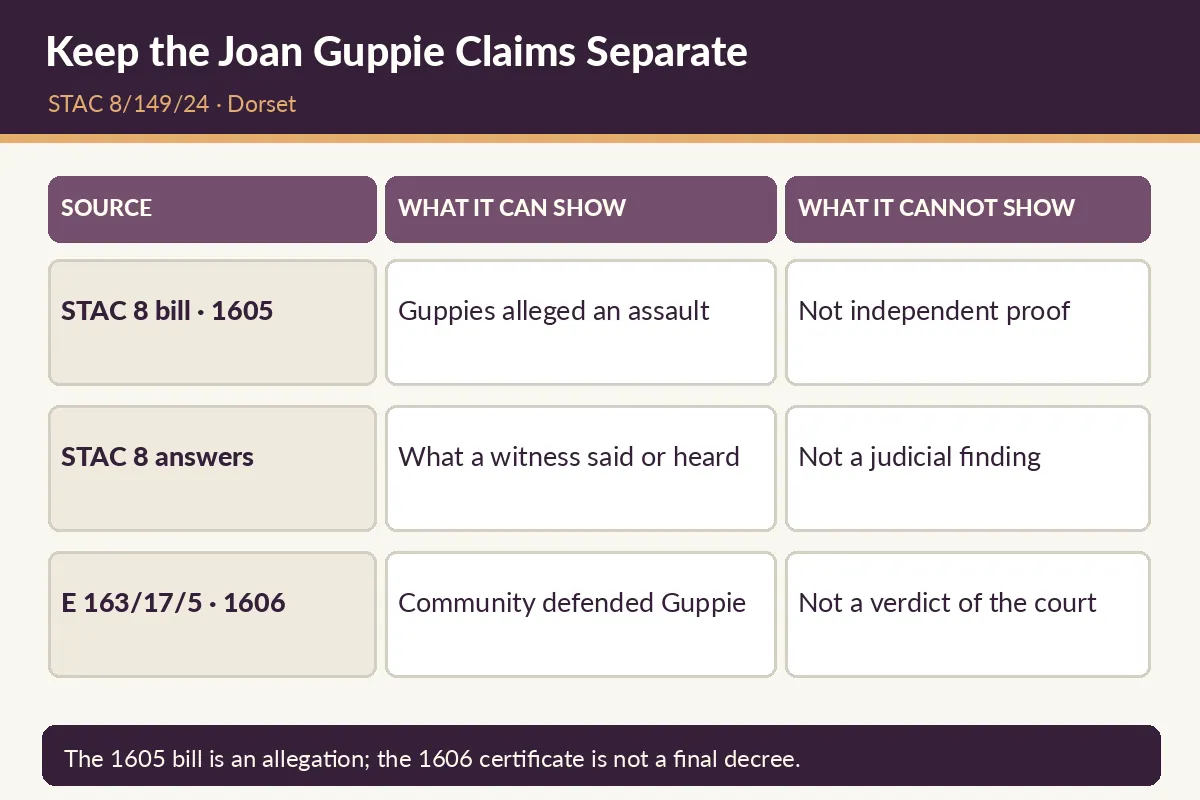
Separate the 1605 Pleading from the 1606 Certificate
The archive’s teaching collection also identifies E 163/17/5, a 1606 certificate in which local people defended Joan Guppie. The document is described as heavily damaged, written in Latin and without a complete transcription in that resource. Treat it as a separate intervention by members of a community rather than as the final determination of STAC 8/149/24. A defensive statement can show what signatories chose to attest, but its survival does not reveal everything the court later did.
Create a small evidence grid with columns for speaker, date, document type, proposition and evidential limit. For the bill, the speaker is the complainant; for an answer or deposition, name the respondent; for the certificate, record a community statement and any uncertainty caused by damage or translation. Do not quietly harmonize conflicting claims. Contradictions are a major part of the historical story, particularly where fear, social reputation and personal disputes overlap.
Why the Court Outcome Cannot Be Assumed
The National Archives states that the final decree and order books of the Court of Star Chamber have not survived. Although some exceptional judgments are reflected elsewhere, the loss of those books imposes a strong limit on casual claims about an individual case. A searchable catalogue reference to the proceedings proves the existence of those surviving proceedings; it does not automatically supply a conviction, a fine or a dismissal. The Guppie materials as cited here do not independently demonstrate the final judicial outcome.
If you need to go further, the archive guide discusses fines in Exchequer memoranda rolls E 159 and the difficulties of researching scattered Star Chamber papers. Such searches must be justified by a specific question and cannot guarantee that a trace exists. Note the difference between a court with jurisdiction to hear witchcraft-related accusations and a specific allegation that the court found someone guilty. The former is historical context; the latter requires surviving case-level evidence.

Write a Family Story That Does Not Repeat the Harm
This case involves mistreatment of a woman accused of witchcraft and potentially graphic evidence of violence. Present only what readers need for the genealogical question and avoid sensationalizing injuries or suggesting supernatural activity was real. Historical spellings of surnames and locations should be preserved alongside carefully identified modern forms, with no automatic merger of similarly named neighbors. A named participant’s presence in a legal record does not establish every relationship between people mentioned in the same paragraph.
A responsible research note can say that STAC 8/149/24 contains a complaint and witness-related material in the 1605 dispute, while E 163/17/5 provides a separate 1606 community response. It can explain what those records reveal about neighbors and allegations, then state that the result of the lawsuit is not established by the consulted evidence. Cite the original archival references as well as the archive’s transcription, and flag any point awaiting a view of the complete documents.
More Research Method Guides
How We Research This Record Series
The starting points for this article are the research guidance published by The National Archives: the series-specific guide and the explanation of Discovery catalogue limits. The official descriptions establish which records may be relevant, not that a specific ancestor appears in an unread original. Our workflow deliberately separates source descriptions, primary-document observations and independent corroboration.
For every claim, record the archival reference and the page or image actually consulted, following The National Archives citation guidance. Ask whether the person or place could be a namesake, whether the source was contemporary, whether a second record is genuinely independent, and whether the material is restricted or undigitized. This article does not assert that any illustrative search example identifies a real ancestor. See our affiliate disclosure; no paid referral is required for these steps.
A reproducible conclusion has three parts: the exact fact the source documents, the reasonable but still testable interpretation, and the unresolved point requiring another record. Do not present a missing result from one file as universal absence. Before repeating a secondary account, inspect how it quotes its evidence, whether the dates belong to different stages of administration, and whether it silently turns an application, report or allegation into a completed event.
The consulted bill and witness excerpts do not establish such a verdict; the court’s final decree and order books have not survived.
No. E 163/17/5 is a separate community statement defending her, not a final decree in the STAC 8 proceedings.
Not necessarily. First inspect the coverage and any available indexes. An online catalogue description may omit names present on the original pages.
No. Open the original item or a reliable image and read the precise wording, document type, date and author before drawing a conclusion.
Keep the full repository reference, page or folio, original spelling, relevant date, recorded role or place and the words that support your claim.