
The National Archives identifies student record cards of prisoners of war who attended the Wilton Park centre before repatriation to Germany and, sometimes, Austria. The cards belong to FO 1120. That is a narrower population than everyone held in Britain as an enemy prisoner, and even an apparently clear entry cannot establish the later course of a person’s life. A family-history question should distinguish participation in a course from a definite date of return, a permanent residence or a change of citizenship.
Begin by listing the known prisoner’s name, alternative spellings, likely nationality, service or civilian status if documented, any prisoner number, a rough postwar date and the document from which each detail comes. Keep the spelling on the original card separate from modern family spelling. Attendance evidence can be unusually valuable, but common names and transcription uncertainty still require a corroboration test before attributing the card to a particular ancestor.
Understand What Wilton Park Records Were Made to Do
Build a working worksheet with columns for the question being tested, document reference, exact recorded wording, event date, recording date and what is still unknown. Treat a catalogue title as a route to evidence rather than a substitute for viewing the item itself. If a source describes a decision, distinguish its wording from the action you hope happened later.

Use the Right FO 1120 Subcollection
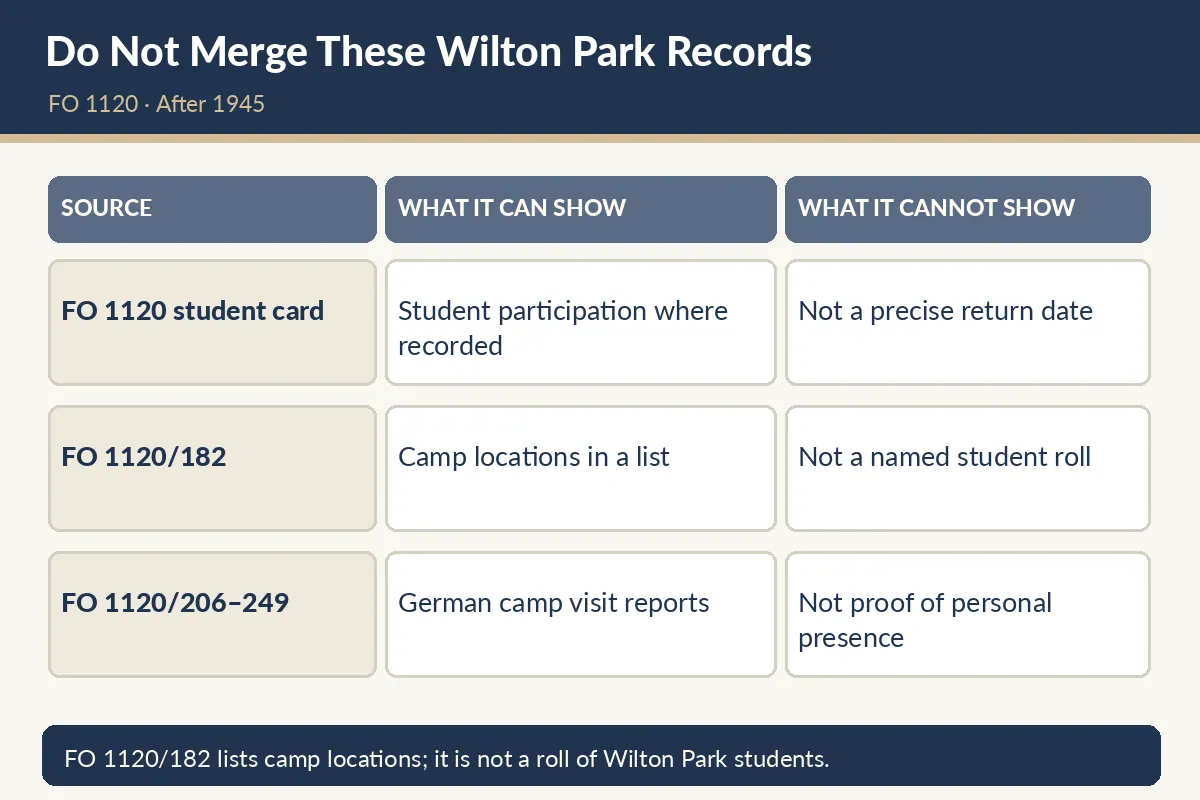
A frequent trap is assuming every FO 1120 description is a personal file. The National Archives separately lists the Wilton Park student cards, a location list for prisoner-of-war camps at FO 1120/182, and reports of German camp visits at FO 1120/206–249. These support different kinds of statements. A list of camps identifies locations in its own period and scope; a visit report speaks to a reported inspection; neither document automatically names an attendee at Wilton Park.
Before opening a reference, write the target claim above it: student attendance, camp location, institutional conditions or later repatriation. Review the catalogue description for its actual title and coverage, then read the underlying document where possible. Do not infer that a particular camp appears in a list at every date, or that a person attended a course because they were previously held in a camp on the same administrative list.
Read a Student Card Without Overloading It
Transcribe only fields visibly present on the card you have obtained. Record the issuing institution, exact reference, card name, any dates, identifying numbers, addresses or annotations, noting illegible marks. Some cards may provide more detail than others; the guide’s mention of student records should not be mistaken for a universal checklist of fields. If an annotation appears later or in another hand, say that it may reflect a separate stage of administration rather than an event on the card’s original date.
Compare the card with independent records in a named-person evidence grid. A matching first name and surname is weak when the population includes many people from the same country. Add available age or birth detail, service record, prisoner number, hometown and chronological fit. Where those features are absent, record the identification as a possibility. The source can still show that a prisoner with that name attended, even when it does not yet identify the family’s ancestor.
Do Not Turn Pre-Repatriation into an Arrival Record
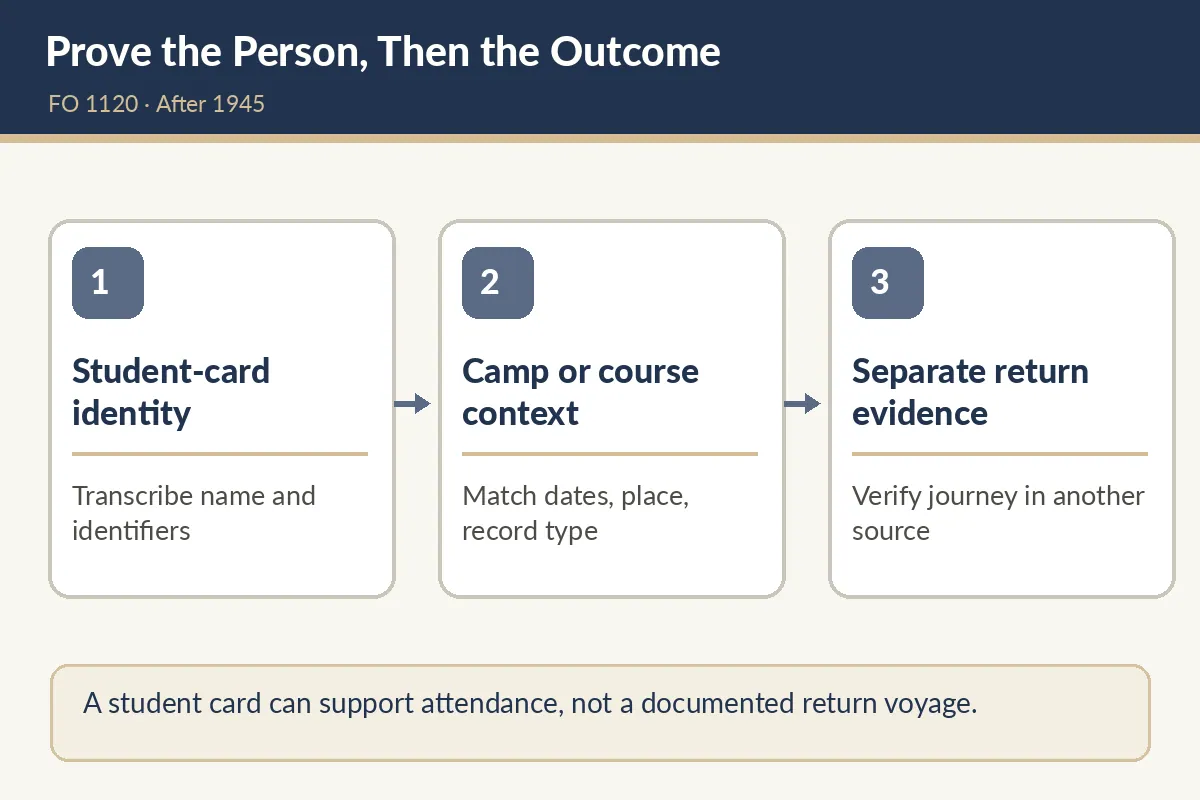
The archive describes Wilton Park attendance as taking place before repatriation. That context explains the institution’s role, but it does not supply an individual embarkation date or a confirmed arrival at a destination. A class card is therefore not a transport manifest. Maintain separate timeline columns for detention, course attendance, documented release, confirmed travel and later residence. Only enter a date in a column when a record directly addresses that stage.
This matters particularly for families whose memories compress several postwar years into one return story. A named card can lead to further searches in German or Austrian local records, Red Cross resources or contemporaneous correspondence when relevant and available. Each outside record must be evaluated for provenance and privacy. Avoid claiming a route, destination or family reunion from an FO 1120 attendance card alone.
Search Beyond the Catalogue Name Field Carefully
The National Archives cautions that its prisoner-of-war documentation is incomplete and that many records concern administration rather than biography. Its Discovery help adds that catalogue searching works on descriptions and titles rather than the full text of every original page. Therefore a no-result surname search is not evidence that a card never existed. Record what FO 1120 files and catalog descriptions you actually examined and ask whether name-level indexing is available for those items.
A good final note should say exactly what has been demonstrated. For example, a card might establish that an identifiable person was a Wilton Park student at a recorded time, while the date of return remains unproven. State which separate document could test the missing date and whether access is open, local-only or unclear. This approach turns an interesting institutional trace into an honest family-history argument rather than a fabricated complete life story.
More Records and Archives Guides
How We Research This Record Series
The starting points for this article are the research guidance published by The National Archives: the series-specific guide and the explanation of Discovery catalogue limits. The official descriptions establish which records may be relevant, not that a specific ancestor appears in an unread original. Our workflow deliberately separates source descriptions, primary-document observations and independent corroboration.
For every claim, record the archival reference and the page or image actually consulted, following The National Archives citation guidance. Ask whether the person or place could be a namesake, whether the source was contemporary, whether a second record is genuinely independent, and whether the material is restricted or undigitized. This article does not assert that any illustrative search example identifies a real ancestor. See our affiliate disclosure; no paid referral is required for these steps.
A reproducible conclusion has three parts: the exact fact the source documents, the reasonable but still testable interpretation, and the unresolved point requiring another record. Do not present a missing result from one file as universal absence. Before repeating a secondary account, inspect how it quotes its evidence, whether the dates belong to different stages of administration, and whether it silently turns an application, report or allegation into a completed event.
It may document Wilton Park attendance. It does not independently establish a departure date, route or arrival home.
No. The National Archives identifies it as a location list of prisoner-of-war camps, a different document type.
Not necessarily. First inspect the coverage and any available indexes. An online catalogue description may omit names present on the original pages.
No. Open the original item or a reliable image and read the precise wording, document type, date and author before drawing a conclusion.
Keep the full repository reference, page or folio, original spelling, relevant date, recorded role or place and the words that support your claim.