
Begin With the Actual RG 129 Record and Question
McNeill Island in Washington appears in NARA’s Bureau of Prisons records as a specific federal institution with multiple surviving administrative series. Record Group 129 section 129.8 lists prisoner commitment logs from 1881–1951, daily reports and journals for 1884–1932, parole board minutes for 1911–1928 and a visitor register from 1934–1938. These materials are described as held in Seattle.
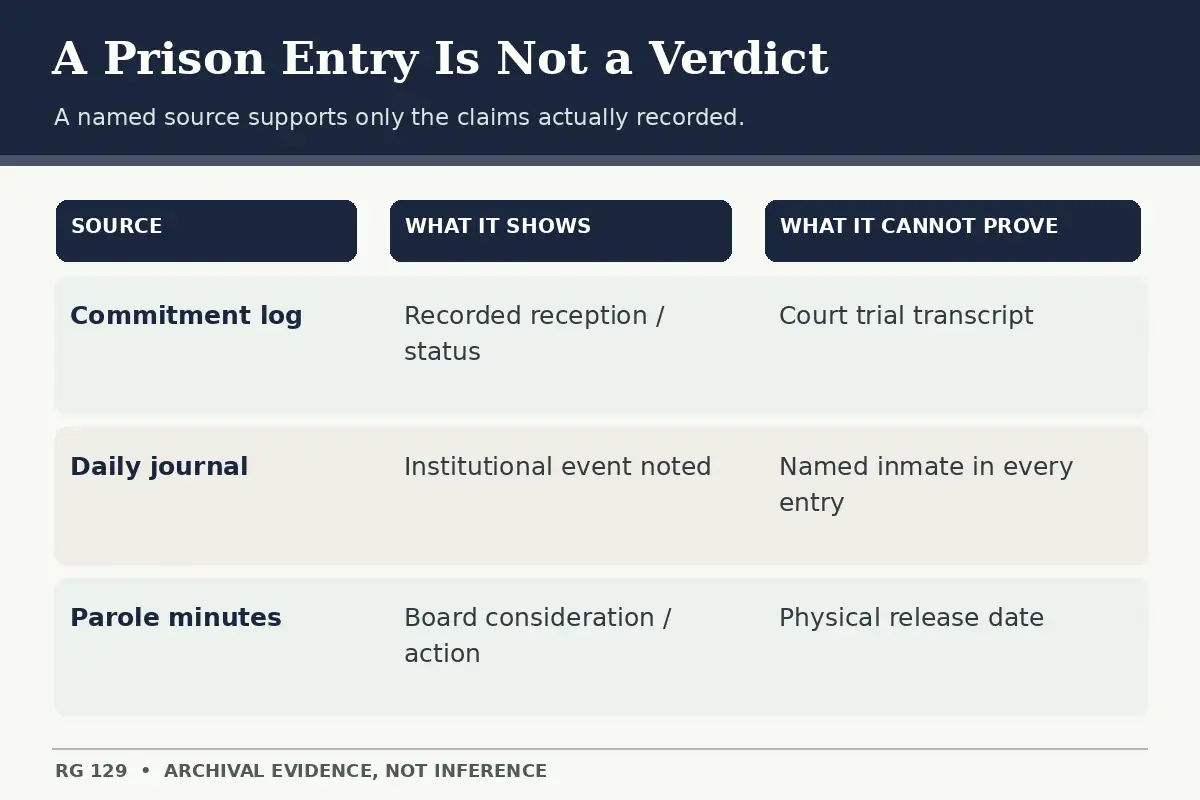
A commitment to a prison is not identical to a complete judicial history. The log may provide names, dates or custody notations depending on the item, but the original conviction, exact legal charge, sentence modification and later release require their own records. Avoid writing that an indexed prisoner was “convicted of” a particular allegation unless an appropriate court record actually establishes it.
The historical source belongs to a named institution. McNeill Island may have held people under differing legal or administrative circumstances over time; the existence of one name in a register is not a sufficient basis for a full biography. Protect privacy where later records remain restricted and avoid identifying living individuals through sensitive prison evidence.

Choose the Correct Documentary Branch Before Searching
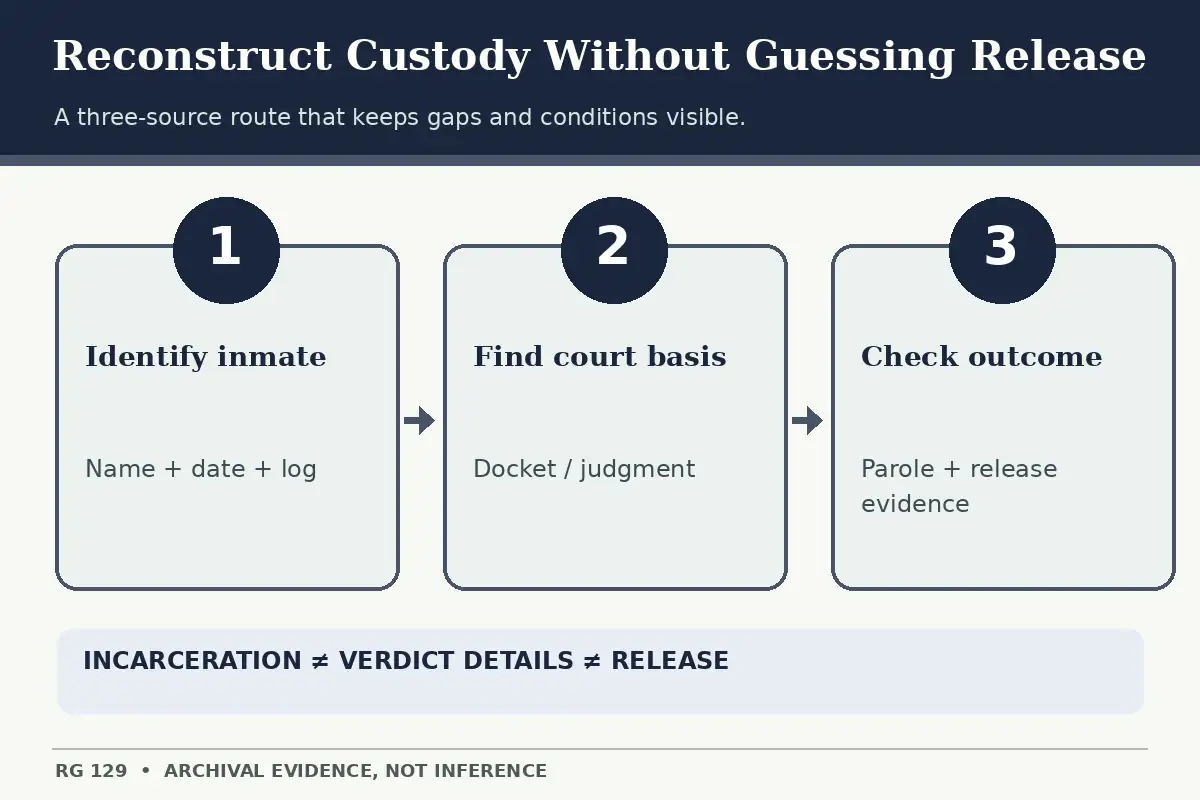
Begin with the person’s name, known approximate custody period, possible court jurisdiction and any independent location clues. In the commitment log transcribe only fields that genuinely appear: entry number, name variants, registration or commitment date, issuing authority, indicated sentence, transfers and notations. Do not presume that every log has the same columns over its long date span.
If a daily journal provides a date of an institutional incident, check whether the person was actually named and whether the occurrence concerns that inmate. A journal may record weather, counts, staffing, movements, disciplinary incidents or routine administration. An entry such as “three arrivals” cannot establish the names of the arrivals without a connected named register.
The NARA guide separately lists parole-board minutes dated 1911–1928. Consideration of parole is not necessarily approval, and an approval is not necessarily the date of physical departure. State exactly the decision recorded, look for a discharge or transfer entry and avoid importing modern parole terminology into historical administrative wording.
Read What the Original Source Can Really Establish
A name match is particularly dangerous in imprisonment records because court cases can involve similar names and varied spellings. Build an identity table comparing age if recorded, place of origin, physical description where actually present, court jurisdiction, known associates and a reliably documented event date. A prison administration number is a stronger locator than a bare surname but still must be linked to the correct underlying court matter.
To establish the legal basis, locate a federal court docket, indictment, judgment or commitment warrant from the relevant judicial district. Those records may fall outside RG 129 and may be held at a different NARA facility. An arrest report, charge or newspaper allegation is not a substitute for the judgment. Note when a document is merely a transcription or later compilation.
For family reconstruction, distinguish an inmate from a visitor. The visitor register of 1934–1938 can record a visit without proving kinship, a household relationship or legal status. Compare any declared relationship against independent evidence such as a civil record, a household enumeration or contemporary correspondence rather than treating visitation as a family-tree link.
Compare Dates, People, Places and Alternative Explanations
A trustworthy narrative separates the timeline into charge, judgment, prison reception, subsequent institutional entries and documented exit. Each stage can have a different custodian and a different date. If a sentence term suggests a theoretical discharge year, never replace that theoretical date with a statement that the person actually left on that day.
Searching a catalog by a name alone is often inadequate because descriptions may exist at the series level, not the individual inmate level. Contact the Seattle holding location using RG 129, McNeill Island, the approximate date and the exact class of record. Record unsuccessful searches by volume, name variant and covered dates, while preserving privacy and lawful access limits.
Preserve the Citation, Gaps and Negative Search Trail
A useful citation starts with National Archives and Records Administration, Record Group 129, the actual record class and the specific item or file identification rather than just the web address. Include the original document title, date, person or place as written, container reference if available, repository or holding location and the date of consultation. The Guide to Federal Records provides a route into the collection; it is not a substitute for the item. In the Catalog, check the description level so that a series-wide date range is not accidentally presented as the date of one document.
Keep a reproducible search note that lists the precise keyword variants, 129.8 section identifier, archival date range and each medium inspected. Write “not located in this indexed set” rather than “no record exists” when the relevant original material has not been examined. Scans may be absent even for described series, and names that appear in individual items may not appear in the electronic description. Ask the custodian about access to the specified material before assuming all surviving files can be downloaded.
Put three evidentiary statuses beside each claim: confirmed directly by an identified document, supported conditionally by comparison, or still unproved. Where records disagree, note the differing document dates and explain whether a plan changed, a reporting period differed, a transcription error is possible or two separate people or sites may be involved. This is more useful than forcing all sources to tell one uninterrupted story. The RG 129 guide supplies a collection outline, but its broad descriptions cannot resolve contradictions hidden in the unexamined originals.
More Records and Archives Guides
How We Research and Verify Archive Claims
We checked the official NARA guide to RG 129, particularly section 129.8, for the record creator, surviving documentary categories, dates and the specific limitation that shapes this article. The source establishes that the described collection exists; it does not establish any unexamined person-level claim. This page therefore gives conditional next steps rather than fabricated file numbers, unnamed digitized scans or guaranteed search results.
We also checked NARA’s instructions for using its Catalog and its research-visit guidance. Catalog descriptions can be at record-group, series, file-unit or item level, and many original pages are not online. We recommend confirming the correct custodian, requesting the precise class of item, preserving provenance and comparing independent records before presenting a conclusion. The site’s affiliate disclosure explains its relationships; no paid record provider is required by this method.
The NARA guide lists commitment logs for 1881–1951 in RG 129 section 129.8.
The RG 129 description identifies Seattle for the McNeill Island textual records.
No. It records a prison-administration event; the court docket and judgment are needed for the legal finding.
No. McNeill daily reports and journals cover 1884–1932 and describe institutional events; named entries may be selective.
Check a documented discharge, transfer or release entry and any relevant parole or court evidence rather than inferring a release from a board minute.