
Recognize the Narrow Scope of the Photo Albums
Two Wandsworth Prison photograph albums held in PCOM 2 are unusually detailed sources for identifying people imprisoned in 1872–1873. They are not a complete portrait collection of Victorian prisoners, and they do not show everyone who passed through the prison in those years. The National Archives states that the included prisoners were sentenced to one month or more. Before searching by name, write down the prison, approximate conviction date, likely sentence length and other identification clues.
The official Wandsworth photograph guide identifies two volumes, PCOM 2/290 and PCOM 2/291. These were kept to help identify people convicted of crimes, particularly on subsequent encounters. The entries may be strikingly personal, but a portrait and a name do not by themselves show that the person is a particular ancestor. A common name still needs supporting chronological and geographical information.
The entry can include a physical description, date and place of birth, offense, sentence, place of conviction and intended residence after release. It often includes residence before imprisonment. Treat every field according to its wording: “intended residence” is a prediction or statement of plan, not a confirmation that the person actually appeared at that address after release. Spelling and ages should be checked against records created for other purposes.
Use the Sentencing Gate to Avoid False Absences
For a Wandsworth conviction in the album period, first ask whether the recorded sentence reached the one-month threshold. Someone held on remand, discharged without such a sentence or sentenced for a shorter period may be absent from the albums even if they were physically in Wandsworth. Do not turn a failed name search into a finding that a person was never imprisoned. The precise rule of inclusion is more useful than a vague claim about a lost archive.
The National Archives guide to prisoners and convicts dates PCOM 2/290 to December 1872–February 1873 and PCOM 2/291 to April–December 1873. That is not uninterrupted coverage of every day in 1872 and 1873; check the volume and the known gap before interpreting an absence. The specialist guide explains that the albums can be searched in Discovery and may be downloaded for a fee, while browsing by volume offers a name-search fallback.
For broader Wandsworth prisoner entries, PCOM 2/230–289 holds registers from 1858–1879, generally with briefer information. These can supply a lead when the person does not appear in a photo album, but should not be represented as photographs. Check the original register date and page, and then ask what crime, sentence or discharge information is actually present in the particular entry. The existence of a related series does not guarantee a matching record.

Transcribe Identity Clues Before Drawing Conclusions
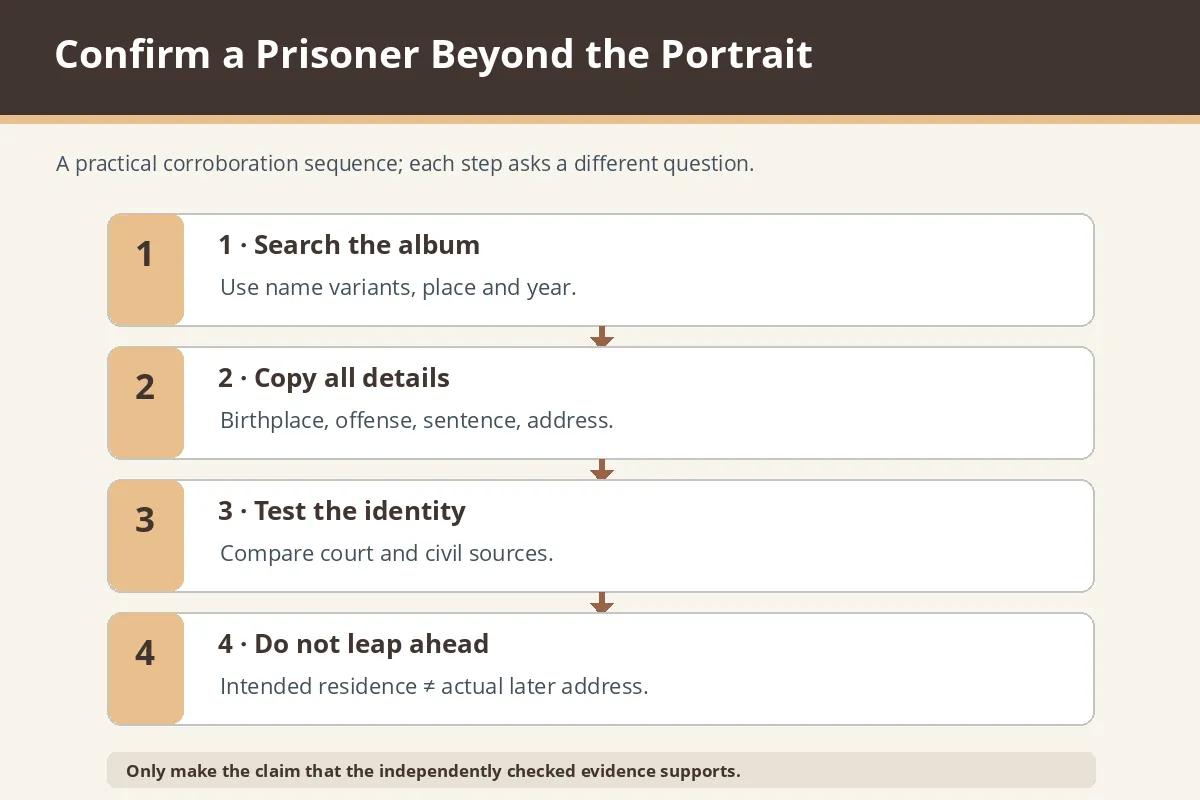
Make a transcription with separate fields for recorded name, age or birth date, place of birth, height or other description, known residence, place of conviction, offense, sentence and intended post-release destination. A profile assembled from these details is substantially stronger than comparing two photographs visually. A camera image can help distinguish people but cannot establish parentage, birthplace or later whereabouts without the accompanying words and independent records.
An age in a prison document may conflict with one in the census. Rather than silently correcting one, calculate the approximate birth intervals and compare the birthplace, occupation and address. A given name may be shortened, a surname misheard or the court jurisdiction recorded differently from the family’s residence. A same-name match should remain provisional if the dates, relationships or reported birthplace cannot reasonably be reconciled.
Read the page headings, annotations and any separate record number before lifting an individual entry. An annotation may have been added later, so avoid treating every mark as contemporary with the photograph. Include the precise PCOM reference and image or page number in the citation. If you use a transcription or an indexed hit, identify it as a derivative view and return to the photographed original to verify the interpretation.

Connect Court Proceedings to Later Family Records
Next search the appropriate local court, sessions or newspaper material using the offense date, place of conviction and other details. A court report can clarify what was alleged, what was established and what sentence was imposed; it should not be conflated with an administrative portrait entry. A newspaper may introduce factual errors or sensational language. Compare the chronology and wording rather than assuming either text is a perfect biographical account.
The intended residence after release is particularly tempting for family-history research, but it must be followed by an independent address record. A later census, marriage certificate, directory or other contemporaneous record may identify the same person or reveal a conflicting same-name candidate. If there is a gap, state the gap plainly. One Wandsworth entry does not prove where a prisoner lived continuously or that they moved to the stated destination.
Treat the offense and punishment with context and care. Historical labels and judicial practices should not become a family stereotype or a description of living relatives. Where a child appears in the material, avoid sensational presentation. Reconstruct the facts from the documents and keep privacy, dignity and uncertainty in view. The photo records were created for a penal institution, not to tell a balanced story of the person’s life.
Write Up the Result as a Bounded Historical Claim
A defensible conclusion might say that a named individual, with a matching birthplace and recorded occupation, appears in a specific Wandsworth album on a stated date. It should not say that a later relative is definitely the same person until the identity evidence is sufficient. Include both supportive and conflicting facts, such as a similar age but a different place of birth. Explain what further search could resolve the conflict.
A failed album search is also reportable if you list the variants, the specific PCOM 2 volumes or date range searched and the inclusion rule. Then try the broader registers and local court records. Preserve “not found in this bounded collection” as a different conclusion from “not convicted.” This distinction is especially important because the two photo albums cover a specific institution, dates and sentence threshold.
More Records and Archives Guides
How We Research This Record Series
We begin with the institutional purpose and dated scope of each archival series, then trace the claims to the original record rather than relying on a search-result snippet. This guide was prepared using the linked custodian research guides, and catalogue descriptions should always be rechecked before a research visit. A series date range describes a group of surviving records, not guaranteed person-by-person coverage. We distinguish a named entry, an administrative statement, a corroborated identity and an unresolved inference; none should be silently substituted for another.
For this topic the custodian references are the primary National Archives guide and the complementary research guide. Access and reproduction arrangements may change; check the archive before ordering a copy. Read the affiliate disclosure for the site’s general relationships. No recommendation here requires a paid partner or presumes a commercial endorsement.
No. The official guide says they include people sentenced to one month or more, within the surviving volume coverage.
PCOM 2/290 and PCOM 2/291 are the two Wandsworth photograph volumes.
Try variant names and browse the relevant volume; use place, sentence and conviction clues.
Do not expect that person in these albums; consider Wandsworth prison registers in PCOM 2/230–289.
No. It is an intended destination, requiring an independent later record for confirmation.