
HO 23 covers certain prisoners transferred from national institutions into county prisons during 1847–1866. Begin with a prison and date; read reception and removal separately from the underlying court’s verdict. Use The National Archives’ prison research guide and our affiliate disclosure. A transfer does not prove a second crime.
Search for a Custody Transfer, Not a New Sentence
HO 23 records a particular kind of movement: prisoners from national prisons lodged in certain county prisons from 1847 to 1866. A second prison name in this series need not mean a second trial, a new offence or a release. The series exists because the government rented accommodation for overflow prisoners. Begin with an existing conviction or prison clue, an approximate date and a county holding location. If you have only a surname, a broad search can attach an unrelated person to a damaging criminal allegation.
The National Archives separates HO 23 from criminal trial registers HO 26/27 and later prison-licence files. A sentence recorded in one source and a transfer in another form two administrative events. Search each using its proper date and repository. An inmate’s literacy, marital state or trade recorded by an official may be based on questions at reception and must not be recast as independently verified biographical fact.
Identify Which County Prison Held the Person
A HO 23 search works best from the prison and the period. The series covers certain county prisons used by the government, not every county lockup in England and Wales. The official custodial information identifies prisons such as Aylesbury, Bath, Leeds, Leicester, Northampton, Nottingham, Preston, Reading, Somerset and Wakefield. Do not treat the list as a directory of the places where the prisoners committed offences or lived before conviction. A lodging prison is simply the place named in the administrative record.
Catalogue entries may not index every surname. Choose a suspected prison, review the coverage dates and inspect the matching volume where the record can be accessed. Keep the spelling of the prison and any historical county division as printed. A similar named person in a different prison may represent an independent case. If the search yields no hit, record whether you checked the relevant book’s index, the image pages or only a commercial database transcription.
Read the Reception and Removal Columns
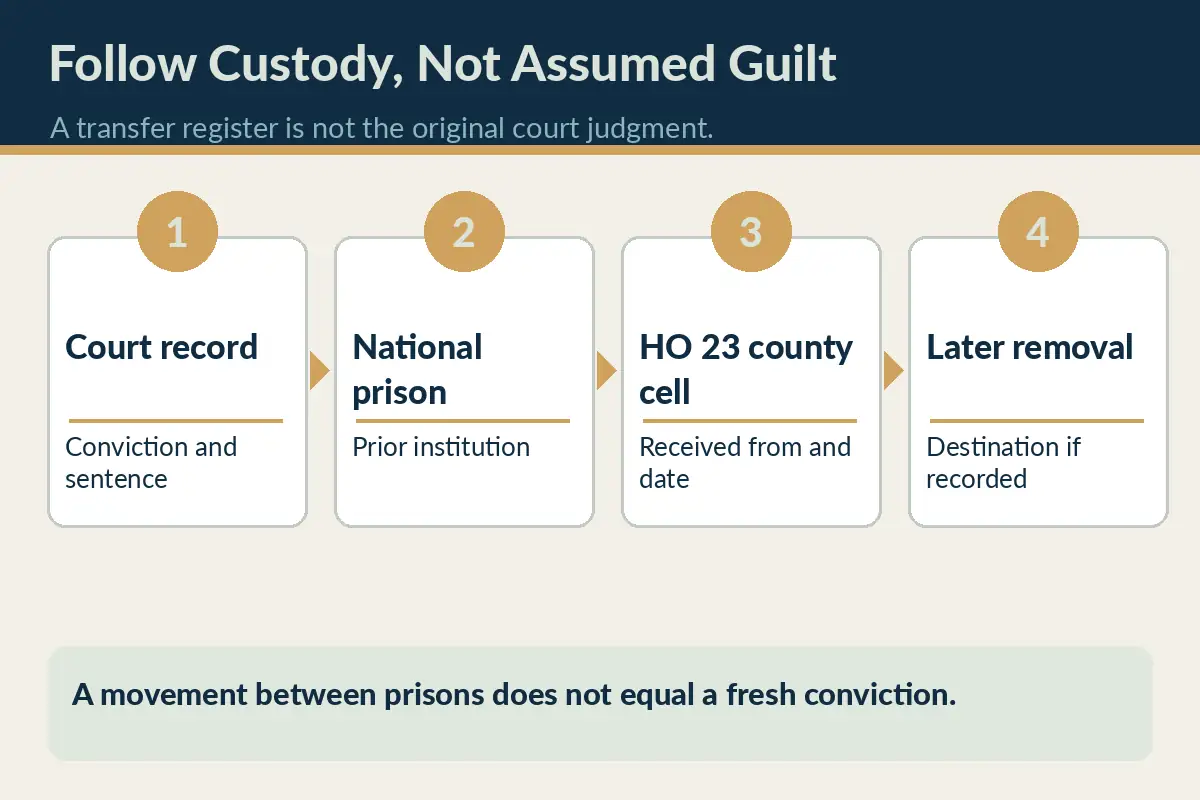
Surviving HO 23 registers can record age, marital status, number of children, ability to read or write, trade, where and when convicted, crime, sentence, previous offences, where received from, and when and where removed. Not every line will have all fields. The heading and its precise wording matter more than a standardized internet extraction. Preserve the reception date separately from conviction and later removal; the year in a caption might refer to the first or last recorded administrative action.
If a removal column names another prison, this is a custodial event, not a new sentence by itself. A blank removal field may reflect incomplete completion, a missing following book or an event outside the surviving span. Do not turn a written previous-offences field into a claim that every alleged incident produced a proven conviction. Consult a court register or original trial proceeding for the verdict, and keep historically reported characterizations in quotation marks with provenance.
Compare the Conviction With a Court Record
A prison register is usually an administrative summary. The underlying trial or court file may separately identify offence language, plea, verdict, sentence and later review. Search those documents by court, district and conviction date, not simply by where an individual was subsequently lodged. A mismatch between a transferred prisoner’s age and a matching name in a court calendar should trigger a namesake check, not an automatic correction to the official age.
Create a three-event worksheet: court disposition, transfer reception and subsequent removal. Record the dates exactly and mark intervals where no record has been seen. If the person later appears in a census, parish register or workhouse list, that source needs its own identity comparison; a person’s trade recorded in HO 23 is a clue but not a unique identifier. Avoid linking a criminal case to a descendant on surname similarity or family tradition alone.

Respect Gaps and the Difference Between HO 23 and HO 24
HO 23 consists of a limited series for national prisoners lodged in county prisons. HO 24 contains prison registers and statistical returns across a different period and purpose. Neither is a complete name list of everyone imprisoned in Victorian Britain. An entry absent from HO 23 may simply mean the prisoner was never moved to that set of contracted cells. Check which prisons and years survive before using a missing name as evidence.
The National Archives’ prison records guide advises searching by prison name and date and checking the “held by” field. Later prison records can be restricted; this nineteenth-century guide is not a reason to seek closed files about living persons. Keep prison administration records, individual custody registers and criminal proceedings distinct. If a page or volume is missing, cite the gap explicitly instead of guessing the transfer date.
Produce a Responsible Person-Level Result
For each proposed match record the exact HO 23 piece, prison, page, name as written, reported personal fields, conviction entry, reception from another institution, and removal details. Note whether the item was an original image, an official finding aid or a paid database transcription. A short, source-bounded statement such as “this register lists a person of that name received at the county prison on this date” may be all the evidence permits.
When the record mentions an illness, trade, literacy or family circumstance, attribute the wording to the document. Avoid sensational language, and do not treat a prison transfer as proof of later criminal conduct. In the research log identify one independent court or civilian record that could resolve namesake uncertainty. The goal is a reproducible custody timeline, not an inferred biography stitched together from different people or an unverified family accusation.

How We Research Prison Transfers
We identify the expected prison and date before browsing HO 23, then transcribe the original custody heading and its recorded transfer events. We treat conviction, reception and removal as distinct stages, and compare court proceedings before making a legal claim. We avoid attaching unverified criminal histories to a same-name ancestor, and we document exactly which HO 23/1–20 volume or index was checked.
More Records and Archives Guides
Official References and Record Access
Our source checks use the custodian’s published descriptions, not guessed coverage. Primary repository guide supports the scope and identification method stated here. Additional official context supports the scope and identification method stated here. Independent form or finding aid supports the scope and identification method stated here.
No. It covers certain overflow prisoners from national prisons lodged in designated county prisons from 1847 to 1866.
No. It can be an administrative movement without any new trial.
HO 23 is arranged by specific institutions and dates; a surname-only index may be incomplete.
Some lines record reported marital status and number of children; corroborate these elsewhere.
HO 24 has distinct prison registers and statistical returns, not the same overflow-transfer series.