
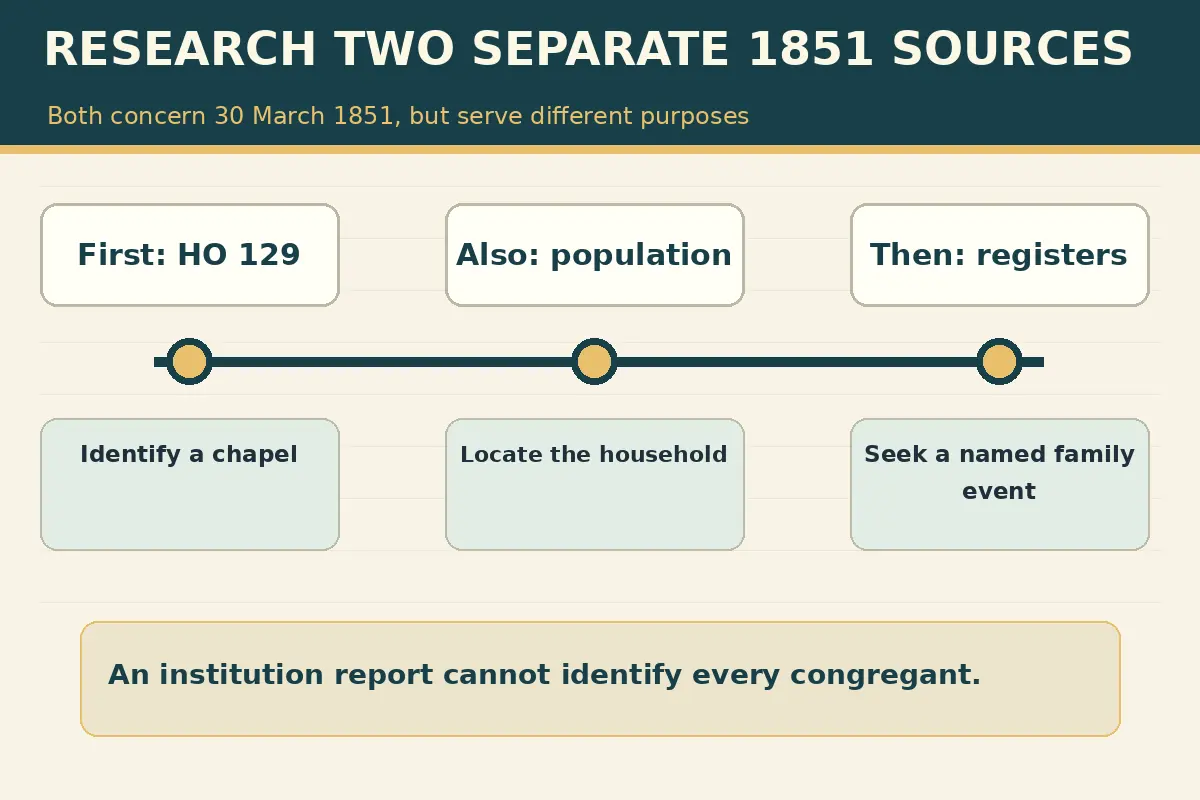
Use HO 129 to identify a place of worship operating in England or Wales on 30 March 1851, then follow that institution to a separate register or local archive. The ecclesiastical census records churches and chapels rather than named worshippers, so it cannot by itself place an ancestor inside a particular congregation. For transparency see our affiliate disclosure.
What the Sunday Return Actually Counts
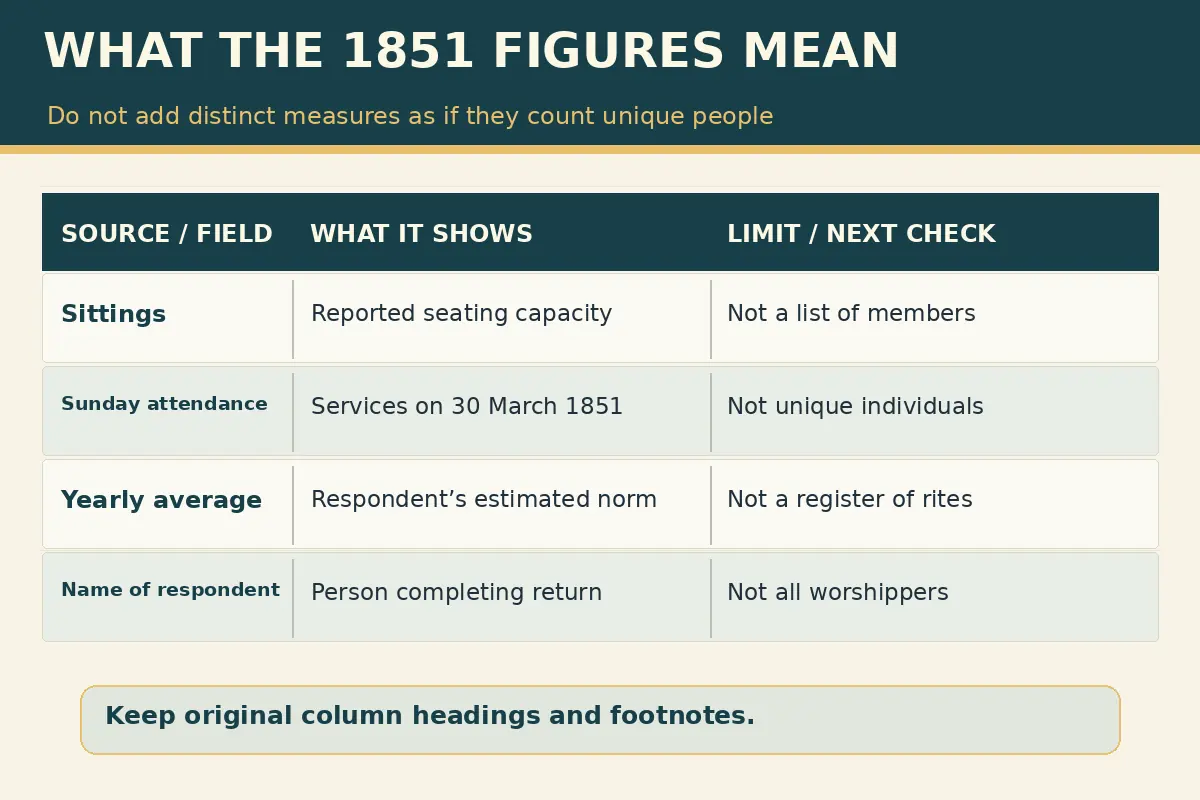
The 1851 religious census asked about individual places of religious worship in England and Wales. The Home Office returns in HO 129 include information about buildings, seating or ‘sittings,’ endowments, estimated attendance on Sunday 30 March 1851, and average attendance in the preceding twelve months. These numbers describe the institution as reported by its respondent, not a roster of people. A reported attendance of 120 does not document 120 distinct identifiable residents, and one individual could have attended more than one service. Treat the attendance column as a clue to local religious life, not a conversion formula for household membership. The official digital microfilm list states the series scope.
Keep HO 129 Separate From the 1851 Population Census
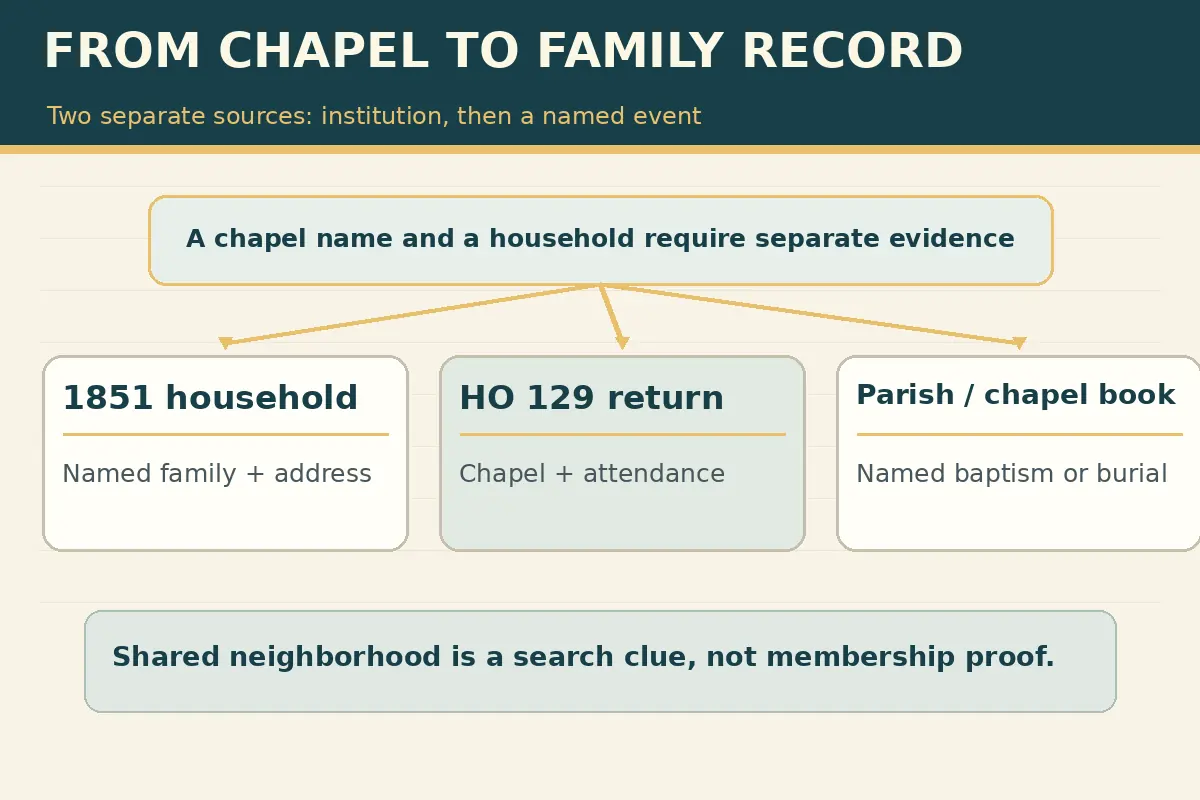
The religious return and the household census took place in the same census season, but they answer different questions. The household return identifies residents by name and place of residence; HO 129 describes places of worship. An address next to a chapel on a population schedule is not membership evidence, and a family’s later denominational identity should not be projected backward without contemporary support. Build two independent citations: the exact place-of-worship return and the household enumeration reference. If a source mentions a minister, distinguish that named respondent from the congregation itself. That distinction prevents a seemingly promising chapel entry from being mistaken for a missing person index.
Start With Chapel Name, Locality and Denomination
Begin with the ancestor’s independently documented township or parish rather than guessing a church from a surname. Make a shortlist of the Anglican parish church, nearby Nonconformist meeting houses and any other worship places in the period. Spellings, chapel names and ecclesiastical associations can change; one chapel can have a popular name, a formal dedication and a street address. The HO 129 catalogue is the first authority for series identification. Work from county and town toward specific pieces where possible. For every candidate capture the building name, reported denomination, address or district, respondent, date and any uncertain word on the original scan.
Read Seating and Attendance Without Double Counting
Sittings indicate estimated seating capacity, not a congregation roll or the number present at a single family event. Some returns distinguish free and appropriated sittings or separate morning, afternoon and evening attendance. Copy column headings exactly before adding figures: totals calculated across service times can count repeat visitors more than once. The average over the preceding year has a different evidentiary meaning from the reported census Sunday numbers. If a figure looks implausibly high or low, check whether a digit, blank, estimate or qualifying note was misread. Never infer the number of children baptized or the number of marriages from attendance figures.
Move From a Chapel to Its Surviving Registers
Once the building is firmly identified, investigate where its historical baptism, marriage, burial, membership or minute books are kept. Start with the local record office and relevant denominational repositories, using the chapel’s historical names and the date of the family event. A chapel return does not promise that any register survives, or that worshippers used that chapel for every rite: legal marriage arrangements and practice differed among denominations and periods. Test neighboring congregations, established parish registers and civil registration where relevant. Record precisely which institution created each register and which modern custodian now holds it. Do not claim that a specific person belonged to a chapel without person-level corroboration.
Use Negative Searches Only Within a Defined Collection
A missing HO 129 result is not evidence that the locality lacked religious worship. Buildings could be described under another name, indexed under another district, omitted, or represented by incomplete paperwork. Keep the original search query, place variant, filters and date in a search log. Then consult contemporary directories, tithe maps, historic town plans and denominational histories for corroboration. If the village chapel existed by 1849 but no matching return appears in the portion searched, the conclusion is only that you did not find the return there. An absence assertion requires a full coverage assessment, not merely a failed surname search.
Evaluate an 1851 Education-Return Exception
The same administrative exercise had an education component, but researchers must not expect a complete school census bundled with every chapel return. The National Archives education guide says that only a very small number of voluntary educational returns survive in HO 129, notably scattered forms around Todmorden and Keighley. If a search result refers to a school rather than worship, identify the document’s actual purpose before citing it. A school’s attendance figure, like a chapel’s, does not supply an identifiable list of pupils. Use the educational fragment to select other institution-level sources, not to create invented childhood biographies.
More Place and Jurisdiction Guides
How We Research an HO 129 Chapel Link
We establish the target family’s residence and dates from person-level evidence first. We then locate HO 129 by historical place, inspect the original return and transcribe chapel name, denomination, number of sittings, service-specific attendance, averages, respondent and any annotations. The original document and its Discovery reference are cited independently from the family record. We compare chapel and parish names against historical maps or a county archive catalogue, then search for separate registers and test each name-level match. The result is a documented route to a potential congregation’s records; it is never a claim that a particular ancestor attended church merely because they lived nearby.
A practical worksheet should have three columns: verified family residence, candidate worship institution, and surviving person-level register. Add a fourth for gaps. For instance, a fictional Jones household in an 1851 street enumeration and a chapel of the same street should initially be two unlinked observations. Only a dated baptism naming a parent, or another independent register, can move the family-to-chapel link from a location hypothesis toward documented participation. Always preserve the actual source wording, even when a modern building uses a different name.
Not as an every-person census. Search by chapel, place and denomination; then consult separately surviving person-level church records.
No. It records reported attendance or estimates, sometimes across multiple services, without naming congregants.
No. HO 129 describes places of worship; the household census is a separate population record.
Not necessarily. Omission, indexing differences and uneven survival mean a failed search is not proof that the chapel never existed.
Record HO 129, the exact piece and page or image, chapel and historical locality, with separate citations for any parish register.