
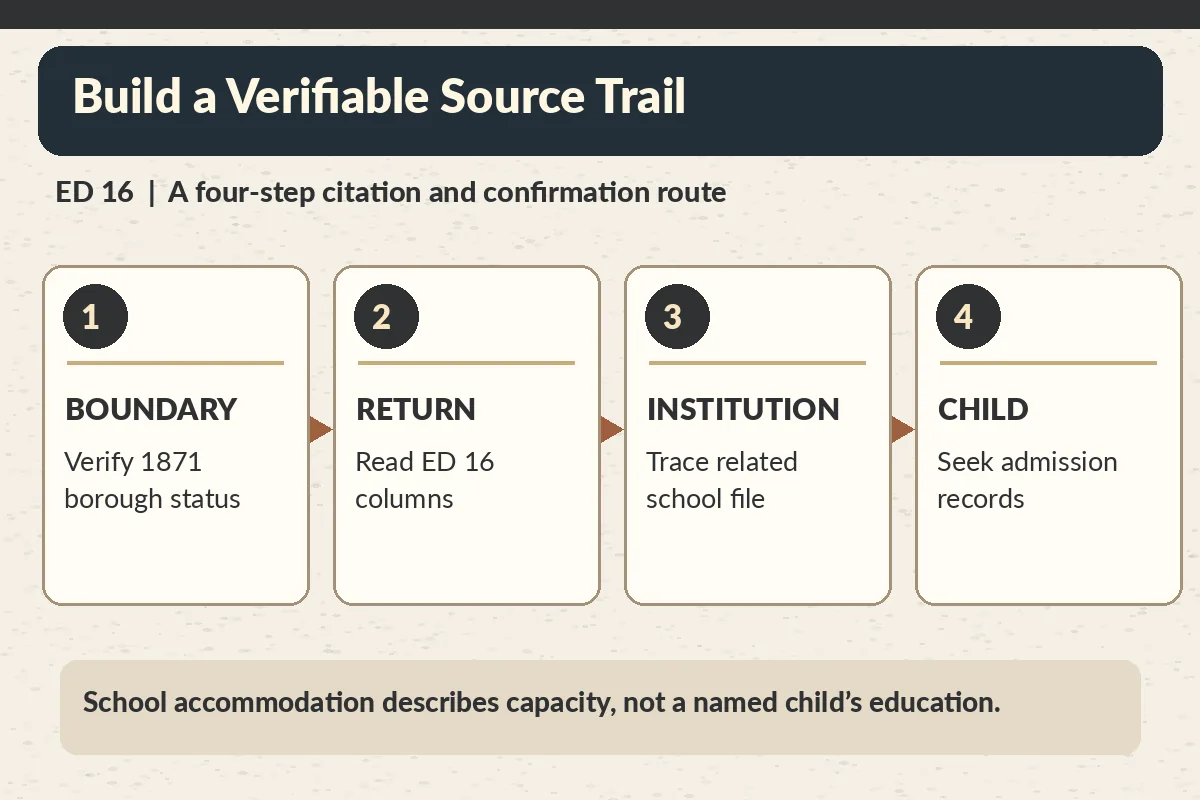
ED 16 is a borough-level route into the 1871 census of school accommodation in England and Wales, not a register of individual pupils. After the 1870 Elementary Education Act, officials needed to understand the number of places available for schooling. The National Archives directs researchers to ED 16 by municipal borough, ED 2 by parish in certain circumstances, ED 3 for London parishes, ED 21 by school and sometimes ED 33 for independent schools. Choose the historic jurisdiction first. A reported capacity does not prove a particular child enrolled, attended class, or lived within the catchment at the census date.
Determine Whether the Place Was a Municipal Borough
Begin with the administrative status of the place in 1871, not its present-day council boundaries. A town name may be used for a parish, a municipal borough and a later urban district, each with different records. The official elementary schools guide makes ED 16 the route for municipal-borough educational census material. Record the historic borough spelling and county, and compare it with a contemporary directory or administrative history before choosing the record. An area that is a city now may not have held the same status in 1871.
If the place was not a municipal borough, follow the archive’s alternatives instead of forcing an ED 16 match. ED 2 concerns parish files when there was no school or more than one school; ED 21 is arranged by school where only one school existed in a parish. ED 3 covers London and is arranged by parish through metropolitan divisions. ED 33 may include some independent school returns. These are distinct filing pathways, not five consecutive volumes every school must appear in.
Know What the 1871 Census Measured
The educational census examined school accommodation in the wake of the 1870 Act. A return may indicate the provision or suitability of places and the schools or facilities counted in a local area. This purpose differs sharply from the decennial population census, which records households and people. Before treating a number as pupils present on the day, read the actual column heading: school places, accommodation, attendance and children of school age are not synonymous categories. Do not use a borough-wide figure as a named child record.
Suppose an ED 16 return indicates that a town lacked sufficient places relative to the population of school-age children. That is evidence of a planning concern, not proof that every local child was excluded or that a proposed new school immediately opened. A building might be planned, certified, expanded or closed at different dates. Record the date the return describes, the person or office making it, and whether the entry describes an estimate, a physical count or a recommendation.

Trace a Specific School Through Related Series
A school named in a borough census return may have corresponding material in ED 21 or other school files, but the precise route depends on the original classification and subsequent administration. Keep the school’s historical denomination, street, parish, official name and alternative names. An elementary school might later change its name or management, creating tempting but unfounded continuity assumptions. Look for a matching address or school number when one exists; a repeated saint’s name across the borough does not prove the schools are identical.
The official inspectorate guide identifies 1871 inspection reports in ED 2, ED 21, ED 16 and ED 3, with different search keys. A school inspection can record facilities or administrative weaknesses, not necessarily the full number of children in attendance. Later ED 21 abstracts and ED 156 full reports concern different dates and should not be attached to an 1871 file without an explicit institutional bridge. Preserve each school’s chronology as a series of evidenced states.
Find Pupil Evidence Outside the Accommodation Census
If the real question is whether a child attended a school in 1871, ED 16 is usually the wrong end point. Search for any surviving admission registers, attendance books, log books, school-board minutes or records held by a local authority or archive. The survival and public access of those records vary. A parish or census address can show a family’s location and a child’s age, but cannot prove which school was attended, even if one school was nearby or the building had adequate places.
Create two separate evidence lines: one for local provision and one for the child. The first records ED 16 findings and any associated inspection. The second captures a school admission entry or another direct record naming the child, where it survives. If all you know is that the borough reported 250 available places, do not assign one of those places to an ancestor. Historical education context is valuable without fabricating a personal enrollment.

Test a Worked Example of a Borough Expansion
Imagine a town petitioning for a new school after the 1871 census. First confirm it was a municipal borough at that date and identify its ED 16 record. Read any stated accommodation figures, the names of existing schools and who certified the assessment. Then look for subsequent correspondence or school files recording approval, building work or a later inspection. An expression of need in the census does not demonstrate that the proposed school opened at the intended location or admitted children on schedule.
To establish a building, look for contemporary plans, local council or school-board minutes and a later map or directory. To establish individual attendance, seek admissions or attendance material that actually names the pupil. Watch for cases where a building was used temporarily or a school transferred premises. If the 1871 figures are ambiguous, quote the original column title and explain the ambiguity rather than rounding or combining unlike categories into a confident local-school statistic.
Document the Jurisdiction and Limits of the Return
Cite ED 16 with the exact piece reference, historic municipal borough, school names where present, return date and the specific column from which a number was taken. State whether the source was an original paper, an image or catalogue metadata. Many education files require consultation or copying rather than open full-text online search; the official guide warns that its covered records are not generally viewable online. A catalogue hit is a reference to a record, not a transcription of the data within it.
A sound conclusion might say that a named borough reported particular school accommodation in 1871 while no school register has yet been identified for the child under investigation. If a subsequent school file supports the construction of new classrooms, cite that separately and date the construction. Avoid projecting modern school districts backward into the Victorian period. A clearly described boundary of evidence is more helpful than an invented pupil list based on accommodation numbers.
More Place and Jurisdiction Guides
How We Research and Verify This Archive Series
Our source check starts with The National Archives research guidance and a second reference, this complementary finding aid. We record the original series, piece or item, date, creator and access method before making a personal or legal inference. Documented statements and independently corroborated outcomes are separate categories. Where a file is missing, unindexed, closed or not inspected, we say so rather than manufacturing negative evidence. A cited catalogue lead does not mean we have seen every folio. For disclosure of any commercial relationships, see our affiliate disclosure.
No. It is a borough-level school accommodation and related inspection source, not a universal named-pupil register.
Start with the historical municipal borough and consult the piece-level catalogue.
Check ED 2, ED 21, ED 3 for London, or ED 33 as appropriate to the original administrative arrangement.
No. Available school places, enrollment, attendance and population counts measure different things.
Locate a surviving admission or attendance record naming the child and corroborate identity independently.