
Barbados CO 28 contains original Colonial Office correspondence, not a complete register of island residents. Its practical value is to connect a dated petition or governor’s despatch with an enclosure, a London office response and, where evidence survives, a local action. The National Archives lists CO 28 for 1689–1873 and 1886–1951, with the intervening 1874–1885 Barbados correspondence in CO 321. That change of series is a routing instruction, not a lost decade. Start with a year, topic, sender and place rather than assuming the surname alone is searchable inside every volume. Keep evidence of a request separate from proof that its proposed outcome took place.
Choose the Correct Barbados Series Before Searching
Decide whether your question concerns correspondence with the Colonial Office, a notice published within Barbados or a private family event. CO 28 is the original correspondence route for most of the period identified in the official Caribbean guide. For 1874–1885, investigate CO 321 instead; this interval cannot be treated as empty simply because a CO 28 search returns no relevant volume. Later records may overlap administrative reorganizations, so inspect the catalogue’s exact dates and hierarchy rather than relying only on a broad series range.
Create a date-and-custody table with separate lines for the year of the event, date of the incoming letter, date of forwarding and date of the response. A letter written in December might be registered or received in the next year. If family tradition mentions a parish dispute, search the parish, the governor’s office and the issue at stake. The catalogued original correspondence describes an administrative paper trail; it does not by itself establish a birth, marriage, emancipation, land purchase or migration.
Use the Colonial Office Indexes as a Finding Aid
The official guide to Colonial Office indexes uses a Barbados quarantine letter of 2 May 1832 to demonstrate how a named topic, year and registration clues can lead to an original volume. Its cited example is CO 28/109/41, showing why a piece number and a document within it are different levels of reference. Begin with any date or subject heading, review the relevant index entry where available and capture its abbreviated references exactly. Do not substitute an index abstract for the despatch.
A useful log has columns for search term, date span, index reference, CO 28 piece, folio or item, and the reason the identity seems plausible. Search alternative spellings of surnames and locality names, including an estate or parish. A subject index may group land, labor and health under administrative categories unfamiliar to a family historian. If a result is too vague to locate, record the failed path and search by volume date instead; a negative catalogue search is not proof that no correspondence was written.

Separate a Petition From the Governor’s Response
A Barbados petition can name a freeholder, worker, trader or association, yet remain an assertion directed to an official. Identify the writer and recipient, whether the document is an original or enclosure, and whether the governor endorsed, forwarded or merely acknowledged it. A covering despatch may summarize several enclosed statements, and the summary is not necessarily an impartial description. Copy the document date and the date it reached London separately to avoid flattening a months-long administrative chain into a single event.
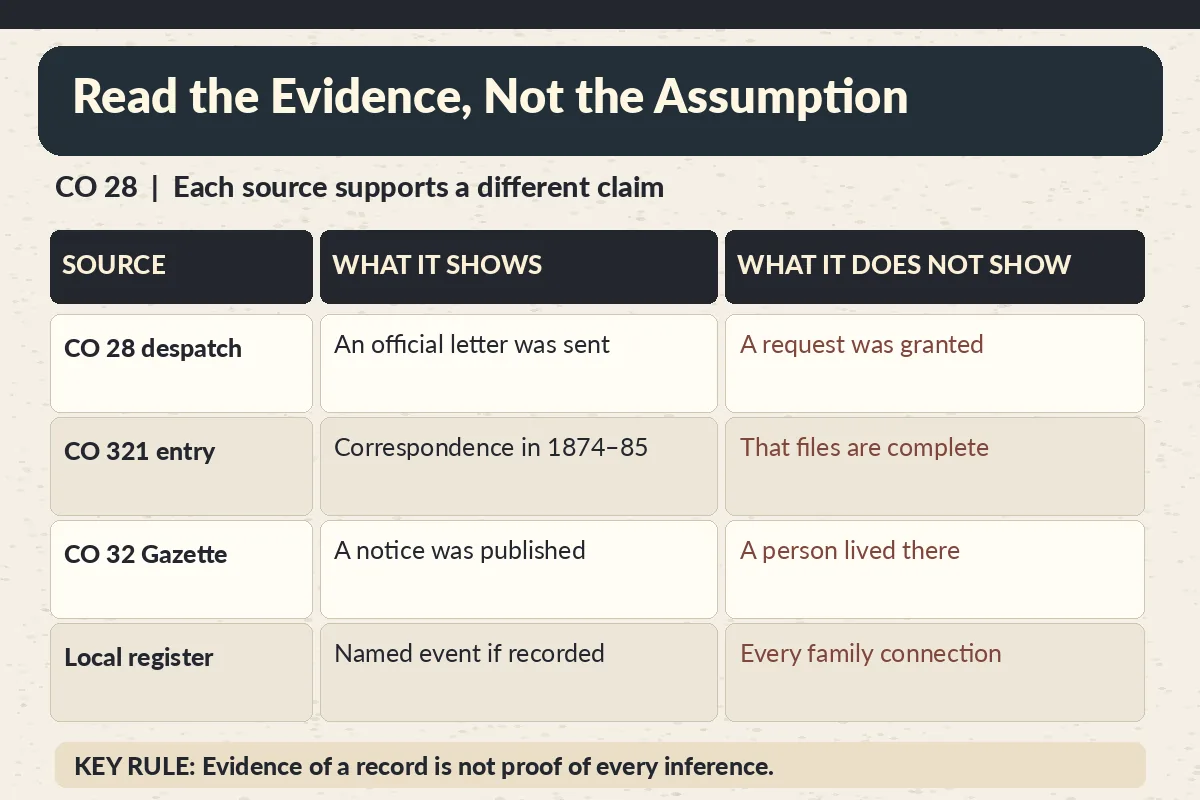
To show that a request was granted, look for a dated Colonial Office response, a local ordinance, a gazette notification, or a subsequent transaction that explicitly records action. The official Caribbean guide identifies government gazettes for Barbados under CO 32, a useful publication route for some public decisions. Even a Gazette notice will not establish a person’s private residence unless it actually names them with a relevant address. Label each claim according to what the source says, not what the research question hopes it says.
Build the Evidence Ledger Around a Particular Year
Suppose a family account says an ancestor petitioned for a license in the 1840s. Start with an approximate year and the official description of the trade or premises, then browse Barbados correspondence and any subject index for that period. If a petition appears, transcribe the applicant’s full name, any associates and the request’s exact wording. Follow a cross-reference to an enclosure or minute if present. An official reference to the application establishes the application, not a license being issued or a successful enterprise.
Next check an independently dated Barbados gazette, license register if surviving, commercial directory or local court source. When a register does not survive, the appropriate conclusion is narrower: the archival record establishes that the applicant sought a license and that the administration discussed it. If the original item is unavailable, state that only a catalogue description or indexed lead has been consulted. Keep the bounds of archival access in the note so a later researcher can continue from the same point.
Handle the 1874–1885 Series Switch Explicitly
A researcher working on a letter dated 1879 should not repeatedly search only CO 28 and conclude that the item never existed. The National Archives’ Caribbean table names CO 321 for Barbados original correspondence in the 1874–1885 interval. Record the switch in the search log and examine the arrangement of the relevant CO 321 pieces. A year range describes archival filing, not a guarantee that a particular letter was retained or that every item was catalogued at person level.
If a family narrative spans that transition, keep a continuous timeline but distinct references: a pre-1874 CO 28 despatch, a CO 321 item during the interval, and a post-1885 CO 28 despatch. The series change itself tells you nothing about changes to a person’s rights, family or occupation. Those propositions require the document’s content and an external source. Separate dates quoted by a later official from dates independently confirmed in contemporary records.
Cite the Correspondence Without Claiming a Biography
Write a full archival citation: Colonial Office, Barbados original correspondence, CO 28 or CO 321, piece, specific item or folio where available, sender, recipient and document date. Note whether you viewed a complete digital scan, an original document in the reading room, or only an index. Do not call an administrative file a personal case file unless its actual contents support that description. Where sensitive colonial records use demeaning or racialized terms, quote only what is needed and explain the source’s perspective.
An evidence-based conclusion can be direct but modest: ‘A petition mentioning this person was forwarded on this date; no grant or later action has yet been established.’ If independently verified records add a residence or profession, present those facts with their own references. Recheck the geographical identity of places whose names occur across several islands. Good colonial family history identifies both the record’s administrative limitations and the people whose voices may not have been preserved.

More Place and Jurisdiction Guides
How We Research and Verify This Archive Series
Our source check starts with The National Archives research guidance and a second reference, this complementary finding aid. We record the original series, piece or item, date, creator and access method before making a personal or legal inference. Documented statements and independently corroborated outcomes are separate categories. Where a file is missing, unindexed, closed or not inspected, we say so rather than manufacturing negative evidence. A cited catalogue lead does not mean we have seen every folio. For disclosure of any commercial relationships, see our affiliate disclosure.
No. It is Colonial Office correspondence and is not a comprehensive person-by-person civil register.
The National Archives identifies CO 321 as the corresponding series for that interval.
No. Read the original and search for a reply, published notice or other evidence of implementation.
The National Archives index guide cites Barbados correspondence CO 28/109/41.
No. Use date, topic, parish, names and the series arrangement; catalogue descriptions may be sparse.