
WO 28 contains War Office military headquarters records useful for studying operations in the Crimean War of 1853–1856. The National Archives recommends searching WO 28 with the term ‘Crimea’ or browsing the relevant Crimea section. Headquarters papers can document instructions, reports and communications about units, positions and supplies. They cannot, simply by naming a regiment or place, prove that every member of that regiment was present or that a proposed operation happened exactly as planned.
Begin with a precise operational question: which headquarters issued an instruction, on what date, to whom and about what movement or situation? Record the item reference, author, recipient, writing date and possible receipt date. A command-level paper should be studied at the level of its administrative purpose. A family history claim about an individual soldier requires a separate chain of service evidence, not a name inserted into a general headquarters dispatch.
Locate the correct headquarters file and period
The Archives’ Crimean War overview groups sources by the department that created them: War Office, Admiralty and Foreign Office. It specifically identifies WO 28 as headquarters papers for the war. Search within the series using locations, formations, commanders and date ranges, while preserving historic spelling. Do not assume a paper labelled ‘Crimea’ concerns the battlefield at a single exact geographic point; it may concern supply, bases, communications or other theaters connected with the campaign.
Copy the full catalogue reference rather than only the series code. A WO 28 piece may contain numerous papers spanning more than one date. Keep folio or page references when available, note whether a description is at file or item level, and record when an original has not been viewed. A catalogue summary is a finding aid, not a substitute for reading the dispatch or its enclosure.

Separate drafts, orders, and acknowledgments
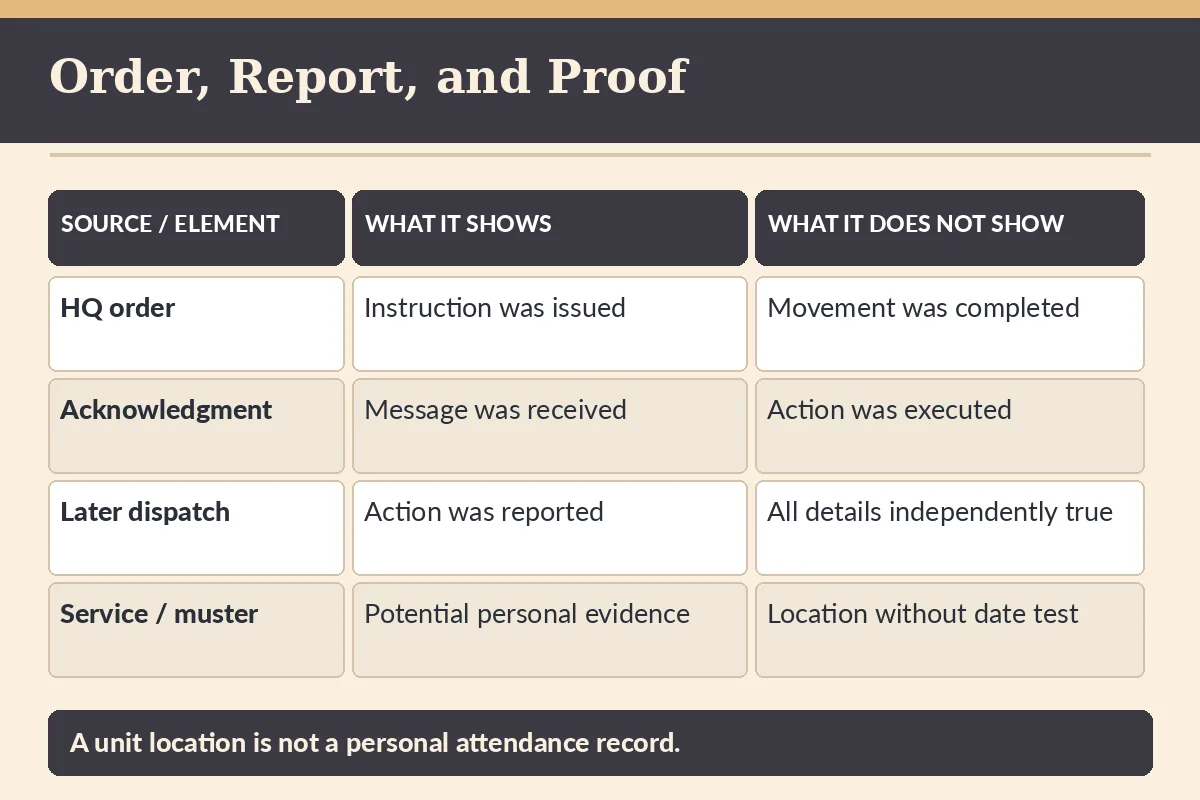
The word ‘ordered’ states an instruction, not verified execution. A plan may have been amended or canceled, a report may summarize events after the fact, and an acknowledgment may simply confirm receipt. Identify the genre of each paper and make separate entries for request, instruction, reported outcome and independent corroboration. When precise dates conflict, check whether one date marks issue, arrival or retrospective reporting. A same-day order and event should not be treated as identical without support.
A report compiled by a senior officer may have reliable overview information but may not name all individual participants. Its omissions can reflect the official purpose or the surviving papers. Terms such as ‘engaged,’ ‘posted,’ ‘attached’ and ‘ordered to proceed’ can describe different degrees of participation. Preserve the wording and require corroboration before saying a soldier fought at a specified place. Do not infer a battle injury from a unit appearing in a report of combat.
Map a unit movement with qualified dates
Use a campaign map cautiously. Determine whether the mapped line is a proposed route, an operational order, or a route documented after an action. Date the map, label the scale and distinguish geographic locations from unit assertions. A headquarters letter may place a brigade in a region, not locate each company or a named soldier. Avoid modern straight-line arrows that silently collapse several days of movement or uncertain wartime geography.
Compare WO 28 with WO 1 or WO 6 where the Archives’ operational guide identifies these as complementary War Office collections for the Crimea. The presence of a different series does not guarantee a duplicate or a more reliable record. Search for an acknowledgment, later dispatch, log or unit-level record. If no confirming document survives, say that a movement was ordered or reported, not conclusively completed at a precise hour.
Test an individual soldier against other records
A unit service history and the history of one soldier are different claims. To place a named soldier with a regiment on a date, look for a personal service file where available, muster or pay evidence, casualty lists, medal records, hospital evidence or contemporary correspondence. The Archives’ Crimea overview directs readers to separate service guides for officers and other ranks. Confirm the unit designation and the person’s rank in the particular period rather than importing a later rank into an earlier battle.
If a headquarters paper mentions a company at a location, determine whether it refers to the whole unit, a detachment or an officer acting alone. A later regimental history may reconstruct the movement from multiple sources; cite that secondary synthesis separately from the original dispatch. Where names match across sources, compare service numbers, rank, unit, dates and other identifiers. A common surname on a casualty list does not become the officer named in the dispatch without a reasoned identity match.

Imagine a WO 28 order directing supplies toward a forward position. The document proves an instruction was issued. A subsequent receipt might show that supplies were accepted, but neither record proves that a relative served with the convoy. If a battalion is mentioned, its operational presence still needs correlation with the time in question. The careful written conclusion identifies the decision, any independently confirmed result and the individual link still requiring evidence.
Maintain separate timelines for headquarters orders, actual movements and each person of interest. Mark an uncertain or approximate date, keep a record of place-name variants and preserve the extent of a map’s evidence. Archive losses or a failed search cannot justify confidently claiming that an action did not occur. The end product is a reproducible statement about one document’s evidentiary value, not a complete imagined battle narrative.
More Place and Jurisdiction Guides
How We Research Crimean War Operations
We checked The National Archives’ Crimean War records overview and its guide to British Army operations for WO 28’s use and for complementary War Office series. These official pages show where to investigate, not proof of any particular soldier’s participation. An article-level source link is not a citation to an unseen WO 28 manuscript.
Our editorial method distinguishes an instruction from an action, an operational report from an eyewitness account, and a unit from a named member. We cite a piece and page wherever possible and flag every unverified inference. For information about site disclosures, consult the affiliate disclosure; no invented service or affiliate relationship is implied.
It contains military headquarters papers, useful for operational correspondence and orders rather than a comprehensive personal service register.
No. Look for acknowledgment, a subsequent report or independent evidence of implementation.
Usually not by itself. Correlate the unit’s activity with the person’s service and individual records.
The National Archives also points to WO 1 and WO 6 for Crimea-related operational records.
Only if the historical geography and map scale support that precision; distinguish planned from observed positions.