
CO 1070 is a Colonial Office card index created during the Second World War to record information about civilians and civilian volunteers who were interned, imprisoned or thought to be in that position in Hong Kong and Malaya. It is not a complete roll of every person held in the region. The National Archives warns specifically that index cards for surnames beginning A–D are missing. A no-result search for one of those names cannot be used as evidence that the person escaped internment.
The National Archives guide to internees explains the administrative purpose of the cards, while its Second World War prisoner guide identifies the missing alphabetical range. Begin with a named individual, likely locality and a time window, but separate the family’s account of captivity from what the surviving cards actually record.
Know who the index was designed to describe
A civilian internee, military prisoner of war and civilian volunteer may have been classified differently. CO 1070 was compiled by the Prisoners of War and Civilian Internee Department and included information about people known or believed to be subject to confinement. Such a card can be an important lead, but a reported status is not identical to a contemporary camp admission register. A person believed missing might later have been located under a different administrative category.
Do not assume the same forms or detail exist for every name. The card may contain an uncertain attribution, an abbreviated location or information supplied secondhand. Even where the name and place match, investigate age, nationality, occupation and household connections before accepting a match. In a region where several communities shared common surnames, the right locality and period matter as much as the lettering of the name.

Treat the missing A–D cards as a search rule
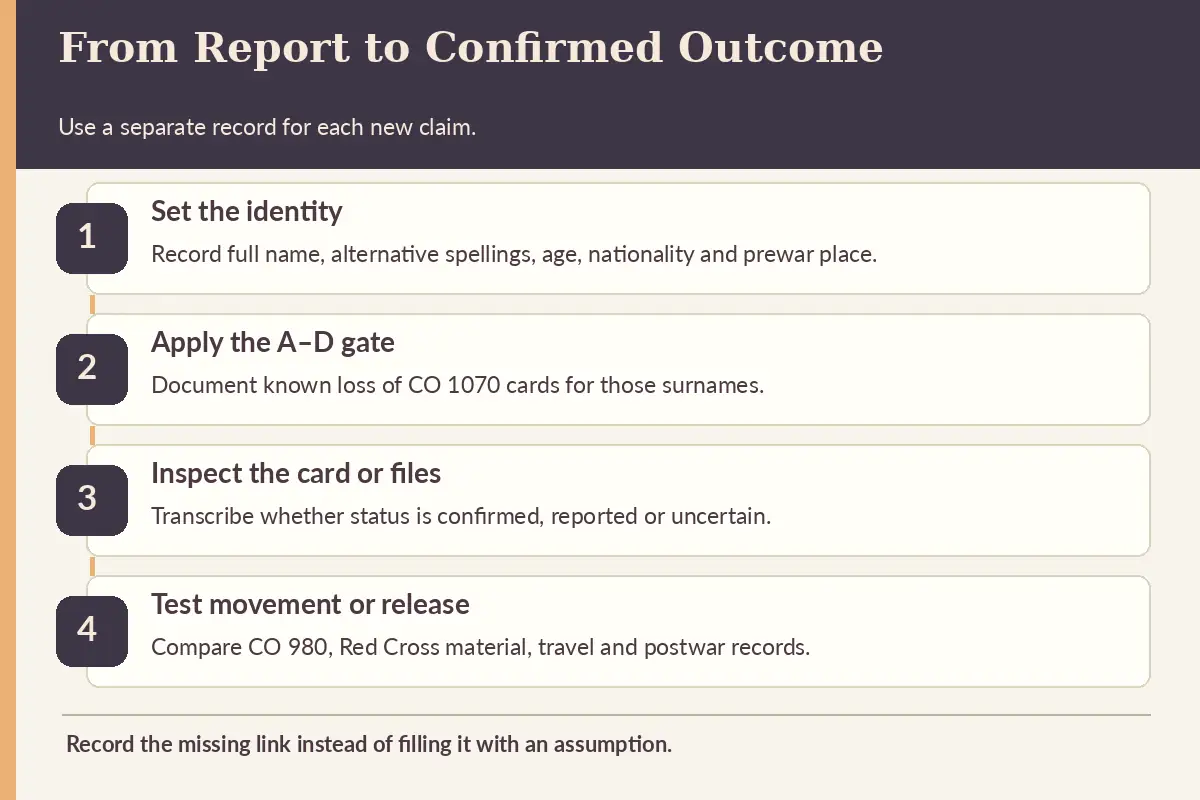
The missing A–D section is a known collection-level limitation, not a reason to exclude families with those surnames from wartime history. Make the letter-range check before searching. If the target surname begins with A, B, C or D, state plainly that the relevant CO 1070 cards are not part of the surviving index, rather than inventing alternative spellings until one appears. A relative may appear under a married surname, but that requires evidence of the name change.
For surnames beginning E–Z, search Discovery within CO 1070 and browse where necessary. Record spelling variants and initials separately. A missing hit outside the known A–D gap can still result from inconsistent indexing, damage, changing names or incomplete wartime reporting. A search log should identify the actual sources and letter ranges checked so a later researcher can reproduce it.
Read a card as a dated administrative statement
When an original card is located, copy its full reference and transcribe the wording of each field. Look for dated amendments, status terms, source initials and any crossed-out information. The first entry might reflect an inquiry or expectation; a later annotation could update the information. Do not convert all marks into a single confident sentence that the person was held at a specified camp throughout the war.
A fictional card reading “reported detained, 1942” would not prove the precise day of arrest or the date of release. The word “reported” is an evidence-quality clue, not dispensable clutter. Keep uncertainty in the transcript. An address might identify the person’s last known prewar residence rather than the camp. A next-of-kin line, if present, must likewise be evaluated for informant and date.

Move from CO 1070 to CO 980 and other records
The National Archives identifies CO 980 as a useful series for civilian internees following the Japanese invasions of Singapore and Hong Kong, including material about camp conditions and civilian detention. Search its catalog descriptions by locality, nationality, institution and names when present. It is not a guaranteed substitute for an individual card: policy files and group lists may have different coverage and indexing. Note exact item references, not just the series number.
Independent evidence might include International Committee of the Red Cross records, contemporary correspondence, official lists, war-related death records or postwar passenger information when available. Their administrative purposes differ, and dates may not align. Make a table with when each record was created, what it says, who supplied the information and what it does not prove. Keep wartime captivity distinct from postwar repatriation.
Separate imprisonment, death and repatriation claims
An administrative card that appears to confirm internment does not automatically establish conditions of captivity, escape, survival or return to a prewar address. A camp transfer is not a release, and a release report is not proof that someone reached a specific family home. If there are conflicting postwar accounts, check whether the named person stayed in the region, entered a hospital or traveled under a different name. These are separate research questions.
When documenting a death, seek an appropriate death register or independently dated official notice instead of treating a wartime “missing” note as a death certificate. Discuss uncertain family stories sensitively and avoid publishing information about living people without their consent. Because CO 1070 grew out of emergency reporting, there can be long intervals between an event and its entry into the administrative index.
Write a conclusion that respects collection gaps
A defensible result can be as specific as: the surviving CO 1070 index records a particular reported status for a named person on a dated card, subject to independent corroboration. For A–D surnames, the defensible result may instead be that a known alphabetical portion is missing and other series were searched. These are meaningful, different results. Do not label the second a failure or a finding of non-internment.
Preserve the catalog reference, card image source, transcript and list of searches undertaken in CO 980 and other relevant repositories. Use a timeline separating reported capture, confirmed confinement, movement, release and return. If no record resolves the gap, leave that interval explicitly open. A precise account of what was and was not preserved is more useful than an invented family narrative.
More Place and Jurisdiction Guides
How We Research This Record Type
We begin with the archival custodian’s documented series description, its chronology, purpose and preservation limits. Then we compare a different official source, review search coverage and access options, and separate the wording of an original item from our interpretation. We check competing place spellings, chronology, provenance and whether the claimed event could be established by this type of record at all.
Our conclusions remain tied to the date and scope of a cited source. A photograph is not a roster, an administrative card may report an unconfirmed event, and a historical map is not a certificate of ownership. The affiliate disclosure explains the site policy; these research routes are not presented as paid endorsements.
A Colonial Office wartime card index concerning civilians and volunteers imprisoned or thought to be interned in Hong Kong and Malaya.
The National Archives explicitly reports that cards for names beginning A–D are missing.
Not automatically. Read its wording and updates, then test release with an independent record.
Look into CO 980 and other relevant wartime and postwar records; record the known CO 1070 preservation gap.
No. One is a wartime card index and the other contains wider Colonial Office material, including civilian internee files.