
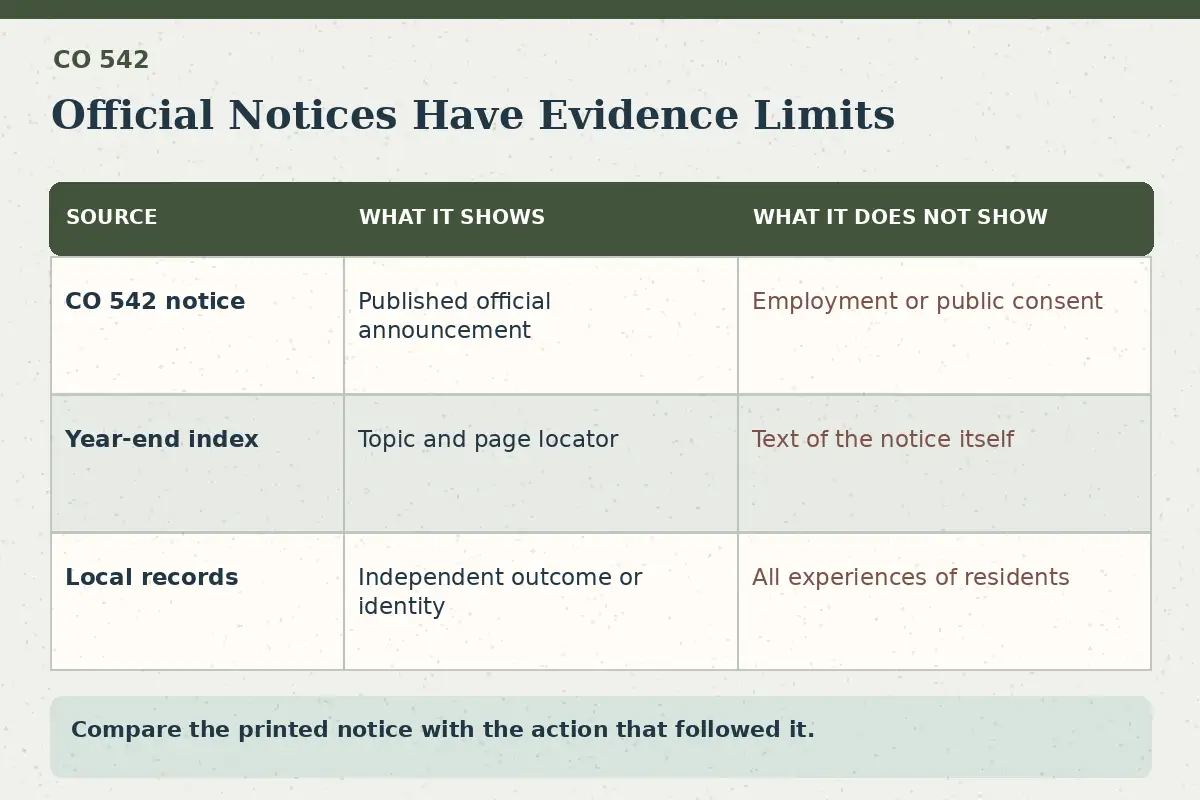
Kenya Government Gazettes in CO 542 are official published notices, not a person-by-person census of Kenya. The National Archives identifies the series as covering 1908–1975 and says the original copies at Kew are not digitized. Notices can help track appointments, retirements, licenses and other administrative decisions, but what a government published is not necessarily proof that a plan was implemented or that an individual remained in a post. Colonial publication practices also made many people less visible. Start with a date, a known locality and one carefully defined claim.
Identify the Issue and Its Historical Jurisdiction
Do not begin with a modern country label alone. The date and historical administrative title printed on a gazette are part of the evidence. Kenya passed through colonial rule, independence and subsequent government changes during the broad 1908–1975 catalog span. A document’s header, issuing authority and terminology should be transcribed without forcing the same constitutional label onto every year.
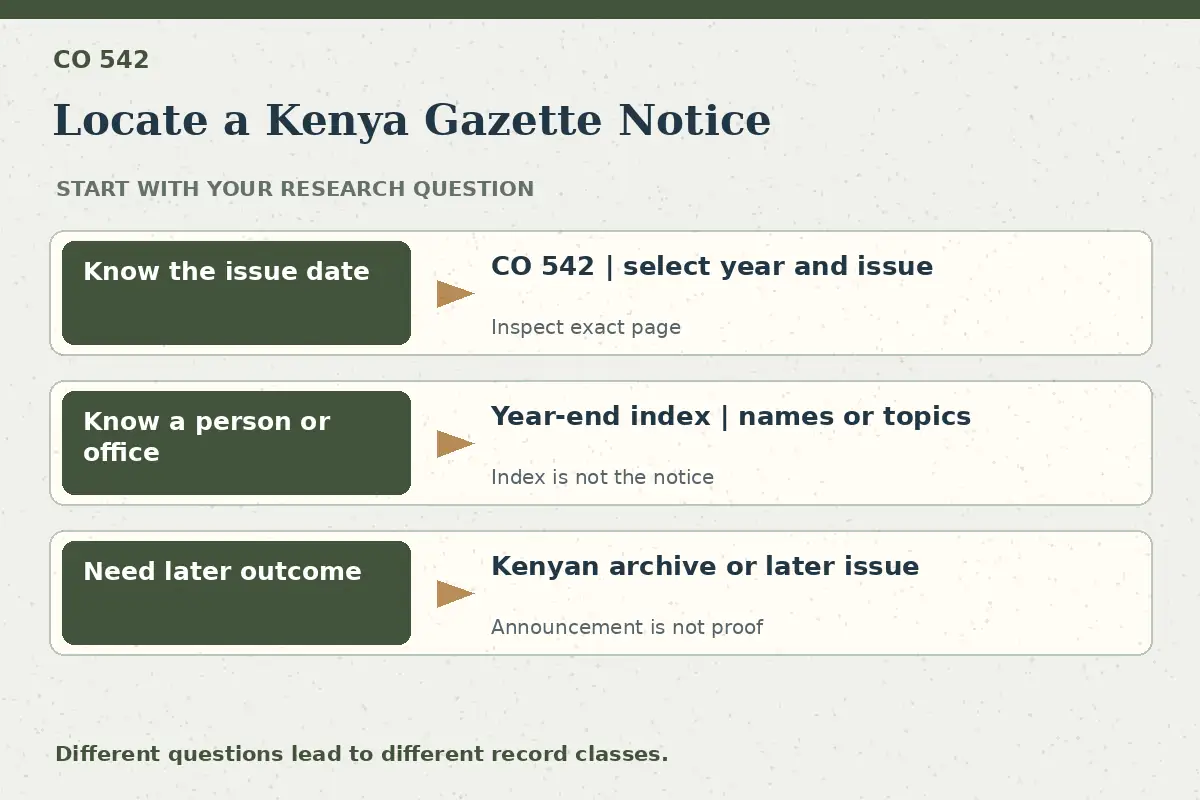
Search the National Archives catalogue for Kenya government gazette and the appropriate year or range, using the CO department reference. The guide says the originals are held at Kew, not available as digitized scans through the archive website. A collection title is not a substitute for looking at the specific bound issue; find its volume or part number, dated issue and page.
The African ancestors guide notes that colonial government gazettes were commonly published weekly and may have an annual index in the final volume of the year. Use that index as a locator, then inspect the cited issue. If the index is absent, the appropriate method may be issue-by-issue browsing. A missing internet name hit is not proof the publication lacks the notice.
Read Appointments and Licenses Without Extra Claims
A gazette may announce the recruitment, retirement or change of post of an official, and may list a business license or named professional. Transcribe the exact verb: appointed, notified, granted, revoked or proposed are different events. If an appointment has a stated effective date, distinguish it from the gazette publication date. Do not infer that the appointee physically reported for duty without follow-up documentation.
For a license notice, capture its legal category, named applicant or business, locality, number if given and period. A published application does not necessarily mean a final grant; a grant does not prove continuous operation or the existence of a customer base. Use later notices, directories, business records and contemporary local sources to test what actually happened.
A single printed administrative notice cannot establish family relationships. Even when two people share a surname or occupy neighboring offices, their connection remains a hypothesis. African and South Asian names may have been misspelled or rendered inconsistently by officials. Preserve the historical entry verbatim and search alternative forms in independent local sources.
Take special care with lists of licenses, tenders or property notices. They may refer to an applicant, a government office, a business trading name or a person with a legal entitlement; those roles are not equivalent. If a later issue corrects an earlier notice, retain both, with their publication dates. The final narrative should explain the correction rather than silently choosing whichever wording best suits an existing family tradition.
Protect Context When Reading Colonial Administration
A colonial government gazette primarily expresses the administration’s decisions and categories. The National Archives warns that archives of British rule can omit many Africans and that offensive or obsolete terms may survive unchanged in titles and records. Such wording should be identified as historical source language, not repeated as an unqualified description of people.
A notice about land, a public work or a new regulation is not by itself proof of consent by affected communities, a completed displacement, or an enduring boundary. Treat legal authorization, intended implementation and actual results as three separate questions. Use local land registries, newspapers, maps, community archives or court records when the claim involves rights or lived experience.
Kew holdings are not a complete replacement for Kenyan repositories. The official guide explains that many internal administrative, family and civil-registration records remain in the respective countries. A research plan centered on CO 542 should therefore include Kenyan archival records and local documentation, especially when investigating personal lives rather than colonial government notices.
For a family historian investigating a named shopkeeper, the gazette is useful only for the administrative part of the story. Pair it with a locally held business register, municipal correspondence, an address in a directory, or a signed private record. Explain whose voice each source represents. The absence of family members from a colonial gazette is unsurprising and cannot be interpreted as their absence from a community or locality.
Create a Notice-to-Outcome Evidence Trail
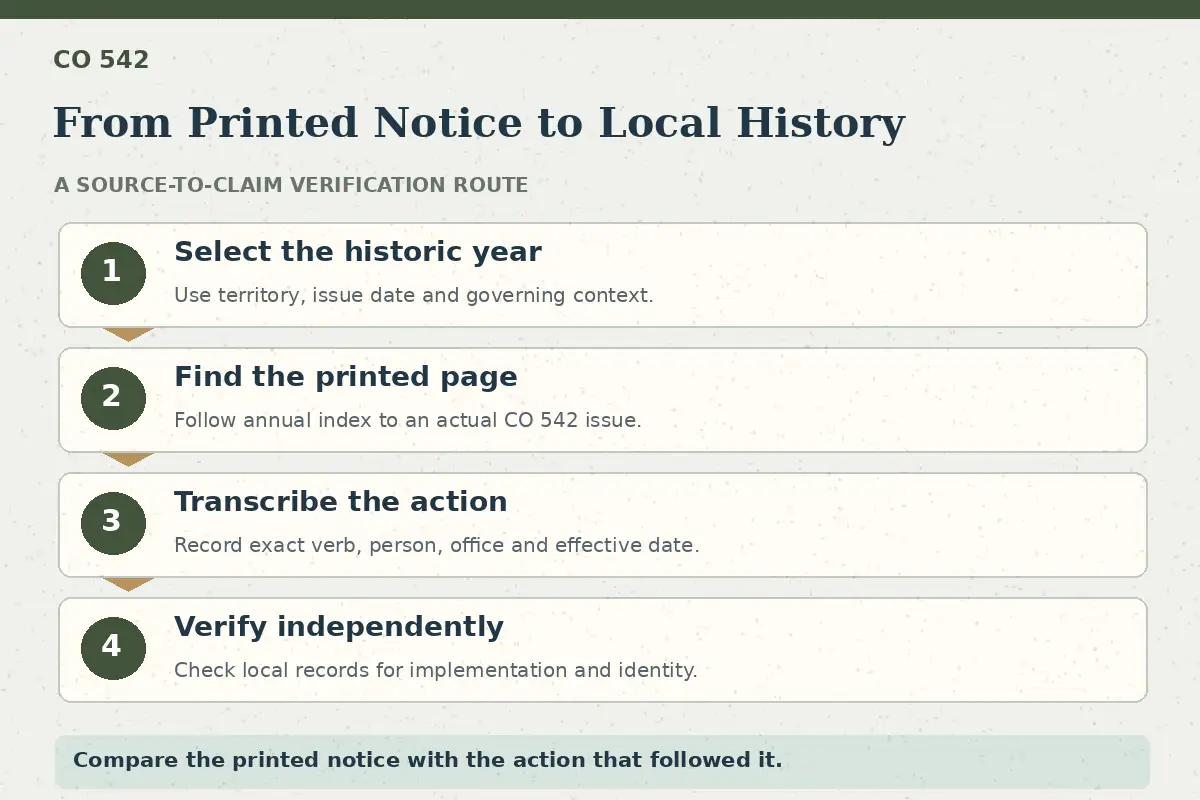
A practical search log should include issue date, page, notice heading, subject, exact names, contemporary spelling of the place, authority, action verb, apparent effective date and the CO 542 reference. Quote only the short phrase essential to the claim and summarize the rest in your own words. Record whether you consulted a yearly index, an issue or a later citation.
For a hypothetical government appointment in 1930, a notice can support the statement that the appointment was officially announced on the printed date. An independent payroll record, staff register, signed letter or subsequent gazette would be needed to test when duty actually began or ended. Do not turn a title recorded in a newspaper into a complete employment biography.
When the document cannot be located, record the years and issues examined and whether any volumes or indexes are missing from the available sample. Try variant place names and administrative spellings. A transparent finding might be that no matching notice was found in inspected CO 542 issues, while the real event and identity remain unresolved. This is stronger than a confident but unsupported narrative.
More Place and Jurisdiction Guides
How We Research CO 542 Records
We rely on the National Archives newspaper guide for the CO 542 reference, date span and lack of digitization. The African ancestors research guide supplies the annual-index route and cautions about colonial record bias; the colonies and dependencies guide clarifies what government gazettes can contain.
We attribute historical government language to its source and avoid assuming official notices establish the experiences or consent of communities. No colonial publication is reproduced in full. Our affiliate disclosure describes editorial relationships.
The National Archives newspaper guide lists 1908–1975; specific holdings and issue dates must be checked.
No. TNA describes CO 542 originals as not digitized; use catalogue references, annual indexes and issues.
No. They publish selected official notices, not all residents or households.
It proves an announcement if read in the issue; attendance and full employment require separate evidence.
Transcribe them as source wording with context, then use respectful modern terminology in your analysis.