
CO 111 contains British Guiana original correspondence received by the Colonial Office, covering 1781–1951. Start with a dated subject, a locality such as Demerara or Berbice, and the historical name of the colony; then identify the incoming despatch or petition and its enclosures. The series can explain an immigration policy, estate complaint or official response, but it is not a continuous passenger list or a register of every indentured worker. The National Archives colonial correspondence guide explains the different search routes before and after the early twentieth century. Keep the documentary author and the person described in the letter separate.
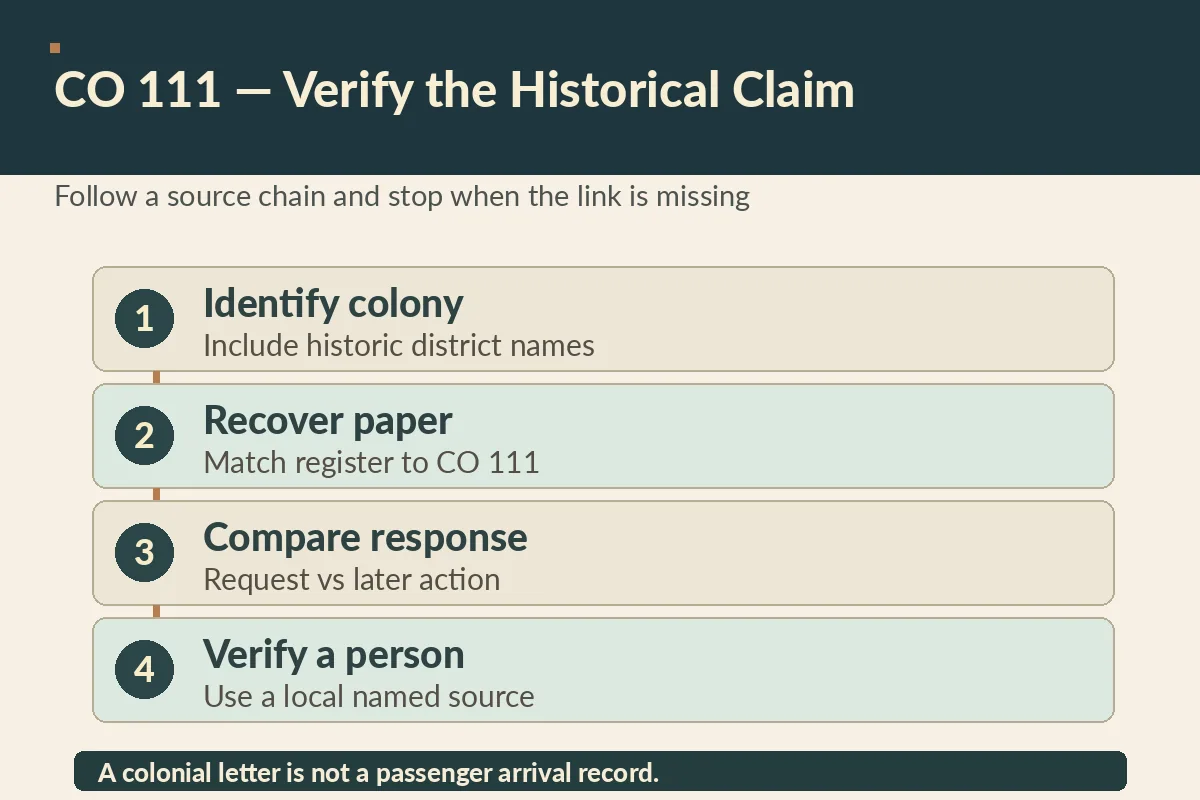
Start With the Correct Colony and Period
British Guiana was administered under a name that later changed to Guyana. Earlier documents can use Demerara, Essequibo and Berbice as geographic or administrative descriptors. Search with those names as historical keywords, but do not assume that a place name used in an eighteenth-century document has the same boundaries as a later district. Begin by recording the event’s approximate date, the estate, settlement or district if known, and whether you seek an official decision or an individual’s experience. The discovery route follows the nature of the evidence, not the modern country name alone.
CO 111 is the original correspondence series; it includes dispatches, petitions, letters and comments accumulated by central government. The companion parliamentary print or a later local gazette may quote an extract but omit attachments or official marginal notes. If you locate a reference in a published summary, use it to find the underlying file instead of treating the printed version as a full copy. When the inquiry concerns a person’s voyage, search shipping and immigration records separately rather than assuming an estate dispute proves that the person landed.
Use Colonial Office Registers Before Searching a Name
For much of the period before 1926, Discovery’s item descriptions are too broad for a reliable surname search. Colonial Office clerks entered incoming papers into registers and indexes, with distinctions among colonial origin, correspondence date, subject and official paper number. The National Archives guidance on registers and indexes sets out the route. For a year with many despatches, begin with the register entry and copy its original reference, not just a tempting catalogue keyword. Check whether the entry describes a bundle or an individual letter.
A register is a finding aid and sometimes preserves information about a paper that did not survive. That is important, but an entry saying that an immigration question was raised cannot demonstrate that the proposed ship sailed or the workers arrived. Make two columns for register description and document actually inspected. Record spelling variants, changing estate names and whether the communication was incoming from the colony or an outgoing reply from London. This evidence ledger prevents a later researcher from transforming a missing original into a supposedly complete narrative.

Separate an Indenture Policy From a Named Laborer
The National Archives’ guide to Indian indentured laborers identifies CO 111 as a source for administration of the indenture system in British Guiana. Such correspondence can discuss recruitment, transport, estate assignments, public health, return passages and disputes over contract terms. Those subjects matter for context, yet many documents concern groups rather than enumerated individuals. A surname in a complaint may identify the writer, interpreter, employer or official, not the worker whose experience you are investigating.
For a person-level claim, seek a locally produced arrival, immigration, plantation or civil-registration record that supplies an identifying number, age, household, parent or other independent detail. An estate name alone is not unique. Compare dates of issue and dates of action: a government circular issued in London is not proof that it was received and implemented on a named estate. When tracing the family of a formerly enslaved person, avoid forcing their history into the indenture system; these were different legal and social experiences with different documentary pathways.
Compare the Incoming Despatch With the Reply
A Colonial Office incoming letter may preserve the complaint, an enclosure and penciled departmental remarks. A draft response may appear on the paper, in an accompanying file or in an outward letter series. Write the precise language of the surviving response in your notes: acknowledged, referred, refused, approved subject to conditions and ordered for further inquiry all mean different things. If the despatch says that a local official proposed compensation, do not describe compensation as paid until a finance or local accounting record supports payment.
A working comparison table should include record reference, date written, date registered, party or authority, request, recorded administrative action and later independent evidence. The main hazard is chronological compression: a sequence of letters over two years can look like a single event in a catalogue abstract. If the final reply is not present, mark the outcome as unknown. A new governor, a change in policy or an overwritten place name may also explain why the later correspondence uses different terms for the same case.

Treat Boundary and Estate Evidence as Separate Problems
CO 111 can contain reports on territory, economic activity and disputes involving the borders of British Guiana. A diagram or sketch attached to a despatch represents what officials submitted at a particular time, not a modern survey or settled private title. For a historical estate or river location, capture the scale, dated authorship, stated assumptions and whether the sketch is a copy. Compare with a map of known date and the relevant land-grant or registry records when ownership is the research question.
A person’s presence in a plantation dispute cannot by itself establish residence for an entire family. Likewise, a border commission’s report does not prove that the proposed line became the final legal frontier. Record disputed, proposed and formally adopted positions as distinct labels. For family history, prefer the smallest credible unit: a name on a dated estate list, a known family relationship in a civil record, or a passenger number whose supporting details agree with the account. Keep colonial narratives from obscuring the individuals affected.
Make the Final Citation Reproducible
End with a citation to the actual CO 111 piece or document, not merely the research guide. Note the original letter number if it is readable, the page or folio, the writer and recipient, any enclosures and the sequence of replies examined. Include a scan or transcription only if allowed by the archive’s terms. For a register-only lead, cite the register separately and state that the original letter has not been checked. The language of absence should be precise: no match in the searched volume is not no historical record of the person.
Before accepting a personal conclusion, test two independent identifiers in a distinct source. For example, an immigration entry giving a family name and arrival date might be supported by a local marriage or estate register, but identical names without age, relatives or number are not enough. A robust result can legitimately end with a documented policy and no verified individual arrival. That is a stronger genealogical claim than inventing a person from a general file title.
More Place and Jurisdiction Guides
How We Research and Cite These Records
We test CO 111 against the National Archives guidance for colonial correspondence and Indian indentured labor records. We keep the original incoming record, the register, the later official reply and local evidence in separate columns, and we do not treat a statement about an estate or group as a verified biography. The exact catalogue item and access status must be checked before describing a paper as available online. For commercial transparency, see the GenHis affiliate disclosure.
British Guiana Colonial Office original correspondence, including incoming despatches and supporting material.
No. Earlier files commonly require consultation of registers and indexes.
No. A named arrival or immigration record is needed for that claim.
Yes. Record the register lead but do not claim you saw the missing letter.
Look for independent local arrival, estate, civil or family records with matching identifiers.