
The National Archives lists AT 16 as a record series containing photographs associated with Historic Buildings Council for England files for grant-aided renovation and preservation schemes, 1953–1984. It is a rich starting point for the history of a listed house, a church, an old shop or another historic structure. A photograph may preserve a lost façade detail or a room before alterations. It does not, just because it appears in a grant file, establish that the council paid for the work, that repairs were finished or who lived in the building.
Search by the building first. Gather its historic name, present and former address, parish, county, alternative spelling and approximate date of proposed repair. The National Archives photography guide identifies AT 16 among collections where photographs sit within files. The difference between “file contains a photograph” and “every picture has a searchable caption” should shape the research plan.
How grant evidence differs from a building biography
A grant file reflects a decision-making process about conservation. Its correspondence, surveys or photographs may describe physical condition and proposed interventions, but do not necessarily provide a complete history of the property. A listed building entry describes the structure’s significance and provides a legal designation reference; it is not a contractor ledger. A local newspaper might report a reopening, which would be evidence of publicity rather than proof of every specified repair.
Suppose a file includes a 1962 photograph of an unsafe roof and a letter recommending a grant. The two items establish that the structure was documented and a recommendation was made; they do not identify the roofer or prove that the grant was accepted. A later dated photograph of new roof covering, together with payment accounts, would be stronger evidence of completed work. Keep the stages separate when writing family or house history.
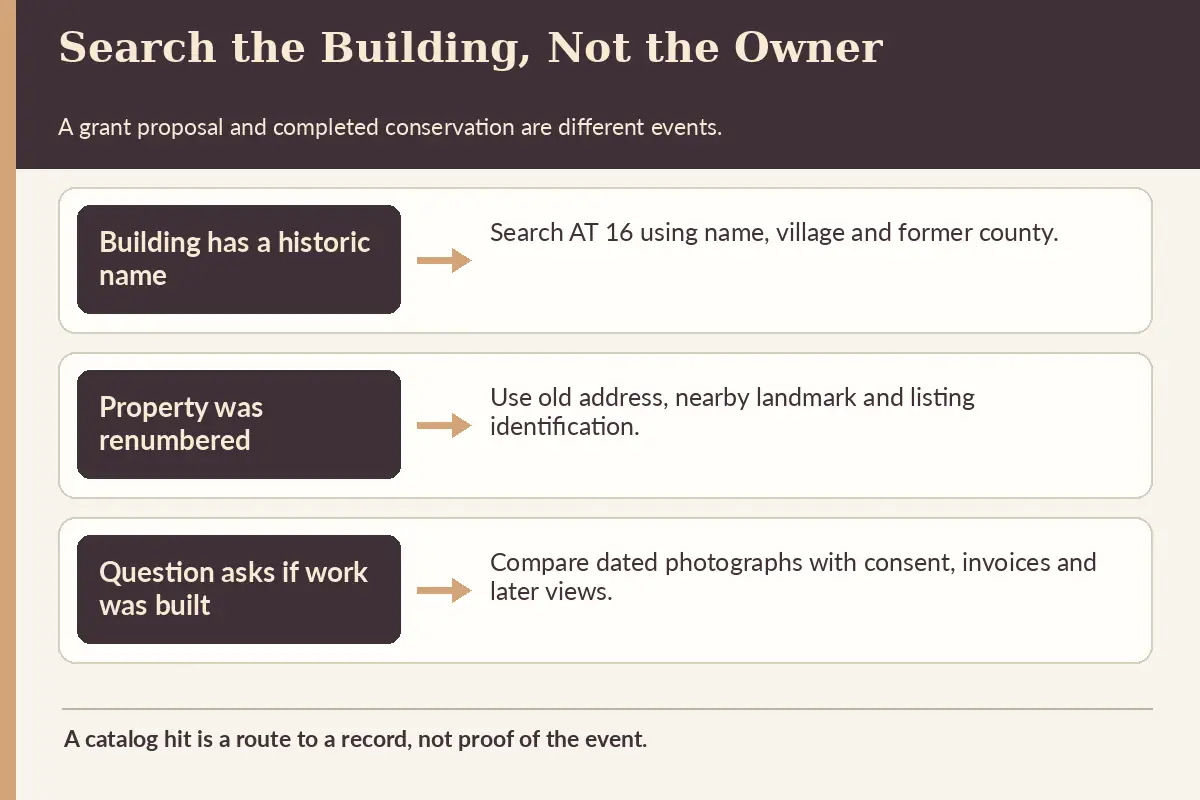
Search building names and changed addresses
Start in Discovery with the building’s original name and restrict the search to AT 16. Try village, parish, road, an older house name, a prominent owner’s estate name or a historical county. Building names and street numbers can change. An unsuccessful current-address search does not show that no grant file exists. A known historic architect, parish or landmark can be a more useful starting term than the latest postal code.
Do not assume each photograph is individually indexed. Record the piece reference, the descriptive date range and the repository’s access instructions, even if no preview image is provided. If a file covers a building group, record which specific structure, wing or plot your hypothesis concerns. Obtain the file or a permitted copy and check all enclosing captions and correspondence before assigning an identity to the photograph.
Read construction detail without misdating changes
Begin with features that can be compared across images: doorway position, window pattern, roof pitch, masonry joint, chimney stack, stair layout or adjoining wall. Note the camera angle and whether the photograph depicts the exterior, an interior or a detached outbuilding. A dark beam in a photograph may be medieval fabric, later repair or a photographic shadow; material and dating claims need a survey or expert report.
The shooting date, negative date, file opening date and grant decision date may differ. Put them in distinct timeline columns, and quote any caption rather than silently converting “circa 1960” into a precise day. If one photo is reused for an application years later, its appearance in that later file does not make it contemporaneous. Keep filenames and descriptive tags separate from evidence written on the original item.

Compare AT 16 with the heritage list
Historic England’s guide to listing entries explains that the National Heritage List for England includes first listing dates, amendment dates and varying amounts of historical detail. Older entries can be brief, while modern entries are often more explanatory. Search the heritage list using the building or a seven-digit list-entry number, then record exactly which entry and revision you consulted. An entry may refer to an entire building rather than one photographed room.
Compare the listing’s described features with the AT 16 image, but do not treat a current list entry as a time machine. A feature may have been removed, restored or redated since a photograph was taken. Similarly a grant file can focus on an element that is not separately described in a listing. For evidence of work actually carried out, seek dated planning papers, building-control documents, receipts, site inspection notes or later photographs held locally.
Distinguish owner, architect, contractor and resident
Historic properties often appear under the name of an estate or institution. The person signing an application may be a trustee or agent; that signature does not identify the household that occupied the property. The listed architect may have designed an earlier phase, not the repair visible in the photograph. Even an owner’s name in correspondence may refer to a legal entity. Build a role table for applicant, grant body, architect, builder, photographer, freeholder and occupant.
To attach a family to the property, use independently dated electoral registers, directories, rates, leases or other person-level records relevant to the period. Do not infer a family link from an old house name matching a surname. If the file concerns a church or public institution, distinguish its managing body from people who regularly used it. Separate the story of a physical structure from a lineage narrative.
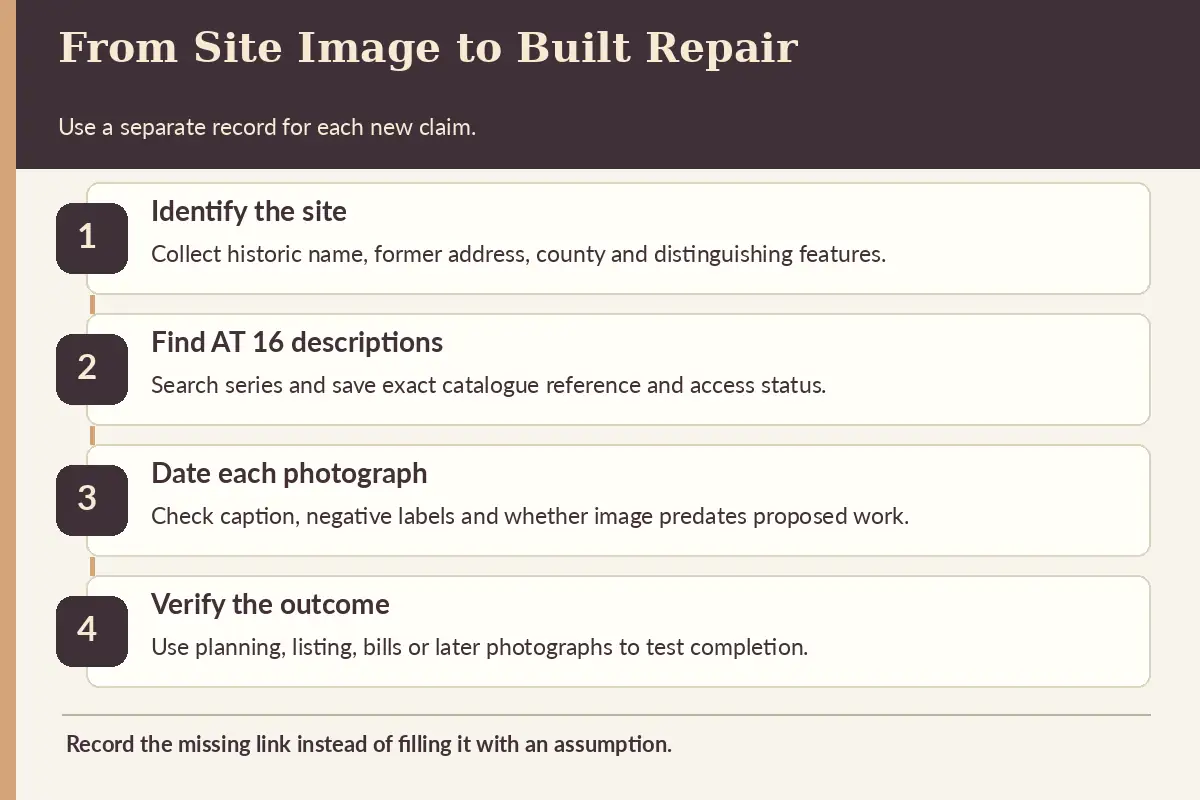
Preserve a dated sequence of architectural evidence
Create a short building chronology with one row per image or record: date as recorded, source reference, physical feature, description, evidence of proposed work, and evidence of completion. Store original photographs according to repository reproduction terms; clearly label your own crop or overlay as an edited comparison. When images disagree, test season, angle and phases of repair before concluding that one is miscaptioned.
A useful conclusion might say that an AT 16 file records the condition of a roof before a proposed conservation project, while later documentation is still needed to show the outcome. If the relevant file cannot be located, check historic county names and local conservation archive collections. Absence of a search hit is an indexing or survival question, not evidence that a building had no conservation work.
More House and Local History Guides
How We Research This Record Type
We begin with the archival custodian’s documented series description, its chronology, purpose and preservation limits. Then we compare a different official source, review search coverage and access options, and separate the wording of an original item from our interpretation. We check competing place spellings, chronology, provenance and whether the claimed event could be established by this type of record at all.
Our conclusions remain tied to the date and scope of a cited source. A photograph is not a roster, an administrative card may report an unconfirmed event, and a historical map is not a certificate of ownership. The affiliate disclosure explains the site policy; these research routes are not presented as paid endorsements.
No. The National Archives describes photographs among files, and item-level captions and indexing can be uneven.
No. It may document condition or a proposal; compare a later dated view, account, or local building-control record.
The National Archives photography guide describes Historic Buildings Council material in AT 16 covering 1953–1984.
Not reliably by itself. Applicants and agents are not necessarily occupants; use electoral rolls or leases for residence.
No. The list records heritage designation and descriptions, whereas AT 16 concerns conservation-related documentation.