
ED 87 is identified by The National Archives as the series of training-college building grant files. A grant file can help reconstruct when a local authority or institution proposed premises, sought state support and exchanged decisions about a building. It is not automatically an opening register, a complete architect’s plan set or a list of trainees. Start with the historical college or local education authority, identify the particular administrative decision, and demand separate dated evidence before claiming that the designed building actually opened.
Identify the Authority and Type of Training College
British teacher training involved voluntary, municipal and other institutions at different times. The National Archives describes the expansion of local-authority training under the Education Act 1902 and recognition of municipal colleges in 1904, followed by building grants to local education authorities. A college name in a family story may be a later name; determine which authority and institutional form were in use at the date under investigation.
Create a name chronology showing official titles, address or parish, administering body, and dates of any merger or relocation. College names can be reused for a new building after an old site closed. If a family member reported attending a teachers’ college, an institutional file can identify its context but attendance must be proved through surviving individual, local or college sources.
Find the ED 87 File From a Place or Proposal
Search the Discovery catalogue with the historical college name, town, local education authority and terms such as building grant or training college. Restrict by the ED 87 series and inspect descriptions rather than assuming every search result refers to the intended premises. Government correspondence can be arranged by the recipient authority or scheme instead of by an eventual college title.
Keep a shortlist of pieces with date ranges and catalogue descriptions. A record may cover preliminary plans, revised proposals or grant negotiations. Confirm exactly which piece you have ordered or consulted; a catalogued file reference by itself does not tell you whether the file contains an approved plan or only unsuccessful submissions.

Distinguish Application, Offer and Final Payment
Treat the financial process as stages. An application can give an intended scheme and requested amount. A grant offer may include conditions and deadlines. Evidence of money actually paid, spent or reconciled could be preserved in different accounts. Do not treat a proposal’s estimated cost as public expenditure or use the announcement date as evidence that work finished.
An effective grant table uses separate columns for proposer, request date, amount requested, decision, conditions, payment evidence and source. When an official letter amends the terms, keep the old and new figures, noting who made the change. Do not invent exact grant amounts or standard file fields; transcribe only details the actual document supplies.
Test a Plan Against Construction Evidence
A design can be dated and detailed yet never built in that form. Record architect, scale, revision date, building phase and specific rooms or wings shown if visible. Compare the design with local authority minutes, dated contracts, photographs, inspections, property records and published opening reports. A later plan can represent alterations rather than the first construction of a training college.
Do not use today’s surviving façade to authenticate every original drawing. Sites may have been extended, reconstructed or renamed. A stronger conclusion identifies the particular block or wing and cites the later source showing it existed. If no completion evidence survives, “planned” or “proposed” is a legitimate and informative end point.
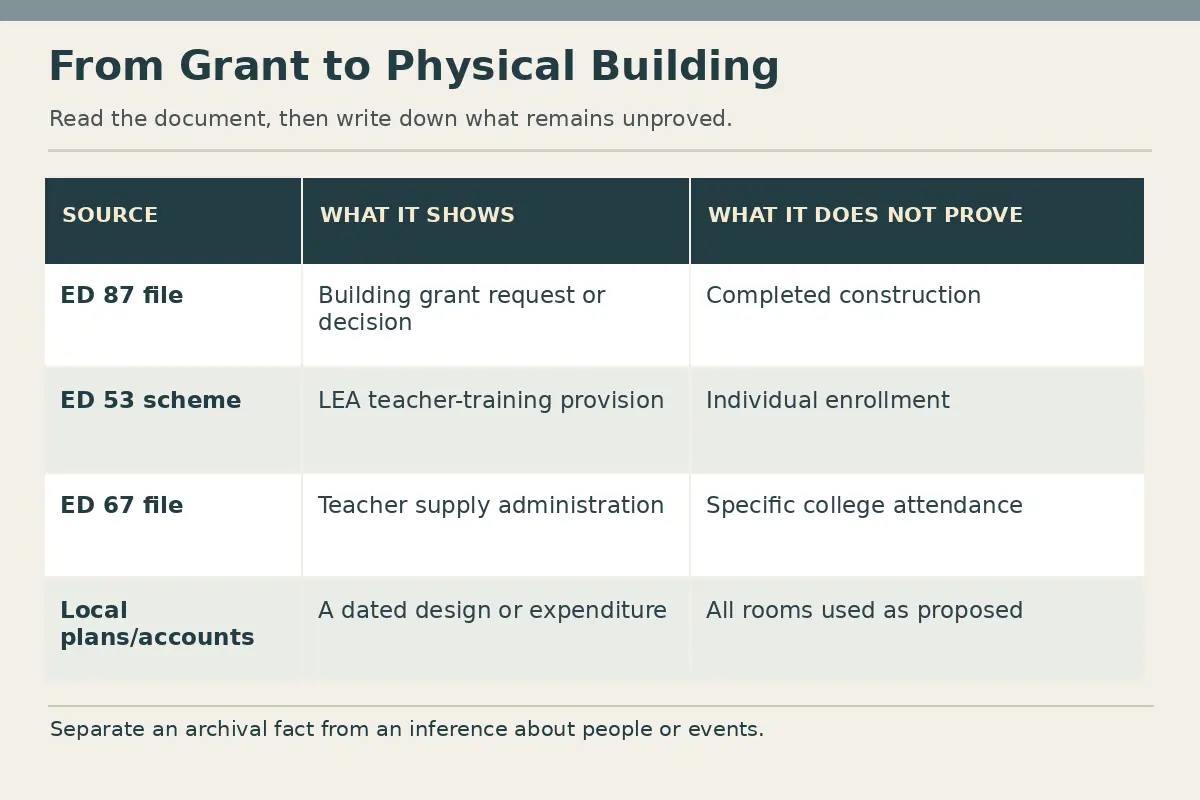
Use ED 53 and ED 67 for a Different Question
The National Archives directs researchers to ED 53 for local education authority schemes and ED 67 for the supply of teachers. These are alternative sources depending on what is missing, not successive administrative steps automatically contained within an ED 87 file. ED 53 might provide context for training provision, while ED 67 addresses staffing concerns rather than a construction completion certificate.
Keep a source-role table that asks what each series can answer. ED 87 is the starting point for a building grant; ED 53 can explain a related local scheme; ED 67 can clarify recruitment or supply policy. Neither general planning nor personnel policy proves that one trainee enrolled, taught, or lived in a particular college residence.
Work a Hypothetical Campus-Move Case
Imagine a 1907 building application naming a proposed municipal training college at the edge of a town. A grant file has a sketch and a later official letter discussing costs, but a 1911 local directory lists the college at an older address. Do not infer a move in 1907 merely from the application. Compare council minutes, building contracts and directories for intervening years.
This is a fictional example. If a 1913 photograph shows a new building, it may support completion by that date but not the exact opening day or the identity of resident students. An inauguration program, admissions book or college history could test those separate propositions. Document an interval rather than choosing an unsupported single construction date.

Cite Each Administrative and Physical Stage
In the working citation include The National Archives, ED 87, exact piece, file title or authority, date and page or folio. Cite local council files, building permits, site photographs and school records individually. A research log should identify whether you saw an original plan, a reproduction or only a catalogue entry. Make sure map and plan dates refer to their actual survey or drawing, not modern upload dates.
State the final result in measured terms. You may prove that an LEA applied for a building grant or that a proposal received specified official support. You might separately establish that a named building existed by a particular year. An individual teacher’s appointment or student’s enrollment remains a different enquiry. This protects the history of the college from attractive but unsupported narratives.
More House and Local History Guides
How We Research the Archive and Check Historical Claims
Our starting point is the relevant official research guidance, cross-checked with a separate authoritative description. We distinguish the series purpose from the contents of a particular piece and from family or local claims made later. A source may be an original, an official summary, a commercial transcript or a modern interpretation; each deserves an explicit label. The original date, jurisdiction, informant and document’s administrative purpose determine which proposition it can support. Illustrative scenarios in this article are invented for teaching, not disguised transcriptions.
Availability depends on the particular item: indexes can be incomplete, paper files may need an archive visit or copy request, and some records have legal access restrictions. We describe verifiable research routes, not guaranteed individual results. We do not infer sponsorship from citing a repository, and we do not recommend unconfirmed commercial links. See our affiliate disclosure for site policies. Where evidence conflicts or a necessary piece has not been examined, we preserve that uncertainty in the conclusion rather than filling the gap with a convenient story.
The National Archives identifies ED 87 as training-college building grant files, whose individual contents vary.
No. Check later construction, inspection or dated use evidence.
No. Look for surviving enrollment or other person-level sources.
ED 53 concerns LEA teacher-training schemes and ED 67 concerns teacher supply.
The exact ED 87 piece, institution or authority, document date and page or folio.